Artemis II Launches Astronauts on Historic Moon Voyage
NASA's Artemis II mission launched Tuesday, sending four astronauts on a historic voyage around the Moon. The powerful Space Launch System rocket lifted off flawlessly, with the Orion spacecraft 'Integrity' and its crew now on course. This mission tests critical systems for future lunar exploration.


Artemis II Blasts Off, Carrying Astronauts on Lunar Journey
NASA’s Artemis II mission successfully launched Tuesday, sending four astronauts on a groundbreaking voyage around the Moon. The powerful Space Launch System rocket lifted off from Kennedy Space Center in Florida, marking humanity’s next significant step in lunar exploration. Mission Control in Houston confirmed a flawless ascent, with the Orion spacecraft, named ‘Integrity,’ and its crew now on course for their lunar adventure.
A Thrilling Liftoff and Ascent
The launch sequence began with a countdown that had the world watching. “Ten, nine, eight, bound for the Moon, humanity’s next great voyage begins,” echoed through the air as the engines ignited. The massive rocket surged skyward, exceeding expectations from the very first moments. Mission Control reported nominal performance throughout the climb, with the core stage of the Space Launch System performing exceptionally well.
Within minutes, Integrity was miles above the Earth, traveling at incredible speeds. The mission passed key milestones, including going supersonic and achieving impressive altitudes. Solid rocket boosters separated as planned, followed by the main engine throttle down and subsequent throttle up. The crew, Commander Reid Wiseman, Pilot Victor Glover, Mission Specialist Christina Koch, and Mission Specialist Jeremy Hansen, confirmed they had crossed the boundary into space.
Crew and Spacecraft Performance
The Orion spacecraft, Integrity, lived up to its name, performing nominally at every stage. Communication signals were clear as the spacecraft passed 30 seconds into flight and continued to transmit vital data. GPS signals were acquired after the launch abort system was jettisoned, allowing for internal checks to verify system accuracy. The crew reported good communication checks, confirming their well-being and the spacecraft’s status.
A significant moment occurred at approximately 8 minutes and 2 seconds into the flight with the confirmation of Main Engine Cutoff (MECO). This signaled that the core stage had completed its burn and separated successfully. Flight dynamics officers analyzed the data, confirming a nominal cutoff. “Integrity, GPS processing. Outstanding,” came the report from onboard, indicating all systems were functioning as designed. The crew is now in orbit around Earth, beginning their journey to the Moon.
The Crew’s Historic Mission
Artemis II carries a diverse and experienced crew. Commander Reid Wiseman and Pilot Victor Glover are from the United States. Mission Specialist Christina Koch, also from the U.S., holds the record for the longest single spaceflight by a woman. Joining them is Canadian Mission Specialist Jeremy Hansen, making this a truly international effort. This mission is a crucial step towards returning humans to the Moon and eventually Mars.
For the crew, the journey inside the relatively small Orion capsule will last about 10 days. While the capsule may appear compact, the experience of microgravity transforms the interior space. “You’ve got lots of room because it doesn’t really matter where you work; you can work upside down, right side up, on the ceiling, on the floor, on the walls,” explained one mission control commentator. “A little bit of space turns into a lot of space in a real quick hurry.” The crew will conduct various tests and observations during their lunar flyby.
Looking Ahead: The Lunar Flyby
The primary objective of Artemis II is to send the crew on a trajectory around the Moon and back to Earth, testing critical systems in deep space. This mission will push the Orion spacecraft and its life support systems to their limits, gathering vital data for future, longer-duration missions. The astronauts will experience the conditions of deep space firsthand, including the effects of radiation and the challenges of operating far from Earth.
Mission Control celebrated the successful launch, with commentators expressing immense relief and excitement. “When you hear the words, MECO, that’s when I can breathe,” one commentator shared, highlighting the tension and importance of each phase of the launch. The successful ascent and confirmation of a stable trajectory mean the astronauts are now on their way to performing a lunar flyby. This mission is not just about reaching the Moon; it’s about paving the way for sustained human presence beyond Earth.
What’s Next for Artemis?
The Artemis II crew will now continue their journey, performing a flyby of the Moon before returning to Earth. Their experiences and the data collected will be crucial for the subsequent Artemis III mission, which aims to land astronauts on the lunar surface. This current mission serves as a vital testbed, ensuring the technology and procedures are ready for the even more ambitious goals ahead. The success of Artemis II brings us one step closer to a new era of space exploration.
Source: NASA’s Artemis II launches astronauts on historic mission around the moon (YouTube)

Related Articles


Trump Fires Attorney General, Artemis II Reaches Lunar Orbit
Attorney General Pam Bondi has been dismissed amid pressure over the Epstein investigation, with Todd Blanche stepping in as acting AG. Meanwhile, the Artemis II astronauts have successfully entered lunar orbit, a historic first since 1972. Severe storms are expected to disrupt Easter weekend travel across the U.S.

Harvard Professor Challenges NASA on Mars Object
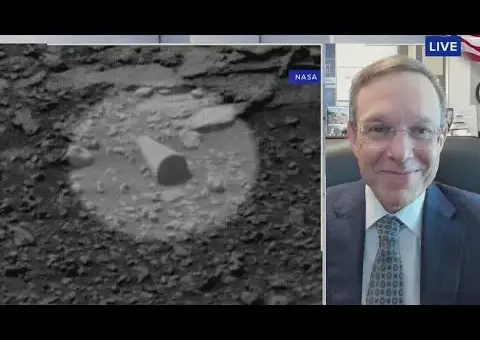
Harvard Professor Avi Loeb is questioning NASA's explanation of a 'party hat'-shaped object on Mars. While NASA calls it a natural rock, Loeb believes it warrants further investigation and highlights the importance of curiosity-driven science.


US Reclaims Moon Lead, Igniting New Space Race
The Artemis II mission marks humanity's return to the Moon's vicinity after 50 years, showcasing stunning Earth views and global participation through the "Send Your Name to Space" campaign. This journey reignites US lunar ambitions, potentially sparking new international cooperation or competition in space exploration.