Artemis II Crew Safely Returns to Earth After Lunar Voyage
The Artemis II crew has safely returned to Earth, splashing down in the Pacific Ocean after a 10-day mission. They journeyed farther from Earth than any humans before, testing the Orion spacecraft for future lunar and Martian exploration.


Artemis II Crew Splashes Down Safely in Pacific
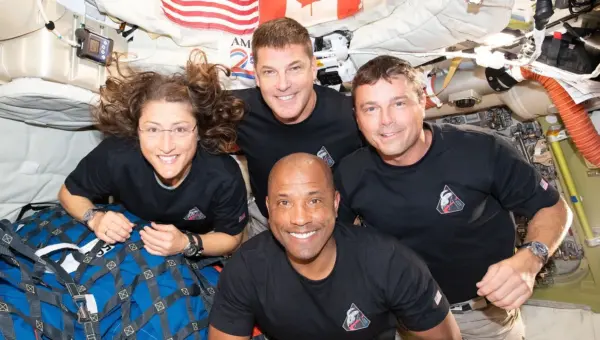
The Artemis II astronauts have successfully returned to Earth, splashing down in the Pacific Ocean on Friday, April 10th, around 7:07 p.m. Central Daylight Time. This marks a triumphant end to their historic 10-day mission, which began with a spectacular launch on April 1st.
A Journey Beyond Human Reach
During their epic journey, the four-person crew ventured farther from our home planet than any humans in history. Their mission, a crucial test flight for NASA’s Artemis program, aimed to prove the capabilities of the Orion spacecraft and its systems with astronauts aboard for the first time. This voyage pushes the boundaries of human exploration, preparing us for future missions that will take us even deeper into space.
Orion’s Voyage and Re-entry
The Artemis II mission took the crew on a path around the Moon, a feat that tested the limits of their spacecraft and their own endurance. The journey out to lunar orbit and back is a complex dance with gravity. Think of it like throwing a ball very, very hard – it goes up, curves around, and comes back down. Spacecraft follow similar, though much more intricate, paths guided by precise calculations of speed and direction. For Artemis II, this meant a carefully planned trajectory that slingshotted them around the Moon before beginning their long coast back towards Earth. The return trip itself is a testament to the power of orbital mechanics, using the gravitational pull of celestial bodies to its advantage. As Orion approached Earth, it entered our atmosphere at incredible speeds, generating intense heat. The spacecraft’s heat shield, made of advanced materials, is designed to withstand temperatures reaching thousands of degrees Fahrenheit, protecting the astronauts inside. This fiery re-entry is a critical phase, requiring perfect execution to ensure a safe landing.
The Splashdown: A Gentle Return
After enduring the intense re-entry, the Orion capsule deployed its parachutes, slowing its descent dramatically. The splashdown in the ocean serves as a gentle, controlled end to a high-speed journey. Recovery teams were on standby, ready to retrieve the capsule and the astronauts minutes after they hit the water. This method of returning spacecraft to Earth has been used for decades, providing a reliable way to bring crews home safely. The Pacific Ocean offers a large, relatively safe area for splashdowns, minimizing risks compared to landing on solid ground.
Artemis Program: Stepping Stones to the Stars
The Artemis II mission is a vital stepping stone in NASA’s ambitious Artemis program. This program aims to establish a long-term human presence on the Moon and eventually send astronauts to Mars. Artemis II builds upon the success of Artemis I, which sent an uncrewed Orion spacecraft on a similar lunar journey in late 2022. That mission validated the spacecraft’s systems in the harsh environment of deep space. By sending a crew on Artemis II, NASA is gaining invaluable data on how the spacecraft performs with humans onboard, testing life support systems, communication, and the astronauts’ ability to function far from Earth. Each Artemis mission is designed to be more complex than the last, gradually building the knowledge and technology needed for humanity’s next giant leaps.
Looking Ahead: The Future of Lunar Exploration
The success of Artemis II paves the way for future lunar missions, including Artemis III, which is planned to land the first woman and the next man on the Moon. This program represents more than just a return to lunar exploration; it’s about building a sustainable presence, conducting scientific research, and learning how to live and work on another world. The data gathered from Artemis II will inform the design and operations of future missions, ensuring the safety and success of astronauts venturing further than ever before. This return to the Moon is a critical step in humanity’s journey to become a multi-planetary species, inspiring a new generation of scientists, engineers, and explorers.
Historical Context
The Artemis program draws inspiration from the Apollo missions of the 1960s and 70s, which first landed humans on the Moon. However, Artemis aims higher, not just for flags and footprints, but for sustained exploration and scientific discovery. While Apollo proved we *could* go to the Moon, Artemis aims to show we can *live* and *work* there, and then use it as a base for deeper space exploration. The technological advancements since the Apollo era are immense, allowing for more complex missions and longer durations in space. Artemis II’s journey, taking astronauts farther than Apollo ever did, is a clear indicator of this progress.
Source: Watch the Artemis II crew come home!!! Re-entry and Splashdown! #artemis2 (YouTube)

Related Articles

Artemis II Crew Safely Returns from Moon Orbit
Four astronauts have safely returned to Earth after a 10-day mission orbiting the moon. The Artemis II crew tested the Orion spacecraft, marking a crucial step towards future lunar landings and human exploration beyond Earth's orbit. This mission highlights international collaboration in NASA's ambitious return to the moon.


Artemis II Astronauts Gear Up for Fiery Earth Re-entry
The Artemis II astronauts are preparing for a high-speed return to Earth after their lunar mission. The Orion spacecraft will endure intense heat and deploy parachutes to slow down for a splashdown off the coast of San Diego, where a naval recovery team awaits to assess the crew's health.


Artemis II Astronauts Share Inspiring Insights with Lawmakers
The Artemis II astronauts, nearing their splashdown, connected with U.S. lawmakers, sharing personal reflections on their historic lunar journey. They discussed inspiration, resilience, and the importance of human connection in space exploration. The crew's messages emphasized chasing dreams and embracing excellence for the next generation.