Artemis II Crew Nears Earth Splashdown After Lunar Flyby
The Artemis II crew is nearing Earth for a planned splashdown in the Pacific Ocean after a successful lunar flyby. This mission is a critical step for NASA's return-to-the-Moon program and future Mars exploration.


Artemis II Crew Nears Earth Splashdown
The Artemis II crew is on the final leg of their historic journey, nearing a splashdown in the Pacific Ocean after completing a critical lunar flyby. NASA’s Orion spacecraft is expected to return to Earth near San Diego, marking the culmination of a mission that tested the agency’s deep space capabilities.
Mission Highlights and Objectives
The Artemis II mission served as a vital test flight for NASA’s program aimed at returning humans to the Moon and eventually sending them to Mars. The four-person crew, commanded by Reid Wiseman and including pilot Victor Glover and mission specialists Christina Hammock Koch and Jeremy Hansen, spent approximately ten days in space. Their journey took them around the Moon, pushing the boundaries of human spaceflight further than any astronauts have gone in decades.
During their lunar orbit, the astronauts conducted various tests and gathered crucial data. This included evaluating the performance of the Orion spacecraft’s life support systems, navigation, and communication under the harsh conditions of deep space. The mission’s success is a critical step toward future lunar landings and establishing a sustainable presence on the Moon.
Expert Commentary and Anticipation
As the Orion capsule begins its re-entry into Earth’s atmosphere, anticipation is high among spaceflight enthusiasts and experts alike. DW News is providing live coverage, featuring insights from Keith Cowing, editor of NASAWatch, and analysis from their Berlin studio team. Cowing, a seasoned observer of NASA missions, offered commentary on the significance of the mission’s final stages.
“This is the moment of truth for Orion. Re-entry and splashdown are incredibly complex phases of any space mission, especially one that has traveled so far from Earth.”
The commentary focuses on the precise maneuvers required for a safe return. The Orion spacecraft will experience extreme heat and G-forces as it plunges through the atmosphere. Engineers have meticulously planned every second to ensure the crew’s safety.
The Return Journey: A Technical Marvel
The return journey is as technically demanding as the outbound trip. Orion’s heat shield is designed to withstand temperatures nearing 5,000 degrees Fahrenheit (2,760 degrees Celsius), roughly half as hot as the surface of the Sun. This shield is essential for protecting the capsule and its occupants from the intense heat generated by atmospheric friction.
Following atmospheric re-entry, a series of parachutes will deploy to slow the spacecraft down further. The final stage involves splashdown in the Pacific Ocean, where recovery teams will be waiting to retrieve the capsule and its crew. This method, similar to that used by the Apollo missions, provides a gentle landing compared to land-based touchdowns.
Broader Implications for Space Exploration
The Artemis II mission is more than just a return trip from the Moon; it represents a renewed commitment to human space exploration. Its success paves the way for Artemis III, which aims to land the first woman and the next man on the lunar surface. This program is building the foundation for long-term lunar operations, including the Lunar Gateway, a space station in orbit around the Moon.
Beyond the Moon, the technologies and operational experience gained from Artemis II are crucial for NASA’s ultimate goal of sending astronauts to Mars. Each mission builds upon the last, incrementally advancing our ability to travel further into the solar system and conduct complex scientific research.
What’s Next for Artemis?
With the successful completion of Artemis II, all eyes are now on the upcoming missions in the Artemis program. The focus will quickly shift to preparing for Artemis III, the landmark lunar landing mission. NASA will analyze the data from Artemis II to make any necessary adjustments to the spacecraft and procedures for future flights.
The successful return of the Artemis II crew will undoubtedly energize public support and scientific interest in space exploration. It signals a new era of human endeavors beyond Earth, bringing us closer to the stars and unlocking new frontiers of discovery.
Source: Live coverage: Artemis II Returns to Earth – Splashdown Approaching | DW News (YouTube)

Related Articles


US Reclaims Moon Race Lead, Artemis II Completes Key Step
NASA's Artemis II mission successfully separated its Orion crew capsule from the service module before a critical atmospheric re-entry. This key step advances the US goal of returning astronauts to the Moon and establishing a long-term presence beyond Earth.

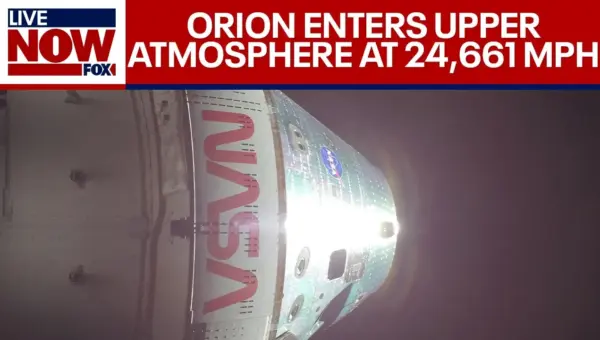
Artemis II Astronauts Face Fiery Re-entry After Moon Trip
The Artemis II mission is set for a high-stakes splashdown as the Orion capsule, carrying four astronauts, re-enters Earth's atmosphere at nearly 25,000 mph. The crew faces extreme heat and G-forces, while NASA monitors the performance of the capsule's heat shield after unusual findings on the prior uncrewed mission. This historic return follows a successful journey around the moon, marked by significant scientific observations.


Artemis Astronauts Brace for Fiery Re-entry Splashdown
The Artemis II astronauts are preparing for a critical splashdown off the California coast after a perilous re-entry into Earth's atmosphere. Concerns linger over the Orion capsule's heat shield performance, which showed significant damage on a previous uncrewed mission. The mission's success is vital for NASA's future lunar and Martian exploration goals.