Artemis II Crew Nears Earth After Record Moon Journey
The Artemis II crew has completed a record-breaking lunar flyby, traveling further from Earth than any humans in history. The astronauts are now en route home after a mission that included naming a lunar crater and experiencing significant emotional milestones. This historic journey marks a critical step towards establishing moon bases and future Mars missions.


Artemis II Astronauts Complete Historic Lunar Flyby, Set New Distance Record
NASA’s Artemis II mission has achieved a monumental milestone, with its four-person crew successfully completing a lunar flyby and setting a new record for the furthest distance humans have ever traveled from Earth. The astronauts, aboard the Orion capsule, are now beginning their journey home after a mission that has captivated the world and signaled a new era in space exploration.
A Journey Beyond Apollo
The Artemis II crew surpassed the previous distance record set by Apollo 13 in 1970. They traveled an astonishing 252,755 miles from our planet. This historic feat was met with deep emotion from the astronauts themselves, who expressed a profound sense of accomplishment and a desire to push the boundaries of human exploration even further. “We will continue our journey even further into space before mother earth succeeds in pulling us back to everything that we hold dear,” stated the crew, reflecting on their achievement.
This mission is not just about breaking records; it’s about paving the way for future lunar bases and eventual missions to Mars. Megan Christian, a reserve astronaut and senior exploration manager at the UK Space Agency, highlighted the significance of this new chapter. “It just really signals the start of of a new era, right? We’re we’re going back to the moon. We’re we’re going to stay,” she explained.
Emotional Moments and Naming a Crater
During their journey, the crew experienced deeply personal and emotional moments. In a poignant tribute, the astronauts named a newly identified crater on the moon in memory of Carol, the late wife of mission commander Reid Wiseman. “Her name was Carol, the spouse of Reed, the mother of Katie and Ellie,” shared crewmate Jeremy Hansen. “It is on the near side of that boundary. And so at certain times of the moon’s transit around Earth, you can we will be able to see this from Earth.”
This naming process will be submitted to the International Astronomical Union for official approval, a body responsible for naming celestial bodies. The decision to name the crater was particularly meaningful, with Commander Wiseman’s teenage daughters, Katie and Ellie, watching from mission control.
Mastering the Void: Communication Blackout
A significant aspect of the mission involved a period of communication blackout as the spacecraft traveled behind the moon. For those on Earth, the idea of being out of contact for 40 minutes might seem terrifying. However, the Artemis II astronauts were extensively trained for this eventuality. “They knew exactly what was happening. They they knew when they were going to go out of contact and when they would be back in again,” explained Christian.
From the astronauts’ perspective, this time was valuable for focus and completing critical observations. “I would probably have been more nervous about making sure that I got all my work done during that time, making sure that I made all the observations that I needed to do,” Christian added, emphasizing the mission’s scientific objectives.
The Long Road Home: A Hazardous Re-entry
With the lunar flyby complete, the four astronauts have begun their four-day journey back to Earth. However, the return trip is far from easy. Professor Kevin Fong, an expert in public engagement in science, described re-entry into Earth’s atmosphere as one of the most hazardous parts of the mission. “They’re going to come in at, I don’t know, something like 20,000 miles an hour into Earth’s atmosphere, this really shallow corridor of atmosphere, which they’re going to rely upon to break and slow them down,” Fong stated.
The intense heat generated during re-entry will test the capsule’s heat shield to its limits. “The heating on the vehicle as they come through that will be incredible. The heat shield has to hold up. So they there’ll be that that will not be easy,” Fong warned. The successful re-entry will be a critical final test for the Orion capsule and the Artemis program.
Looking to the Future: Moon Bases and Mars
The Artemis II mission serves as a crucial stepping stone towards establishing a sustained human presence on the Moon and eventually sending astronauts to Mars. “We are hoping to return to the moon and this time we’re going not just to visit and plant flags but to stay and to establish bases,” Fong elaborated. The lessons learned from Artemis II will directly inform the development of future lunar infrastructure and technologies needed for deep space exploration.
The success of Artemis II builds upon decades of space exploration knowledge, from the Mercury and Apollo programs to the Space Shuttle era. “All of that learning hadn’t been thrown in the bin. It had been tapped forwards into this program,” Fong noted, highlighting the continuous evolution of space technology and human ambition.
Source: Artemis II Trip Nearing Completion, Now The Plan For Moon Bases Begins (YouTube)

Related Articles
Artemis II Astronauts View Moon’s Far Side, War Tensions Rise
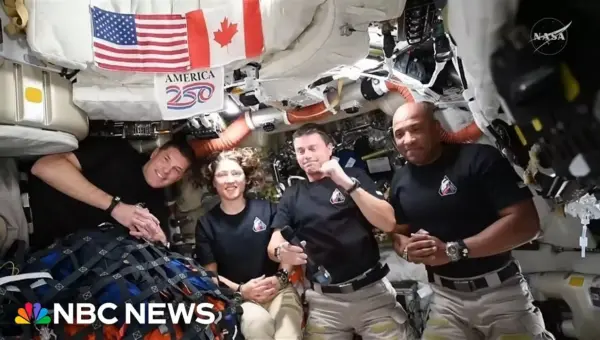
The Artemis II mission made history as astronauts viewed the Moon's far side for the first time, traveling farther than any humans before. Meanwhile, escalating tensions with Iran loom as President Trump set an 8 p.m. deadline for a deal or face strikes on critical infrastructure. Congressional reactions are divided, with Republicans supporting the President and Democrats voicing strong concerns.

US Moon Mission Ignites New Space Race Era
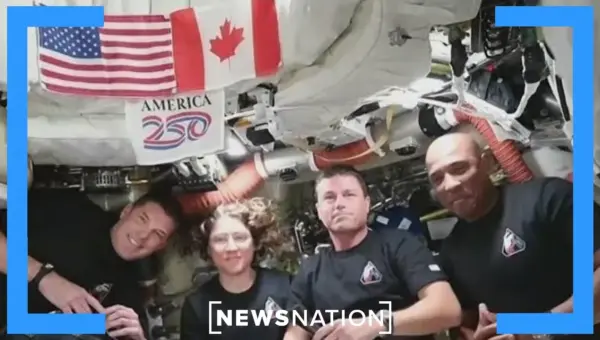
The Artemis II mission has successfully completed a historic lunar flyby, pushing the boundaries of human space travel. This mission marks a new era in lunar exploration, with the crew witnessing unique celestial events and setting new records. Its success signals renewed US commitment and potential shifts in the global space race.


NASA Faces UAP Questions After Witness Account
A witness at NASA's Marshall Space Flight Center reported seeing unidentified egg-shaped objects on an ISS live feed. The feed was quickly cut when questioned, raising concerns about NASA's transparency. This incident echoes historical suspicions of government secrecy surrounding unexplained phenomena.