Artemis II Crew Faces Fiery Return from Moon Orbit
The Artemis II crew is preparing for a perilous re-entry into Earth's atmosphere after a week-long journey around the Moon. This high-speed descent at 25,000 mph echoes the challenges of Apollo missions, with potential risks of extreme forces or atmospheric bounce. A successful splashdown, aided by the U.S. Navy, will mark a major step for human deep space exploration.


Artemis II Crew Faces Fiery Return from Moon Orbit
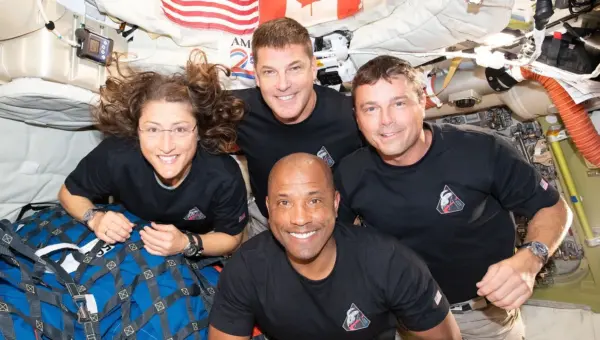
The Artemis II mission, carrying four astronauts on a historic journey around the Moon, is nearing its end. The Orion spacecraft is set to splash down off the coast of San Diego tonight, marking the return of humans to deep space after more than 50 years. This final phase of the mission, re-entry into Earth’s atmosphere, is considered the most dangerous part.
High-Stakes Re-entry into Earth’s Atmosphere
As the Orion spacecraft travels at approximately 80,000 miles from Earth, the crew is preparing for a high-speed plunge. They will slam into the atmosphere at a blistering 25,000 miles per hour. Mission control emphasizes that even a slight deviation in trajectory could have serious consequences. If the angle is too steep, the crew could face extreme G-forces and structural stress. If it’s too shallow, the spacecraft might bounce off the atmosphere entirely. During this process, the capsule is expected to reach temperatures close to 5,000 degrees Fahrenheit, appearing like a fireball as it tears through the sky. Mission control anticipates losing contact with the crew for several minutes during re-entry.
Echoes of Apollo Missions
NASA officials note that not much has changed regarding the challenges of returning from lunar orbit since the Apollo missions. The speed of re-entry is significantly faster than returns from low Earth orbit. This faster descent means a quicker passage through the atmosphere but requires precise execution. The parallels to the Apollo missions are strong, unlike the more routine returns from the International Space Station.
Sonic Booms Over Southern California
Residents in Southern California can expect to hear and feel a sonic boom as the Orion spacecraft makes its re-entry. The U.S. Geological Survey predicts this event will occur around 5 to 5:15 PM local time. This auditory and sensory experience will signal the spacecraft’s dramatic arrival back on Earth.
Naval Recovery and Medical Checks
The U.S. Navy will play a crucial role in the mission’s conclusion. The USS John P. Murtha is tasked with assisting the crew and recovering the Orion capsule. This recovery operation is a tradition that welcomes astronauts back from deep space. Following their recovery from the capsule, the astronauts will undergo medical screenings and checkups before returning to the Johnson Space Center in Houston.
Scientific Data Collection and Astronaut Health
Before the splashdown, NASA scientists will gather important data. They will simulate how the crew would exit the Orion capsule if it doesn’t land precisely on target. This research is vital for understanding how astronauts’ bodies change after extended periods in deep space. Scientists expect the astronauts to move more slowly and with less lateral agility immediately after landing, which is considered a normal part of recovery.
Global Impact
The successful return of the Artemis II crew is a significant milestone for human space exploration. It demonstrates NASA’s capability to send humans on complex missions beyond low Earth orbit and return them safely. This mission paves the way for future lunar landings and potential missions to Mars. It also highlights the ongoing international interest in space, with various nations developing their own space programs and capabilities. The technology and knowledge gained from missions like Artemis II are crucial for advancing our understanding of the universe and our place within it.
Historical Context
The Artemis program builds upon the legacy of the Apollo program, which successfully landed humans on the Moon between 1969 and 1972. Artemis II is the first crewed mission to travel to the Moon since the Apollo 17 mission in 1972. It serves as a critical test flight for the Orion spacecraft and the Space Launch System rocket, ensuring their readiness for future lunar missions, including landing astronauts back on the Moon with the Artemis III mission.
Future Scenarios
The successful completion of Artemis II will boost confidence in NASA’s deep space capabilities. This could accelerate plans for future Artemis missions, potentially leading to a sustained human presence on the Moon. Conversely, any significant issues during re-entry could lead to delays and a reassessment of safety protocols. The data collected will also inform the design and operation of future spacecraft for missions to other celestial bodies.
Source: Countdown to splashdown for Artemis II’s return to earth | Morning in America (YouTube)

Related Articles

Artemis II Crew Safely Returns from Moon Orbit
Four astronauts have safely returned to Earth after a 10-day mission orbiting the moon. The Artemis II crew tested the Orion spacecraft, marking a crucial step towards future lunar landings and human exploration beyond Earth's orbit. This mission highlights international collaboration in NASA's ambitious return to the moon.


Artemis II Astronauts Gear Up for Fiery Earth Re-entry
The Artemis II astronauts are preparing for a high-speed return to Earth after their lunar mission. The Orion spacecraft will endure intense heat and deploy parachutes to slow down for a splashdown off the coast of San Diego, where a naval recovery team awaits to assess the crew's health.


Artemis II Astronauts Share Inspiring Insights with Lawmakers
The Artemis II astronauts, nearing their splashdown, connected with U.S. lawmakers, sharing personal reflections on their historic lunar journey. They discussed inspiration, resilience, and the importance of human connection in space exploration. The crew's messages emphasized chasing dreams and embracing excellence for the next generation.