Artemis II Crew Achieves Lunar Milestone, Shatters Records
The Artemis II mission has concluded its historic nine-day journey, marking the first time humans have flown around the Moon in over 50 years. The crew achieved a new distance record for humanity and captured unprecedented views, paving the way for future lunar missions.


Artemis II Crew Achieves Lunar Milestone, Shatters Records
The Artemis II mission, a monumental journey that saw the first humans venture around the Moon in over 50 years, has successfully concluded. This historic flight, carrying astronauts Reid Wiseman, Christina Koch, Victor Glover, and Jeremy Hansen, pushed the boundaries of human space exploration, delivering unprecedented views of the lunar landscape and achieving a new distance record for humanity.
A New Era of Lunar Exploration Begins
After lifting off on their nine-day mission, the Artemis II crew embarked on a trajectory that would take them farther from Earth than any humans before. The Orion spacecraft performed flawlessly through complex maneuvers, including the Trans Lunar Injection burn, which precisely set them on course for their lunar journey. This mission served as a critical testbed for technologies and procedures vital for future lunar landings and beyond.
Record-Breaking Lunar Flyby
On day six of their mission, the Artemis II crew reached a pivotal moment: their closest approach to the Moon. At just over 4,000 miles (6,000 kilometers) above the lunar surface, they surpassed the previous record set by Apollo 13. Commander Reid Wiseman, pilot Victor Glover, and mission specialists Christina Koch and Jeremy Hansen were not only setting records but also making history with their observations and experiences.
Human Moments and Scientific Discoveries
Beyond the technical achievements, the mission was marked by deeply human experiences. The crew shared their daily lives, from exercising in microgravity to performing medical demonstrations. A particularly poignant moment came with a special message from Apollo astronaut Jim Lovell, who welcomed the crew to his “old neighborhood” and passed the torch of lunar exploration. The crew also had the unique opportunity to name two new lunar craters, christening one “Integrity” after their spacecraft and another, “Carroll,” in honor of a lost loved one.
The scientific observations from the mission were extensive. The crew spent hours observing the Moon’s surface, documenting its intricate features, craters, and geological formations. They were the first humans to see the entire disk of the Moon at once, capturing stunning images of features like the Orientale Basin and the Aristarchus crater. The mission also included crucial tests of the Orion Crew Survival System suits and the new Optical Communications System, which uses lasers to transmit data at high speeds.
Challenges and Triumphs
While the mission was largely successful, it wasn’t without its challenges. The Orion spacecraft experienced minor issues with its waste water system, prompting creative solutions from the crew and ground control. There were also reports of a faint burning smell, but all critical systems appeared to be functioning normally. These issues, however, did not detract from the mission’s overall success, providing valuable data for future spacecraft design and operations.
A Fiery Return to Earth
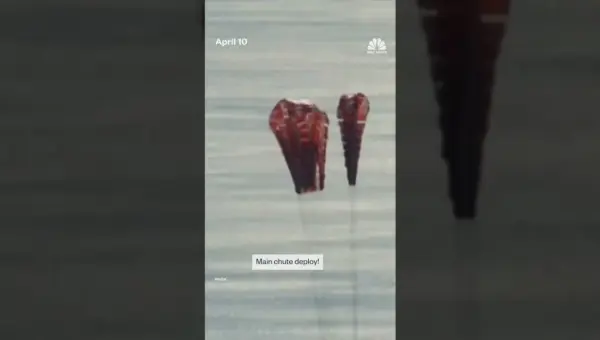
The journey back was equally demanding, culminating in a high-speed re-entry into Earth’s atmosphere. The Orion capsule endured scorching temperatures, reaching up to 3.9 Gs, before deploying its parachutes for a splashdown in the Pacific Ocean off the coast of San Diego. The successful re-entry and splashdown demonstrated the spacecraft’s resilience and the crew’s training.
Looking Ahead: Artemis III and Beyond
The Artemis II mission has paved the way for the next phase of lunar exploration, including the ambitious Artemis III mission, which aims to land humans on the lunar surface. Progress continues at SpaceX’s Starbase facility, with ongoing tests of the Starship and Super Heavy vehicles essential for the Human Landing System. The data gathered from Artemis II will be instrumental in ensuring the success of these future endeavors, bringing humanity one step closer to establishing a sustainable presence on the Moon and venturing further into the solar system.
Source: We Just Watched Artemis II Come Back… That Was Intense (YouTube)

Related Articles


NASA’s Orion Lands Safely, Proving Heat Shield Fixes Work
NASA's Orion capsule successfully returned astronauts to Earth, proving the effectiveness of heat shield fixes after the Artemis I mission's issues. Retired astronaut Andy Allen highlighted the extensive collaboration and technical readiness behind the program.

Artemis II Astronauts Safely Splash Down After Moon Mission
The Artemis II mission concluded successfully as all four astronauts splashed down safely in the Pacific Ocean, marking a significant milestone in lunar exploration. The crew module, Integrity, completed its journey around the Moon and safely re-entered Earth's atmosphere, with all astronauts recovered after a successful parachute deployment sequence.


Artemis II Crew Returns Safely to Earth After Lunar Mission
The Artemis II astronauts have successfully returned to Earth, splashing down in the Pacific Ocean after their historic journey around the Moon. The mission concluded with a challenging re-entry and a smooth recovery operation, bringing all four crew members home safely. This success marks a critical step for NASA's lunar exploration goals.