Artemis II Astronauts Return, Ushering New Space Race Era
The Artemis II mission is concluding with its crew's return to Earth, marking a pivotal moment in space exploration. The astronauts are preparing for a high-speed reentry after a historic lunar flyby, showcasing advanced technology and human resilience. This mission signals a renewed global focus on the Moon and potentially a new era of space competition.


Artemis II Astronauts Return, Ushering New Space Race Era
The Artemis II mission is nearing its end as its four-person crew prepares for a critical reentry into Earth’s atmosphere. This mission marks a significant step in humanity’s return to the Moon and signals a renewed global interest in space exploration. After traveling nearly a quarter of a million miles and completing a historic loop around the Moon, the astronauts aboard the Orion capsule are on their final journey home. This mission is not just about reaching space; it’s about setting the stage for future lunar missions and potentially beyond. The successful completion of Artemis II will pave the way for more complex lunar operations, including potential landings and long-term bases.
Preparing for a Fiery Descent
The upcoming reentry is one of the most dangerous and complex phases of the mission. NASA’s Orion capsule is set to hit Earth’s atmosphere at speeds close to 25,000 miles per hour. This high-speed descent will generate extreme temperatures, reaching nearly 5,000 degrees Fahrenheit. The capsule’s heat shield is designed to withstand this intense heat, protecting the astronauts inside. Parachutes will then deploy to slow the capsule’s descent before it splashes down into the Pacific Ocean off the coast of San Diego.
Recovery Operations Underway
Following the splashdown, a massive recovery operation will swing into action. Navy crews, including those operating MH-60 Seahawk helicopters, will be standing by. These crews will descend onto the capsule to extract the astronauts. Their immediate priority will be medical evaluations to ensure the crew’s health after their extended time in space. The astronauts will then travel to San Diego before returning to the Johnson Space Center in Houston, where they will undergo further debriefing and medical checks. This recovery process is crucial for gathering data and ensuring the astronauts’ well-being.
Astronauts Reflect on a Historic Journey
The Artemis II crew has spoken about the profound impact of their mission. They described the experience of seeing Earth disappear behind the Moon as awe-inspiring. The sense of teamwork and brotherhood among the crew members was highlighted as a unique and privileged aspect of the journey. The astronauts emphasized the importance of finding joy and lifting each other up, suggesting a broader purpose for humanity in space exploration. They noted that the full realization of their experience will likely come after they have had time to process it, especially after the intense reentry phase.
The Broader Significance of Artemis
The Artemis program, named after the twin sister of Apollo in Greek mythology, aims to establish a sustainable human presence on the Moon. This program is a key part of NASA’s strategy to explore the solar system, with Mars as a long-term goal. Artemis II, as a crewed lunar flyby, serves as a vital test for the Orion spacecraft and its systems before astronauts attempt to land on the Moon with Artemis III. The mission’s success demonstrates the capability of the United States to lead in human spaceflight once again, potentially reigniting a new era of space competition and cooperation.
Global Impact: A New Space Race?
The Artemis II mission’s success and the renewed focus on lunar exploration come at a time of increasing international interest in space. Countries like China are also pursuing ambitious lunar programs, including plans for a lunar research station. This could lead to a new space race, characterized not just by national prestige but also by competition for resources and strategic positioning. The United States, through NASA and its commercial partners like SpaceX, is aiming to maintain its leadership in space exploration. The economic implications are vast, involving advancements in technology, new industries, and potential resource utilization.
Historical Context and Future Scenarios
The current drive for lunar exploration echoes the Apollo era, but with different objectives. While Apollo was largely driven by the Cold War competition between the US and the Soviet Union, Artemis focuses on scientific discovery, long-term presence, and commercial opportunities. The success of Artemis II builds on decades of space exploration, from the initial lunar missions to the International Space Station. Future scenarios range from increased international collaboration, similar to the ISS model, to intensified competition, potentially leading to geopolitical tensions over lunar resources or strategic locations. The technological advancements required for lunar missions also have potential applications on Earth, driving innovation in fields like materials science, robotics, and life support systems.
Source: Artemis II prepares for reentry into Earth’s atmosphere | Morning in America (YouTube)

Related Articles

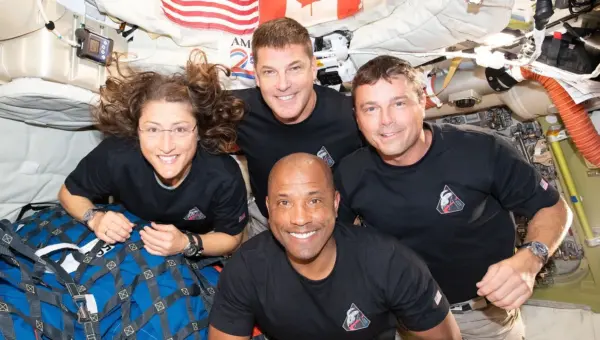
Artemis II Crew Safely Returns from Moon Orbit
Four astronauts have safely returned to Earth after a 10-day mission orbiting the moon. The Artemis II crew tested the Orion spacecraft, marking a crucial step towards future lunar landings and human exploration beyond Earth's orbit. This mission highlights international collaboration in NASA's ambitious return to the moon.


Artemis II Astronauts Gear Up for Fiery Earth Re-entry
The Artemis II astronauts are preparing for a high-speed return to Earth after their lunar mission. The Orion spacecraft will endure intense heat and deploy parachutes to slow down for a splashdown off the coast of San Diego, where a naval recovery team awaits to assess the crew's health.


Artemis II Astronauts Share Inspiring Insights with Lawmakers
The Artemis II astronauts, nearing their splashdown, connected with U.S. lawmakers, sharing personal reflections on their historic lunar journey. They discussed inspiration, resilience, and the importance of human connection in space exploration. The crew's messages emphasized chasing dreams and embracing excellence for the next generation.