Artemis II Astronauts Return: A Giant Leap for Space Exploration
The Artemis II mission has successfully returned to Earth, concluding a groundbreaking voyage that sent astronauts further into space than ever before. The mission tested critical technologies for future lunar and Martian exploration and provided valuable scientific data. Experts emphasize the mission's inspirational value and its role in humanity's expansion into the solar system.


Artemis II Mission Concludes with Safe Earth Return
The Artemis II mission, a critical step in humanity’s return to deep space exploration, successfully concluded with the safe splashdown of its crew back on Earth. The mission, which saw astronauts travel further into space than any humans before them, orbited the Moon and tested vital technologies for future lunar and Martian journeys. This successful return marks a new chapter in space exploration, bringing the astronauts safely home after their groundbreaking voyage.
A Textbook Re-entry and Splashdown
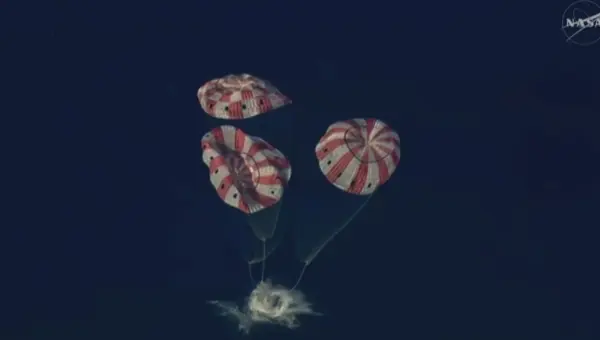
Cheers erupted as the Artemis II capsule, named ‘Integrity,’ completed a textbook re-entry into Earth’s atmosphere and splashed down in the ocean. The mission control confirmed the splashdown at 7:07 p.m. Central time, 5:07 p.m. Pacific time. Following the fiery re-entry, a period of communication blackout occurred due to the intense heat creating a plasma shield around the capsule. This six-minute window is always a tense moment for mission control, but the astronauts reported they were in peak condition, leading to a collective sigh of relief.
Testing Technology for Future Missions
While the Artemis II crew did not land on the Moon, their mission was crucial for testing the systems needed for future lunar landings. They traveled around the Moon, venturing further into space than any previous human mission. The Space Launch System (SLS) rocket performed as expected, successfully launching the astronauts into orbit. A key component, the European Service Module, powered the trans-lunar injection, sending the crew towards their lunar objective. The mission’s success validates the advanced technology being developed for NASA’s ambitious space programs.
Scientific Discoveries and Future Planning
During their journey, the astronauts conducted science experiments, particularly focusing on the far side of the Moon. This area is of great interest due to the discovery of water ice at the Moon’s south pole. The Artemis II mission acted as a reconnaissance, scouting potential landing sites for future missions like Artemis 4, which aims to land humans on the lunar surface. The crew also captured stunning images, including an Earthrise photo, reminding humanity of its place in the vastness of space. These scientific observations are vital for planning future, more complex missions.
The Inspiration of Space Exploration
Space correspondent Jackie Goddard highlighted the inspirational value of space missions. She emphasized that beyond the incredible science and technology, it’s the human stories and the people behind these endeavors that truly capture the public’s imagination. Many involved in space exploration, from astronauts to engineers, were inspired as children by looking up at the stars. This sense of wonder and the pursuit of extraordinary achievements continue to drive new generations towards careers in science and engineering.
Addressing Skepticism: The Value of Space Travel
Space scientist and author D. Maggie Aderin-Pocock addressed common skepticism about the cost and purpose of space travel. She explained that space exploration serves two main purposes. Firstly, it expands our understanding of the universe, akin to appreciating poetry and music. Secondly, and more practically, it provides vital data for Earth observation. Satellites built for space missions help monitor climate change, track shipping, and aid in disaster prediction and response. Human missions, like Artemis II, offer inspiration and are seen as essential steps for humanity’s long-term survival, potentially establishing bases beyond Earth.
“Humans are too precious to have just on one planet. If we’re all here, there are various things that could sort of cause us challenges in the future. So the idea of seeding humanity further out into space, having not just one sort of base, but a number of bases makes a lot of sense.”
– D. Maggie Aderin-Pocock
A Message of Encouragement to Aspiring Scientists
Aderin-Pocock shared her personal journey from a challenging background to becoming a respected space scientist. She encouraged young people, especially girls and those from underrepresented communities, to pursue their dreams, no matter how ambitious. Her message is clear: “Reach for the stars.” She believes that with a big vision and determination, individuals can overcome obstacles and achieve extraordinary things, inspiring them to explore their potential in space science and beyond.
The Future of Human Spaceflight
The success of Artemis II, alongside advancements from other nations like China and the rise of commercial spaceflight, signals an exciting future for human space exploration. Aderin-Pocock expressed both wonder and caution, emphasizing the need for proper legislation to guide these developments responsibly. The goal is to ensure that these steps into space benefit all of humanity. The mission’s smooth execution paves the way for more ambitious journeys, potentially leading to sustained human presence beyond Earth.
Source: ‘These Are Our Next Steps Towards Getting Out There’ | Artemis II Safely Returns To Earth (YouTube)

Related Articles

Artemis II Crew Returns Safely, Paving Way for Lunar Missions
NASA's Artemis II mission successfully concluded with the safe return of four astronauts to Earth. The Orion capsule splashed down in the Pacific Ocean after a 10-day journey around the Moon. This mission marks a crucial step towards future lunar exploration and establishing a sustained human presence in space.


Artemis II Crew Achieves Lunar Milestone, Shatters Records
The Artemis II mission has concluded its historic nine-day journey, marking the first time humans have flown around the Moon in over 50 years. The crew achieved a new distance record for humanity and captured unprecedented views, paving the way for future lunar missions.


NASA’s Orion Lands Safely, Proving Heat Shield Fixes Work
NASA's Orion capsule successfully returned astronauts to Earth, proving the effectiveness of heat shield fixes after the Artemis I mission's issues. Retired astronaut Andy Allen highlighted the extensive collaboration and technical readiness behind the program.