Artemis II Astronauts Face Fiery Re-Entry After Lunar Orbit
The Artemis II astronauts are returning to Earth after a historic journey around the Moon, facing a critical and fiery re-entry into the atmosphere. Space expert Dallas Campbell explains the intense 'moment of tension' as the Orion spacecraft travels at 25,000 mph, relying on its heat shield and parachutes for a safe splashdown. The mission marks a significant step in humanity's return to deep space and paves the way for future lunar exploration.


Artemis II Crew Nears Earth After Historic Lunar Journey
The four astronauts of the Artemis II mission are preparing to splash down in the Pacific Ocean off the coast of San Diego, marking the end of their nine-day journey around the Moon. This mission saw the crew travel farther from Earth than any humans in history. As the Orion spacecraft hurtles towards Earth, the final phase of their return is one of intense focus and technical challenge: re-entry into the atmosphere.
The ‘Moment of Tension’: Understanding Re-Entry
Space expert Dallas Campbell, author of “Space Journal: The Art and Science of Cosmic Exploration,” described the re-entry process as a critical and tense part of any human spaceflight mission. “Re-entry is always a difficult moment, but a moment of tension if you like,” Campbell explained. The astronauts are currently traveling at about 2,000 miles per hour, but as they get closer to Earth, they will accelerate significantly due to gravity.
The Orion spacecraft is expected to hit Earth’s atmosphere at a staggering 25,000 miles per hour. To put that speed into perspective, imagine compressing air rapidly, similar to covering the end of a bicycle pump. This compression creates immense heat. “It’s going to get very, very hot, about 3,000 degrees Celsius,” Campbell noted. During this intense phase, the spacecraft will lose radio communication with Earth, and its atmosphere will act as a brake.
Parachutes and Heat Shields: Ensuring a Safe Landing
As the spacecraft slows down and the atmosphere thickens, drogue parachutes will deploy to further reduce speed. These smaller parachutes will then pull out the three main, larger canopies. These parachutes are designed to bring the Orion capsule down to a safe landing speed for splashdown in the ocean. The spacecraft is expected to land at a slight angle, hitting the water at only a few miles per hour after decelerating from tens of thousands of miles per hour in a matter of minutes.
A crucial component for surviving this fiery descent is the spacecraft’s heat shield. Campbell pointed out that while the heat shield on the uncrewed Artemis I mission experienced some issues, these problems have been addressed. “There is a high confidence that it’ll all be okay,” he stated, though acknowledging that the integrity of the heat shield is a key concern during re-entry. “You’ve got to kind of hope that the heat shield works. It will work. They’ve got good people on the job.”
Artemis II: Achievements and the Future of Lunar Exploration
Beyond the technical feat of returning astronauts safely, the Artemis II mission has significant achievements. It marks the return of humans to deep space after more than 50 years and serves as a crucial test for the Orion spacecraft with a crew aboard. “Having humans doing that is incredibly important because we’re as the space economy gets more and more important, as the space race between America and China heats up, actually knowing how to do it is pretty important,” Campbell said.
The mission also reignites public interest in human space adventure. Pilot Victor Glover shared his perspective from space, emphasizing the beauty and uniqueness of Earth. “You have this oasis, this beautiful place that we get to exist together,” he told media. “Just trust me, you are special. In all of this emptiness, this is a whole bunch of nothing. This thing we call the universe.”
Why the Long Gap Since Apollo?
Campbell addressed the long hiatus in human lunar missions since the Apollo program ended in 1972. He cited political and economic reasons, noting that the Apollo missions were incredibly expensive, comparable to a “war budget.” During that era, America was also dealing with the Vietnam War and significant social unrest, making such costly endeavors unsustainable without clear justification from scientific returns.
Since then, priorities shifted. The focus moved to building the International Space Station, emphasizing international cooperation. Furthermore, Mars became the next perceived frontier, though Campbell highlighted that Mars missions are vastly more complex and dangerous than lunar trips. A Mars journey takes months each way, requiring astronauts to survive extreme conditions and radiation for extended periods, something humanity is not yet fully equipped for.
The Moon as a Stepping Stone
Campbell views the Moon as an essential stepping stone for future deep space exploration, including Mars. “It’s our nearest stepping stone in the solar system. It’s 4 days away. We need to learn how to live off the land. And that’s what this is all about. Artemis 2 is the first step of that,” he explained. Future Artemis missions, like Artemis III and IV, aim to conduct lunar landings and test the necessary technologies, including human landing systems being developed by private companies like SpaceX and Blue Origin.
The involvement of private companies is a significant change from the Apollo era, where NASA managed almost every aspect. Today, commercial partnerships are crucial for developing new hardware like lunar landers. This collaboration, alongside renewed public enthusiasm, suggests a new era of lunar exploration is dawning.
The Future: Space Tourism and Lunar Bases
Looking ahead, Campbell anticipates the rise of space tourism and the potential for lunar bases. While exact timelines are uncertain due to political factors and the complexity of developing new technologies, the groundwork is being laid. “It’s only a matter of time before a company like Axiom or one of these big tech companies will put a hotel on the moon,” he speculated, possibly within the next five to ten years. The ultimate success of these ambitious plans, he concluded, hinges on sustained political and public will. “If there’s a will, there’s a way. If there’s no will, there’s no way.”
Source: Inside Artemis II's ‘Moment of Tension’: The Most Dangerous Part Of The Mission Explained (YouTube)

Related Articles

Artemis II Crew Channels ‘Apollo 13’ in Space
The Artemis II crew drew parallels to the dramatic events of 'Apollo 13' during their mission. Astronauts faced technical challenges and found moments for levity, highlighting the realities of space travel.

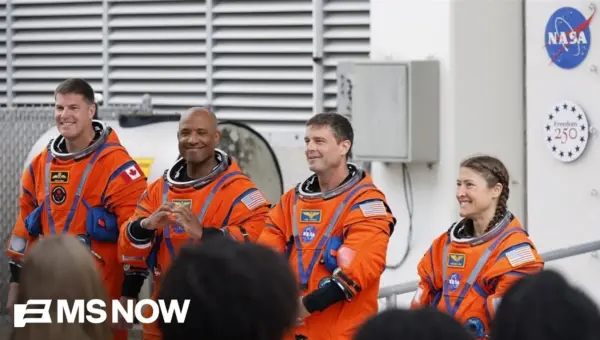
Artemis II Crew Returns: NASA Celebrates Historic Moon Mission Success
NASA's Artemis II mission has successfully splashed down, concluding the first crewed journey around the Moon in over 50 years. The mission provided crucial data on space travel and human health, while the crew's precise re-entry demonstrated the Orion capsule's capabilities. This historic flight paves the way for future lunar exploration.

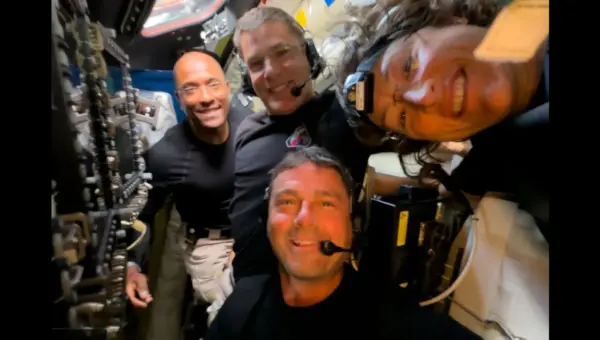
Astronauts Inspire Nation on Historic Moon Journey Home
Lawmakers connected with the Artemis II astronauts as they prepared for re-entry, praising their inspiring journey around the moon. The crew shared personal reflections and a commitment to future space exploration, highlighting the mission's unifying impact.