Artemis 2 Crew Sees Unseen Moon Side for First Time
Astronauts aboard the Artemis 2 spacecraft have captured the first human views of the Moon's far side, a region largely unseen by human eyes. This historic moment offers unparalleled detail and perspective, highlighting the unique capabilities of human observation in space exploration. The mission progresses towards its April 10th splashdown, marking a significant step in NASA's lunar ambitions.


Artemis 2 Astronauts Witness Previously Hidden Lunar Views
The crew of the Artemis 2 spacecraft has achieved a historic milestone, catching their first glimpse of the far side of the Moon. This marks the first time humans have seen this portion of the Moon with their own eyes. The astronauts described the experience as “absolutely spectacular,” noting how different it looked from the familiar face of the Moon.
Astronaut Christina Koch shared her awe, stating, “It was just absolutely spectacular. And something about your senses that is not the moon that I’m used to seeing.” The crew confirmed they were indeed seeing the far side by checking their lunar targeting information.
This mission is a critical step in NASA’s Artemis program, aiming to return humans to the Moon and establish a long-term presence there. The Artemis 2 mission, carrying four astronauts, is currently on a trajectory that will allow them to see about 60% of the Moon’s far side, a vast area that has never been directly observed by humans.
A New Perspective on the Moon
While satellites have mapped the far side of the Moon for decades, human eyes offer a unique level of detail. Ka Burgess, a science correspondent covering the mission, explained the significance of this human observation. “They’re going to be going so far past it that they’re going to be able to actually look back and pretty much see the kind of the whole far side of it, 60% of which has never had human eyes set on it before,” Burgess noted.
The Artemis 2 spacecraft is currently over 214,000 miles from Earth and about 65,000 miles from the Moon. In about 12 hours, the spacecraft will enter the Moon’s gravitational pull, essentially “falling” into its orbit rather than continuing to climb away from Earth.
This mission builds on the legacy of the Apollo program. While Apollo astronauts caught glimpses of the far side, they were much closer to the Moon. The Artemis 2 crew, however, will travel further, providing a more comprehensive view. The Apollo 13 mission in 1970, after an onboard explosion, used a slingshot maneuver around the Moon’s far side to return to Earth, inadvertently giving its crew a brief look at the unseen hemisphere.
Why Send Humans to See What Robots Can Photograph?
The question of why human astronauts are needed when advanced satellites and rovers exist is often raised. Scientists emphasize that human observation offers a level of detail and adaptability that machines cannot match. Astronauts undergo extensive training, becoming “flying geologists” prepared to identify and report on geological features.
They are trained to observe and describe colors, textures, and formations, providing commentary back to mission control. “The great thing is that human beings can do that, robots can’t is to suddenly go, ‘Oh my God, what’s that over there? Quick, let’s let’s zoom in on that because that’s amazing,'” explained one scientist.
Although transmissions from the far side of the Moon are not possible due to its position relative to Earth, the astronauts will record their observations. This detailed visual and verbal data will be invaluable for future lunar exploration and scientific research.
Mission Challenges and Future Goals
Despite the historic views, the mission has faced minor challenges. The most notable issue has been with the spacecraft’s waste management system, specifically a tube for liquid waste that may have frozen. The crew has worked to resolve this by angling the spacecraft to allow sunlight to warm the affected area.
Fortunately, the astronauts have backup systems and are not experiencing significant discomfort. Mission planners anticipated potential issues, and the spacecraft is equipped with alternative facilities. Addressing such technical hurdles is crucial for the success of future missions.
The Artemis program’s ultimate goal is to land humans on the Moon, establish a sustainable presence, and use it as a stepping stone for eventual missions to Mars. Following Artemis 2, two more missions will test lunar landers and orbiters before a planned human landing in 2028. The long-term vision includes building a research base on the Moon and normalizing lunar missions.
Looking Ahead: Splashdown and Beyond
The Artemis 2 mission is scheduled to conclude with a splashdown in the Pacific Ocean on April 10th. This phase involves re-entry into Earth’s atmosphere at high speeds and temperatures, followed by a parachute-assisted descent into the ocean.
The successful completion of Artemis 2, including the historic view of the Moon’s far side and the management of minor technical issues, paves the way for the subsequent phases of the Artemis program. The journey to the Moon continues, bringing humanity closer to its ambitious goals of deep space exploration.
Source: Artemis Mission To Reveal 60% Of The Moon Never Seen By Human Eyes (YouTube)

Related Articles

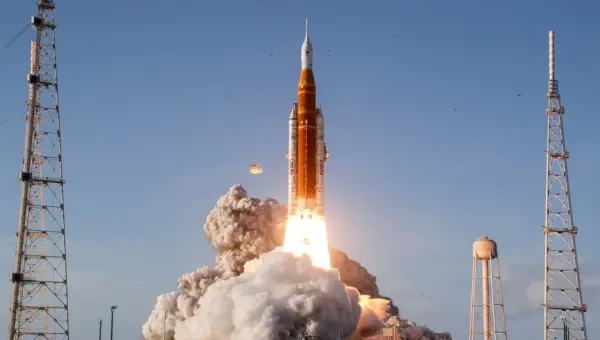
Artemis II: Moon Mission Continues, Honoring Apollo’s Legacy
The Artemis II mission is in its fifth day, marking a significant return to lunar exploration. Astronaut Charlie Duke honored the Apollo legacy, sending encouragement to the current crew as they entered the moon's sphere of influence. This mission is a vital step towards future lunar landings and beyond.


Artemis II Crew Shares Stunning Moon Views from Deep Space
The Artemis II crew is traveling towards the Moon, sharing stunning images and historic interviews from deep space. For the first time since 1972, humans are venturing this far, experiencing breathtaking views and preparing to photograph the Moon's far side.

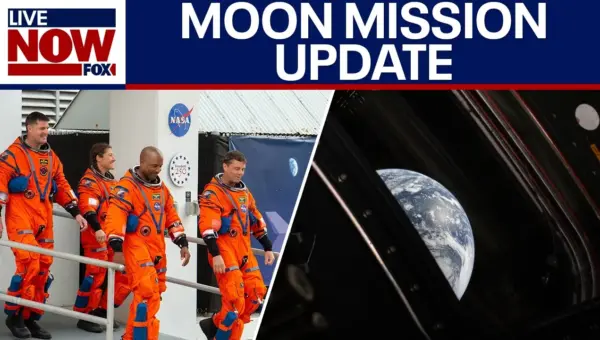
Artemis II Crew Nears Moon Amidst Toilet Troubles
The Artemis II crew is nearing the Moon, but not without facing technical challenges. Issues with the spacecraft's toilet system, suspected to be caused by ice, are being actively managed. Despite this, the astronauts are preparing for a historic lunar flyby, capturing unprecedented views and conducting scientific observations.