Apple’s New MacBooks Shock the Windows World
Apple's new MacBook Neo and M5 Max MacBook Pro are disrupting the laptop market. The affordable Neo offers a premium experience at $600, challenging Windows budget options. Meanwhile, the high-end Pro sets new performance benchmarks, putting pressure on Windows' premium offerings. The industry is bracing for Windows manufacturers' response.


Apple’s New MacBooks Shake Up the Laptop Market
Two new MacBooks have recently hit the market, and they’re sending ripples through the entire laptop industry. On one end, we have the incredibly affordable MacBook Neo, a laptop that offers amazing value for its price. On the other, the powerhouse M5 Max MacBook Pro is pushing performance boundaries to new heights. These releases are putting Windows laptops, and by extension companies like Microsoft, Dell, HP, and Asus, on notice.
MacBook Neo: A Budget Champion
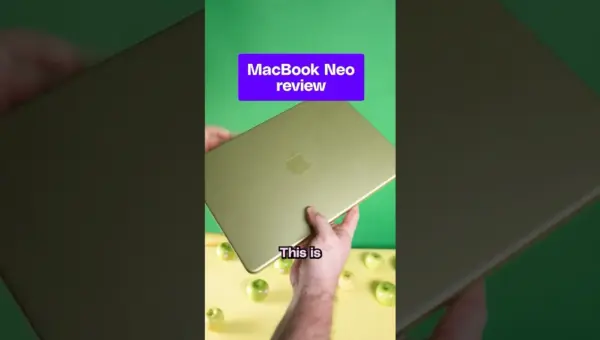
The MacBook Neo is being hailed as one of the best deals in tech right now. For just $600, it delivers efficiency, capability, and build quality that outshines most laptops in its price range. Its success is so significant that an Asus executive described it as an “industry shock.” This affordability, combined with a premium feel, challenges the traditional notion that a good laptop must cost a fortune.
M5 Max MacBook Pro: Peak Performance
At the opposite end of the spectrum, the new $6,000 16-inch M5 Max MacBook Pro is an absolute beast. Its multi-core CPU performance sets a new record for any Mac ever made. The integrated GPU is now more powerful than the M2 Ultra found in the $10,000 Mac Pro. Plus, the new SSDs boast read and write speeds approaching an astonishing 20,000 megabytes per second. This machine is a dream come true for creative professionals who demand the absolute best performance.
The Windows Laptop Dilemma
The arrival of these impressive MacBooks forces us to look at what’s happening on the Windows side. The Windows laptop experience has always been defined by choice and variety, much like the difference between iPhones and Android phones. However, this vast selection is now proving to be both a strength and a significant weakness.
Dell XPS 14: A Premium Contender with Quirks
Take the new Dell XPS 14, for example. This laptop features a stunning 14-inch 2.8K OLED display with thin bezels and a 120Hz variable refresh rate. Its all-metal body and large force-touch trackpad offer a premium feel. Inside, it boasts an Intel Core Ultra 300 series processor with integrated graphics, 32GB of RAM, and a 1TB SSD. It’s a beautiful machine that feels great in many ways, a significant improvement over some past XPS models.
However, it’s not perfect. The ports are all Thunderbolt 4, lacking the newer Thunderbolt 5 standard, and there’s no SD card slot or other full-size ports. Opening the lid is also an awkward process due to the lack of a lip. The keyboard, while decent, is a bit shallow, and the layout of the function keys can be a bit confusing. This $2,200 laptop highlights a recurring issue: for a premium Windows machine to succeed, multiple companies must execute flawlessly.
The Windows Ecosystem Challenge
For a Windows laptop like the XPS 14 to truly shine, it requires Dell to deliver excellent hardware, Intel to provide powerful and efficient chips with good integrated graphics, and Microsoft to offer a polished, ad-free, and bloatware-free operating system. When all these elements align, the result can be a fantastic machine. Unfortunately, this perfect alignment doesn’t always happen, and Windows itself can feel like the weakest link.
Microsoft’s Software Woes
While Windows isn’t fundamentally broken, it often lacks the premium polish found on Macs. The setup process for the XPS 14 involved lengthy forced updates, mandatory sign-ins, and persistent prompts to use Microsoft services like OneDrive and Microsoft 365. Even after setup, ads for software like McAfee appeared on a $2,000 laptop. Microsoft’s push for AI features, including Copilot and the controversial Recall function, along with generative AI in Paint, further complicates the user experience. The requirement for a dedicated Copilot button on new Windows 11 laptops to be classified as an “AI PC” feels like a forced addition that detracts from a clean, premium feel, especially when spending a significant amount of money.
Apple’s Integrated Advantage
Apple has long focused on the premium market, with its cheapest new MacBooks typically starting at $1,000. Their vertical integration, where hardware and software are designed in tandem by Apple Silicon, creates a seamless, efficient, and performant experience that users love. This tight integration is a key reason why expensive MacBooks have been so popular for years.
Where Windows Still Shines
Despite Apple’s strengths, high-end Windows laptops still offer compelling reasons to exist, primarily through choice and variety. For instance, if you need a high-end gaming laptop, options like the Razer Blade with a powerful GPU and a 240Hz display are readily available. However, even these specialized machines rely on the same challenging principle: all components from various manufacturers must perform exceptionally well simultaneously.
The Low-End Disruption
The real shockwave, however, is hitting the lower end of the market. Apple’s efficient hardware and software design, which excels at the high end, is proving equally effective at the budget level. While users expect some compromises in cheaper laptops, the MacBook Neo offers a premium, integrated, and efficient experience for just $600 (or $500 with a student discount). This directly challenges laptops like the Acer Aspire 16, which, while decent for $550 with its large screen and good battery life, can’t match the Neo’s build quality or software polish.
Apple’s Strategic Play
The MacBook Neo is more than just a cheap laptop; it’s a strategic move by Apple. By offering a premium experience at an aggressive price, Apple aims to attract new users to the Mac platform. These new customers are then more likely to subscribe to Apple services like iCloud, Apple TV+, and AppleCare. Apple is essentially using the hardware margin as a means to acquire long-term customers for its profitable services division. This strategy appears to be working, as Mac recently saw its best launch ever for first-time Mac customers.
The Future for Windows Laptops
The success of the MacBook Neo puts Windows laptop makers in a difficult position. They must not only coordinate excellent hardware from various suppliers but also contend with the added costs and profits required by each component manufacturer. This makes it incredibly challenging to produce high-quality, affordable laptops while remaining profitable. The industry will be watching closely to see how Windows manufacturers respond to this challenge. If they cannot find a way to compete, the MacBook Neo could significantly impact their market share, potentially leading to a crisis for some.
Specs & Key Features: Dell XPS 14
- Display: 14-inch 2.8K (2880 x 1800) OLED, 120Hz variable refresh rate
- Processor: Intel Core Ultra 300 series (Panther Lake)
- Graphics: Integrated Intel Graphics
- RAM: 32GB DDR5
- Storage: 1TB SSD
- Ports: 3x Thunderbolt 4, 1x Headphone Jack
- Build: All-metal chassis, soft-touch palm rests
- Trackpad: Large force-touch trackpad
- Price: Starting at $2,200 (as reviewed)
Source: The Windows Laptop Problem (YouTube)

Related Articles


MacBook Neo: The Phone-Centric Laptop Arrives
Apple's new MacBook Neo targets smartphone-centric users, offering a capable secondary computing experience. It bridges the gap between mobile and desktop, but raises questions about Apple's iPad strategy.


MacBook Neo: Apple’s Budget Laptop Wins Big
Apple's new MacBook Neo, powered by an iPhone chip, is making waves with its impressive performance, playful design, and an aggressive $599 price point. It challenges the iPad and disrupts the budget laptop market.

Apple’s $600 MacBook Neo: The Mac for Everyone
Apple's new MacBook Neo disrupts the budget laptop market, offering an iPhone-powered Mac experience for just $599. Designed for students and everyday users, it promises solid performance for basic tasks, all-day battery life, and a refined Apple experience at an unprecedented price point.