Apple’s M5 Chip: Shrinking Tech to Atomic Scales
Apple's upcoming M5 chip represents a monumental leap in semiconductor miniaturization, pushing transistors to near-atomic scales. This article explores the incredible journey of shrinking technology, from room-sized computers to pocket-sized devices.


Apple’s M5 Chip: Shrinking Tech to Atomic Scales
The relentless march of technological progress, particularly in semiconductor manufacturing, continues to astound. While Apple has established a yearly cadence of unveiling new, more powerful chips for its devices, the sheer density of innovation packed into these tiny components often defies easy comprehension. This year, with the rumored M5 chip, the focus isn’t just on raw performance, but on appreciating the incredible miniaturization that makes it all possible. We’ve moved beyond simply stating transistor counts; we’re now at a scale where individual transistors are measured in nanometers, approaching the very building blocks of matter.
The concept of teaching rocks to perform complex mathematical operations is a testament to human ingenuity. Year after year, Apple presents impressive figures for its M-series chips – M1, M2, M3, and now the anticipated M5. These numbers, often presented as billions of transistors on a single chip, can feel abstract. To truly grasp this scale, one must venture into the realm of the infinitesimally small, a journey that reveals the astonishing engineering required to fit such power into devices we carry in our pockets.
The Journey to the Microscopic
Imagine shrinking down, not by a few orders of magnitude, but by hundreds of times. This is the perspective offered to understand the M5 chip’s capabilities. Starting at an average human height of approximately 6’3″, a 100x reduction places us at the size of a single key on a keyboard. At this scale, a MacBook Pro’s deck resembles an expansive apartment building, and components like RAM and storage, boasting a staggering 8 terabytes, are vast landscapes. The M5 chip itself, at this initial reduction, might be comparable in size to a single transistor from 1948 – a stark reminder of the progress made since computers filled entire rooms.
Moore’s Law, the observation that the number of transistors on a microchip roughly doubles every two years, has been a driving force behind this miniaturization. This principle has held remarkably true since the dawn of the semiconductor industry, pushing engineers to constantly innovate and shrink components. The progress is not merely theoretical; it’s a result of immense human effort and brilliant minds dedicated to advancing computing power.
Entering the Realm of Micrometers and Nanometers
Further shrinking by another 100x brings us to the micrometer scale. At 200 micrometers tall, we are now comparable in height to the thickness of a human hair or a sheet of paper. This is the realm where the tiniest visible structures reside. A transistor from 1968, just 20 years after its 1948 predecessor, would now appear as tall as the world’s tallest building from this perspective. This era, while still seeing computers used primarily by governments and research institutions and costing hundreds of thousands to millions of dollars, represented a significant leap from room-sized machines.
The journey continues. Another 100x reduction plunges us into the nanometer scale, where a human becomes just 2 micrometers tall. At this point, invisibility to the naked eye becomes a reality. A single human hair transforms into a cliff face hundreds of stories high, and a grain of rice looms like a mountain. Physics begins to behave strangely; air molecules become too large to breathe, and the wavelength of visible light matches our height, leading to a blurry, wavy perception of the world. Yet, by the 1980s, consistent manufacturing of functional electronics at this scale was achieved, powering the computers that began to resemble today’s devices and paving the way for laptops and mainstream internet access.
The M5 Chip: Approaching Atomic Limits
The latest leap, another 100x shrink, brings us to 20 nanometers. Here, individual transistors from a hypothetical 2026 M5 MacBook Pro are roughly the size of a garage. While precise specifications are proprietary, the smallest components are indeed smaller than a human at this scale. Astonishingly, at this level, individual atoms become visible, appearing as large as marbles. The manufacturing process, known as photolithography, is akin to developing a photograph using light projected through a microscope, but onto atomic structures.
The question of how much longer Moore’s Law can apply as we approach atomic limits is a subject of intense debate. However, the current achievement is remarkable. To put it into further perspective, if a modern transistor were the size of a Toyota Prius, an iPhone containing all its transistors would be as large as the planet Earth. The progression from room-sized computers requiring the space of a US state to pocket-sized devices is a testament to this incredible miniaturization.
Who Should Care?
This deep dive into the M5 chip’s potential scale is for anyone fascinated by the underlying technology that powers their daily lives. Tech enthusiasts, students of engineering and physics, and even casual users who appreciate the marvel of modern gadgets will find value in understanding these advancements. The implications extend to performance gains in everything from creative professional applications to everyday multitasking, all enabled by packing more power into smaller, more efficient chips.
While specific details about the M5 chip’s release date, price, and exact specifications remain speculative, the trend is clear: Apple, and the semiconductor industry at large, are pushing the boundaries of physics and engineering. The journey from room-sized computers to pocket-sized supercomputers is a story of relentless innovation, and the M5 chip, whenever it arrives, will be another chapter in this extraordinary saga of miniaturization and power.
Specs & Key Features (Hypothetical M5 Chip)
- Transistor Count: Billions, with individual transistors measured in nanometers (e.g., 3nm process node).
- Manufacturing Process: Advanced photolithography techniques.
- Scale of Components: Individual transistors approaching atomic dimensions.
- Integration: High density allowing for powerful processors in compact devices.
- Performance: Expected significant improvements over previous M-series chips.
- Efficiency: Continued focus on power efficiency alongside performance gains.
The constant drive to shrink technology not only makes our devices more portable and powerful but also more energy-efficient. As we approach the physical limits of silicon, the innovation in chip design and manufacturing becomes even more critical. The M5 chip, whenever it debuts, will undoubtedly showcase the pinnacle of this ongoing technological evolution, continuing Apple’s legacy of pushing the boundaries of what’s possible in personal computing.
Source: I shrunk down into an M5 chip (YouTube)

Related Articles

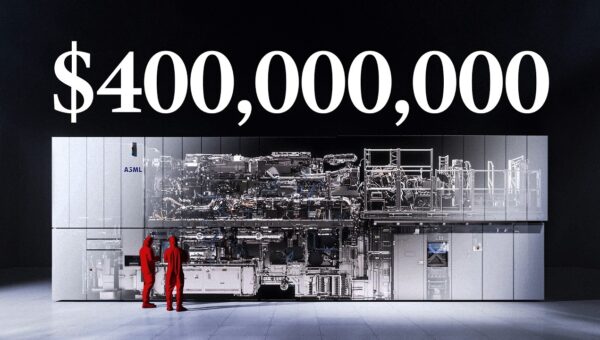
The $400 Million Machine Saving Moore’s Law
For over 50 years, Moore's Law drove technological progress. Now, a $400 million machine by ASML is the sole enabler of advanced chip manufacturing, using extreme ultraviolet lithography to overcome physical limits and continue the digital revolution.


Honor’s ‘Robot Phone’ Adds a Gimbal Arm
Honor's 'Robot Phone' made waves at MWC with its integrated gimbal-stabilized camera arm and 200MP sensor. This innovative device aims to redefine mobile videography with advanced AI tracking and dynamic shooting capabilities.


Walmart’s $360 SuperBox: A Piracy Pandora’s Box?
The $360 SuperBox, sold on Walmart.com, promises unlimited streaming content but raises serious questions about legality, security, and ethics. This device offers a tempting bypass to subscription fees but comes with significant risks, including potential botnet involvement and network compromise.