American Ignorance Exposed: Global Misunderstandings Surface Online
A look at online interactions revealing a surprising lack of global awareness among some Americans, from misunderstanding political systems to mistaking national symbols. This provincialism hinders global understanding and collaboration.

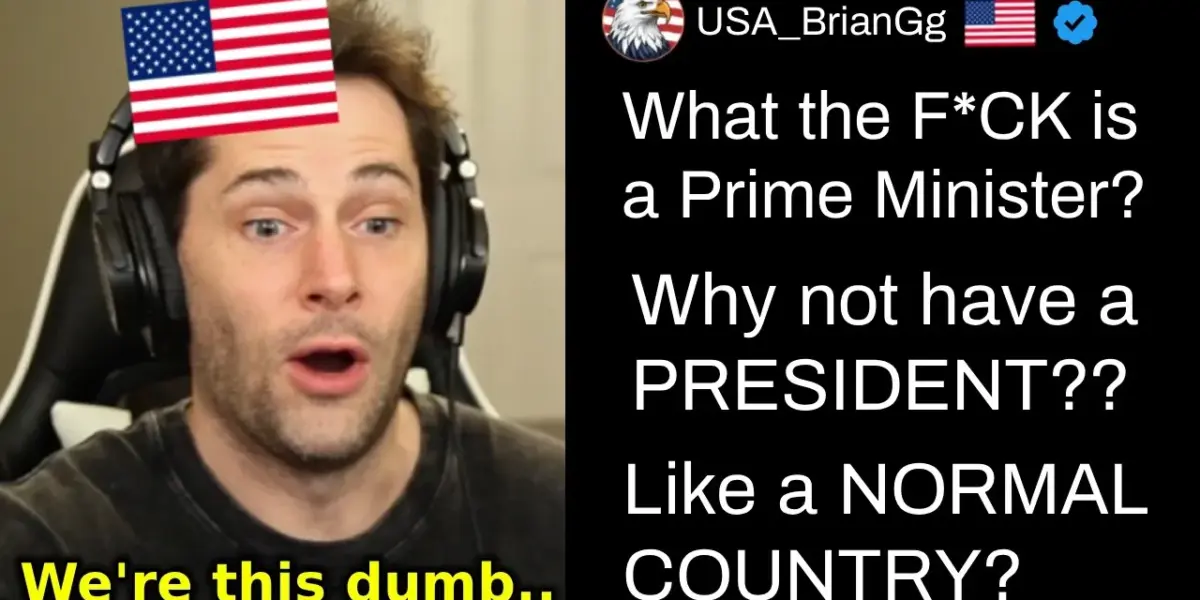
The Digital Echo Chamber: When Americans Mistake Their World for the World
In an era defined by unprecedented global connectivity, a peculiar phenomenon persists: a segment of the American population appears remarkably detached from the realities of the wider world. This isn’t a critique of patriotism, but rather an observation of a pervasive mindset that assumes American norms, systems, and even language are the universal standard. Recent online interactions, as highlighted in a recent video, serve as stark, and often bewildering, evidence of this disconnect.
Parliamentary Systems and the “Normal” Country Fallacy
One of the most striking examples of this provincialism is the outright confusion and hostility directed towards parliamentary systems and the role of a Prime Minister. The reaction, characterized by phrases like “What the f is a prime minister?” and “Why not just have a president like a normal country?”, reveals a deep-seated belief that the American presidential model is the only legitimate or sensible form of governance. This perspective not only dismisses the democratic legitimacy of countless other nations but also overlooks the fact that parliamentary systems are, in reality, far more common globally than the American presidential system. The frustration expressed online often stems from a refusal to seek even basic information, opting instead for vocalized bewilderment. This highlights a critical failure to engage with global diversity, preferring instead to view any deviation from the American way as inherently strange or incorrect.
Furthermore, the argument often ignores potential benefits of parliamentary systems. For instance, the ease with which a prime minister can be removed in a parliamentary system, compared to the fixed four-year term of a US president, can be seen as a significant advantage, particularly in times of political instability or widespread dissatisfaction. The tendency to criticize what one doesn’t understand, rather than to learn, is a recurring theme.
Global Platforms, Localized Understanding: The WhatsApp and Takeaway Conundrum
The disconnect extends beyond political structures to everyday technologies and language. The incredulous question, “Who even uses WhatsApp? Literally nobody,” starkly illustrates how a lack of personal familiarity can lead to the erasure of global realities. WhatsApp boasts billions of users worldwide, a fact that seems to escape those who equate its absence in their immediate social circle with its non-existence on a global scale. This suggests a worldview so insular that if something isn’t prevalent in the United States, it might as well not exist.
Similarly, the confusion over the term “takeaway” in the context of food ordering highlights a linguistic provincialism. In many parts of the world, particularly the UK, “takeaway” is the standard term for food that is ordered to be eaten elsewhere, equivalent to the American “to-go” or “delivery.” The American reaction, questioning the term and asserting that “takeaway in America it’s to go or delivery,” demonstrates an assumption that American English is the global standard. This is often compounded by a surprise that the internet is, in fact, a global platform populated by people with different linguistic conventions and cultural practices.
“Of All Time” Fallacy: The American-Centric View of Records
Perhaps one of the most revealing examples of American exceptionalism in action is the way records and achievements are framed. When a post declared that “The Simpsons” had reached 800 episodes, becoming the “longest running scripted prime time TV show of all time,” it was met with a community note clarifying that this record was specific to American television. Globally, shows like the British soap opera “Coronation Street” have aired over 11,000 episodes. This tendency to omit geographical qualifiers, implicitly presenting American achievements as global ones, is a recurring pattern. It reflects a subconscious belief that the United States is the primary, if not sole, stage for significant cultural milestones. The sheer scale of programs like “Coronation Street,” “Emmerdale,” and “EastEnders” dwarfs “The Simpsons,” yet the initial framing suggests a world where only American context matters.
Geographical and Political Illiteracy: Great Britain and the Liberian Flag Incident
The confusion surrounding the term “Great Britain” further underscores a lack of basic geographical and political understanding. The question, “Why does England get away with calling itself Great Britain?” demonstrates a fundamental misunderstanding of the relationship between England, Great Britain, and the United Kingdom. England is a constituent country within Great Britain, which itself is an island comprising England, Scotland, and Wales. The term “Great” in Great Britain historically referred to its size in contrast to Brittany (Lesser Britain) in France, not to a claim of superiority. The American interpretation, projecting a sense of American exceptionalism onto the term, misses the historical and geographical context entirely.
Even more bewildering is the incident involving the flag of Liberia being mistaken for an American flag, with the subsequent comment suggesting it should have 52 stars. This error is compounded by the subsequent, and equally nonsensical, assertion that “Liberals don’t have a flag.” This mix-up of national symbols, geographical locations (Liberia vs. liberal), and political ideologies demonstrates a profound level of confusion that borders on the absurd. It highlights an inability to distinguish between distinct national entities and political leanings, further illustrating a detachment from global realities.
Why This Matters
This pervasive American insularity has significant implications. It fosters a closed-mindedness that hinders genuine cultural exchange and understanding. When individuals operate under the assumption that their way is the only way, they miss opportunities for learning, innovation, and empathy. In a globalized world, such a mindset can lead to diplomatic missteps, economic disadvantages, and a diminished capacity to address complex international challenges collaboratively.
Implications, Trends, and Future Outlook
The examples cited suggest a trend where the internet, intended to be a unifying force, can also become an echo chamber for pre-existing biases and a platform for uninformed pronouncements. The ease with which misinformation and provincial viewpoints can spread online, especially when amplified by algorithms, poses a challenge to critical thinking. As global interdependence deepens, fostering a more globally aware citizenry within the United States is not merely an academic exercise but a practical necessity. Educational systems, media consumption habits, and individual efforts to seek diverse perspectives will all play a crucial role in bridging this understanding gap.
Historical Context
The phenomenon of American exceptionalism has deep historical roots, often linked to the nation’s founding ideals and its rise to global prominence. However, in the past, this exceptionalism was often coupled with a degree of curiosity about the world. Today, in the digital age, the form it takes is often characterized by a passive dismissal of the unfamiliar, a resistance to engaging with information that contradicts a pre-existing worldview, and an implicit assumption that American experiences are universally relevant. The internet, while offering access to vast amounts of information, has paradoxically allowed some to retreat further into their own informational silos.
The examples presented, while at times darkly humorous, serve as a critical reminder that the “global village” is still very much a work in progress. For the United States to effectively navigate the complexities of the 21st century, a conscious effort to move beyond a narrowly defined, self-referential perspective is not just beneficial, but essential.
Source: Proof Americans Have NO IDEA How the World Works (YouTube)

Related Articles


Germany’s Quirks: Why Americans Flinch at Closed Stores and Paid Toilets
Americans often find themselves bewildered by certain German norms, from the complete absence of air conditioning in homes to the strict rules of the Autobahn. This analysis delves into five key points of confusion, exploring the cultural and practical reasons behind them.


German Numbers: The Brain-Bending Linguistic Puzzle
A viral video reveals the baffling German method of pronouncing numbers, where '21' is 'one-and-twenty,' sparking global fascination. Despite its linguistic complexity and challenges for learners, the tradition faces strong public resistance to reform, even as Germany boasts numerous world-changing innovations.


Chinese Friend’s American Road Trip Reveals Stark Contrasts with Media Portrayals
A Chinese friend's road trip across the USA revealed surprising truths about American life, challenging negative portrayals often seen in Chinese media. From pristine blue skies and free amenities to encountering universal kindness, the experience offered a stark contrast to her preconceived notions.