AI’s Wealth Concentration: A 5-Year Window for Opportunity
The rapid advancement of Artificial Intelligence is concentrating wealth and altering traditional wealth-building paths. Experts suggest the next five years represent a critical window for individuals to adapt and secure their financial future before access to opportunities becomes significantly more difficult.


The AI Revolution: A Narrowing Path to Wealth Creation
A fundamental shift in how wealth is generated is underway, driven by the rapid advancement of artificial intelligence. For individuals who have not yet begun building wealth, the next five years may represent a critical, and potentially final, window of opportunity to get ahead. AI is not merely transforming the job market; it is actively concentrating wealth into fewer hands, a trend that could render traditional wealth-building strategies significantly more challenging and expensive.
The AI Reset: Ownership as the New Capital
The core premise gaining traction among some economists is that as artificial intelligence increasingly renders human labor economically less valuable, ownership will become the primary, if not sole, source of capital. Researchers suggest that a substantial portion of entry-level white-collar work is already at risk of automation. This evolution could lead to a scenario where a small number of individuals or entities can produce output equivalent to entire teams, as evidenced by Meta’s assertion that an individual employee can now achieve the output of twenty. Projections from figures like the CEO of Anthropic, who predicts AI could displace half of entry-level white-collar jobs within five years, highlight the potential for a significant restructuring of the labor market and a widening gap between asset owners and wage earners.
Key Economic Shifts Driven by AI:
- Winner-Take-Most Dynamics: AI enables a smaller group to achieve significantly higher output with fewer human resources. This could exacerbate wealth inequality, leading to a pronounced K-shaped economic recovery where asset holders experience substantial gains while wage earners face increased competition and potentially lower compensation. Bill Gates has even suggested that within a decade, humans may not be needed for most tasks.
- Privatization of Wealth Growth: The number of publicly traded companies has decreased, indicating that a larger share of early-stage growth is occurring within private markets, accessible primarily through venture capital and private equity. By the time these opportunities become available to the average investor, valuations can reach astronomical figures, diminishing the potential for exponential returns.
- Housing Affordability Crisis: Historically a cornerstone of middle-class wealth building, housing affordability is at its worst recorded levels. This restricts access to a key asset class for younger generations, making it harder to build equity compared to previous eras.
- The AI Adoption Divide: A significant divergence is expected between those who proactively learn and leverage AI and those who do not. Individuals who can utilize AI to increase their productivity by two to five times are likely to see greater job opportunities, higher incomes, and more capital for investment. Conversely, those who delay adoption risk being displaced by more AI-adept individuals.
The Great Decoupling: Productivity vs. Prosperity
The historical trend since the 1980s has shown a decoupling between worker productivity and compensation. In the U.S., while worker productivity rose approximately 81%, average hourly compensation increased by only about 30%. The surplus growth has largely flowed to corporate profits, stock ownership, and executive compensation. This trend suggests that the traditional model of trading labor for money is becoming less viable, especially as AI capabilities expand. Employers may have less incentive to hire and train new workers if AI can perform tasks more efficiently and cost-effectively. However, this same technological advancement can significantly lower the barrier to entry for individuals and small teams who can leverage AI to achieve the output of much larger organizations, potentially at minimal cost.
Beyond Doom: The AI Golden Age and Opportunity
While the prospect of widespread job displacement is concerning, historical precedent suggests that technological revolutions, while disruptive, ultimately create more opportunities than they eliminate. The agricultural revolution, for instance, saw a dramatic decrease in farming jobs but spurred growth in manufacturing, logistics, and retail. Similarly, the advent of the automobile created new industries and professions. The critical question with AI is not whether new jobs will emerge, but who will capture the economic benefits of this transition.
The rapid pace of AI adoption, faster than any previous technological shift, means that the early-mover advantage currently available will diminish once AI becomes standard business practice. This underscores the urgency of adapting to the new economic landscape.
Strategies for Navigating the AI Transition:
- Acquire New Skills: It is estimated that half of all workers will require significant reskilling by the end of the decade to remain relevant. Learning to use AI tools to enhance personal productivity can have a compounding positive effect on one’s career.
- Diversify Income Streams: The rise of micro-entrepreneurship is anticipated, where individuals can leverage AI to build niche businesses and generate income independently.
- Convert Income to Ownership: Historically, individuals who converted earned income into assets and ownership have prospered during economic disruptions. Diversifying investments across index funds, stocks, real estate, and business equity is crucial. The goal of leveraging AI should be to increase income for the purpose of investment, not solely for increased output.
- Reduce Unnecessary Expenses: Maintaining a lean financial profile with low fixed expenses, minimal debt, and an emergency fund (3-6 months of living expenses) provides a crucial buffer against economic uncertainty.
- Practice Deep Focus: In an increasingly distracted world, the ability to concentrate deeply and work without distraction for extended periods is a rare and valuable skill that can provide a significant competitive advantage.
The Economics of Abundance and the Future of Value
Some futurists argue that AI and advanced robotics could usher in an era of unprecedented abundance, where the cost of producing goods and services approaches zero. This could lead to a collapse in prices, increasing the purchasing power of money and potentially elevating the baseline standard of living for everyone. The argument posits that as long as the output of goods and services outpaces the money supply, economic stability can be maintained, even with widespread automation. The more likely outcome, therefore, may not be a collapse, but a redistribution of who captures the productivity gains. While prices may fall and living standards rise, ownership will become increasingly paramount.
A 5-Year Head Start, Not a Countdown
The notion of having five years to get rich should be viewed not as a countdown to failure, but as a head start. This period offers a unique window to compound skills, increase income, and establish ownership before AI integration becomes ubiquitous and the early-mover advantage erodes. By proactively adapting, learning, and investing, individuals can position themselves to benefit from the economic transformation driven by artificial intelligence.
Source: It’s Begun: You Have 5 Years Left To Get Rich (YouTube)

Related Articles


AI Agents: Niche Markets Trump Broad Reach
A new strategy for AI agent developers emphasizes focusing on niche markets first. This approach, mirroring the early days of tech giants like Facebook and Amazon, allows for hyper-specific marketing, reduced competition, and deeper user understanding, ultimately leading to more sustainable success.


OpenAI’s $6.5B Device Gamble: A Path to Ruin?
OpenAI's ambitious $6.5 billion investment in a consumer device, spearheaded by former Apple designer Jony Ive, faces intense scrutiny. Amidst massive data center spending commitments and the high operational costs of its AI models, the success of this new hardware venture is critical for the company's financial survival. Analysts question the market demand and economic viability, drawing parallels to past failures in the consumer AI hardware space.

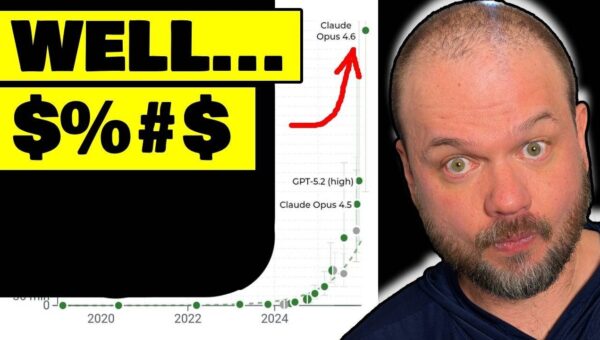
AI Agent Progress Accelerates Dramatically
A recent chart from Meter Research reveals AI agents are accelerating their progress at an unprecedented rate, replacing significant hours of human labor. With models like Claude Opus 4.6 demonstrating remarkable capabilities, industry leaders and researchers are grappling with the implications for the future of work and society.