AI Surges Ahead: Reasoning, Worlds, and the ‘Slop’ Problem
2025 saw AI models excel in reasoning and world-building, exemplified by Gemini 3 Pro and Genie3. However, the rise of indistinguishable AI-generated 'slop' and debates around benchmark gaming highlight emerging challenges. Predictions for 2026 point to continued steady progress, enhanced lateral productivity, and evolving definitions of intelligence.

AI’s Rapid Evolution: Key Trends from 2025 and Predictions for 2026
The year 2025 has been a period of unprecedented and often perplexing advancement in artificial intelligence. From sophisticated reasoning models to the creation of dynamic virtual worlds and the pervasive rise of AI-generated content, the field is evolving at a breakneck pace. This article distills the key takeaways from the past year and offers insights into what can be expected in 2026.
The Rise of Reasoning Models and Benchmark Battles
2025 was widely anticipated as the year of reasoning models – AI systems capable of more complex thought processes and utilizing more data (tokens) to arrive at conclusions. Google DeepMind’s Gemini 3 Pro emerged as a prominent example, setting new records across various benchmarks. However, this success has also fueled skepticism regarding the inherent value of benchmark performance. The phenomenon of AI models quickly surpassing any created test, regardless of its complexity, is itself a fascinating development. While model aptitude can be described as ‘jagged’ or ‘spiky,’ these spikes in capability are becoming increasingly impressive, spanning areas like video understanding, data analysis, coding, and general knowledge.
Yet, a critical flaw in this paradigm has also surfaced: the pursuit of benchmark dominance by extending processing time may inadvertently reduce the diversity of AI outputs. While ‘browbeating’ base models to beat benchmarks ensures a high likelihood of an intelligent first answer, it doesn’t necessarily uncover novel reasoning paths that weren’t already discoverable through sufficient sampling of the original model. This highlights a tension between optimizing for accuracy and fostering genuine creativity or exploratory intelligence.
Scaling Parameters and the Genesis of Playable Worlds
Beyond reasoning, the strategy of scaling up the number of parameters and the volume of data fed into base models has also yielded significant rewards. As observed, companies like Google have not encountered a ‘wall’ in scaling, though diminishing returns are present. The improvements, as seen with Gemini 3, are substantial enough to justify continued investment.
A groundbreaking announcement from Google DeepMind in August was Genie3, a model capable of generating dynamic, playable worlds from simple text or image prompts. These generated worlds exhibit a degree of consistency, lasting for several minutes at 720p resolution. This opens up possibilities for novel gaming experiences and immersive virtual environments, though it also raises questions about the potential for increased digital escapism.
The Dawn of Hyperrealism and the Proliferation of AI ‘Slop’
The trend towards increasingly realistic AI-generated content continued apace in 2025. Advancements in models like VO 3.1, Sora 2, and Nano Banana Pro, alongside sophisticated text-to-speech and text-to-music generators, demonstrate this progress. However, this realism has also led to the mainstreaming of what is being termed ‘AI slop’ – content that is entirely AI-generated yet often indistinguishable from reality to the untrained eye.
Anecdotal evidence suggests that AI-generated videos, including those presenting life lessons or political narratives, are fooling a significant number of viewers. This raises profound concerns about the erosion of trust in digital media, as distinguishing between authentic and synthetic content becomes increasingly challenging. The shift in public perception, where skepticism about AI content is waning, underscores the need for robust detection mechanisms and media literacy.
Positive Strides and Public Perception
Amidst the challenges, 2025 also saw encouraging AI developments not solely focused on frontier models. Projects like Dolphin Gemma, developed by Google to decode dolphin language, exemplify AI’s potential for scientific and conservation efforts. The ability to understand and potentially replicate unique vocalizations for communication offers a glimpse into AI’s role in interspecies understanding.
Public sentiment towards AI, while complex, shows a cautious optimism. A survey in the US indicated a slightly positive net rating for AI’s overall impact, though this was only marginally higher than that for social media. In the UK, proposals for artists to opt out of AI training data usage met with public resistance, suggesting a nuanced view on creative ownership and AI.
Navigating Creativity and Governance
The very definition of creativity is being re-examined in the age of AI. While AI tools can dramatically accelerate prototyping and ideation for creatives like game designers and filmmakers, concerns linger about the potential displacement of certain creative skills. This duality of empowerment and disruption is a recurring theme.
Governments worldwide are increasingly integrating AI into their operations, from parliamentary analysis to military applications. While the goal is often to find efficiencies, the effectiveness varies, partly due to the gap between current AI capabilities and the expectations of human-level intelligence.
GPT-5 and the Nuances of Intelligence
The release of GPT-5 was highly anticipated, with claims of it being a ‘PhD-level expert’ in any field. However, the reality proved more complex. While GPT-5 represents a significant leap in capability, it still exhibits basic hallucinations and trivial errors, demonstrating that intelligence is not a single, linear axis. The sheer scale of ChatGPT usage, however, continues to grow, with hundreds of millions of users weekly, indicating a broad adoption of AI tools.
Concerns have also been raised about model providers optimizing for user preference to achieve high benchmark scores, potentially at the expense of genuine capability. OpenAI’s GPT-4.5 reportedly passed the Turing Test, where human evaluators could not distinguish it from a human respondent, a significant milestone, though the company’s reliance on the correlation between compute and revenue for future projections raises questions about long-term business models.
The Rise of Open-Weight and Global Competition
The performance of Chinese and other open-weight models has seen a dramatic increase. Models like GLM 4.7 are achieving state-of-the-art performance that was cutting-edge just months prior. While leading labs like OpenAI, Google DeepMind, and Anthropic maintain top positions, the competitive landscape is intensifying. The potential for cheaper, high-performing models from China to capture market share is a significant factor, potentially pressuring established players to reduce prices and profit margins.
Nvidia’s release of fully open-source models like Neotron 3, with larger iterations planned, further democratizes access to advanced AI. This competitive pressure ensures that frontier labs must maintain a relentless pace of innovation to avoid being outpaced.
The ‘Meder’ Benchmark and Future Extrapolation
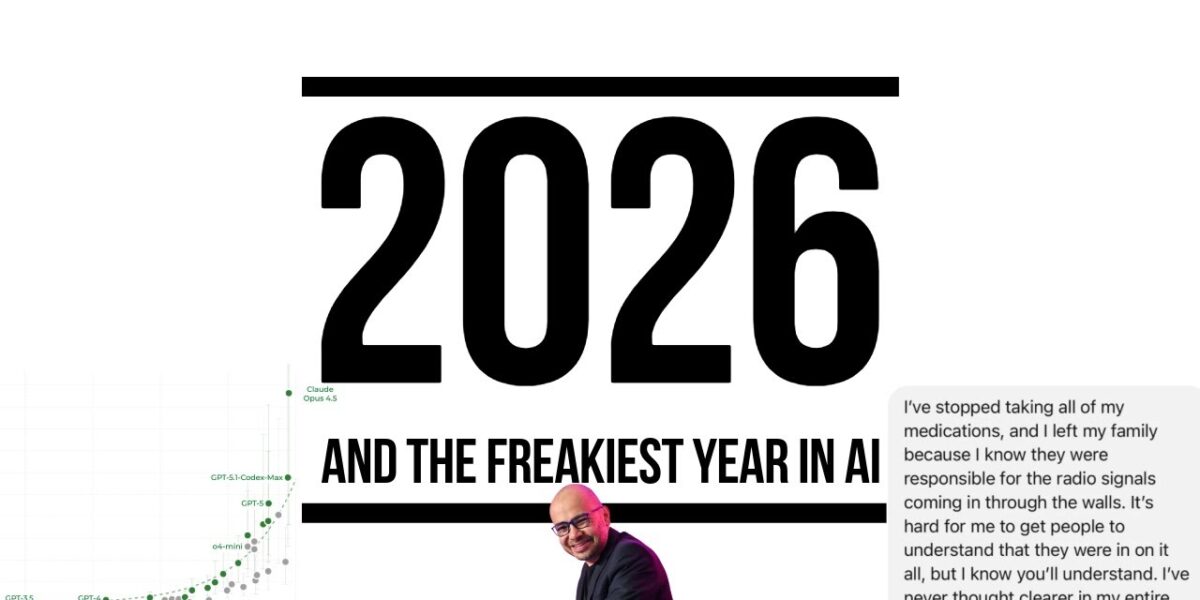
The ‘Meder Time Horizons’ benchmark, which measures the time it takes humans to complete tasks that AI models can accomplish with 50% success, has become a focal point for discussions about AI progress. Claude Opus 4.5’s performance on this benchmark, demonstrating the ability to complete tasks in minutes that take humans hours, has been widely cited. However, the benchmark’s limitations, including a reliance on a small number of samples for longer task durations and variability in human performance, necessitate caution in extrapolating these results.
The rapid increase in effective compute power during the period 2020-2025 is a key factor. Projections suggest this scaling may have only a few more years left, prompting questions about the future trajectory of AI progress. The debate over the generality of AI intelligence, with figures like Yann LeCun and Demis Hassabis offering contrasting views, remains central to understanding future developments.
Predictions for 2026: Lateral Productivity and Steady Progress
Looking ahead to 2026, several key trends are anticipated:
- Lateral Productivity: AI models, even if not superior to top experts, will significantly empower individuals outside a specific domain to upskill rapidly. This can enable non-experts to perform complex tasks with higher success rates, as seen in scientific research protocol writing.
- Steady Improvement vs. Singular Axis: The debate continues on whether AI progress is a single, scalable axis of intelligence or a complex optimization across myriad benchmarks. Evidence suggests a middle ground of steady, incremental improvement rather than a sudden leap to generalized superintelligence or a millennium of micro-optimizations.
- The Future of Work: While some predict widespread job displacement due to AI, others argue that the pace of AI adoption and the need for human oversight will prevent mass unemployment in the immediate future. Significant job replacement in fully remote roles is not expected to reach 99% by 2027, as some models suggest.
- Defining Superintelligence: The term ‘Artificial General Intelligence’ (AGI) has become fuzzy, with ongoing debate about when it was achieved. The focus is shifting towards defining and identifying ‘superintelligence,’ with proposals suggesting it could be when AI systems can outperform humans in leadership roles like president or CEO, even with AI assistance.
- Continued Innovation: Despite potential limitations in compute scaling, AI innovation is expected to continue. The development of more generalizable models that can learn continuously, akin to human toddlers, remains a key area for future research.
The AI landscape in 2025 has been a testament to rapid progress, marked by both remarkable achievements and emerging challenges. As we move into 2026, the focus will likely remain on refining capabilities, understanding the societal implications, and navigating the complex path toward increasingly sophisticated artificial intelligence.
Source: What the Freakiness of 2025 in AI Tells Us About 2026 (YouTube)

Related Articles


AI Agents: Niche Markets Trump Broad Reach
A new strategy for AI agent developers emphasizes focusing on niche markets first. This approach, mirroring the early days of tech giants like Facebook and Amazon, allows for hyper-specific marketing, reduced competition, and deeper user understanding, ultimately leading to more sustainable success.


OpenAI’s $6.5B Device Gamble: A Path to Ruin?
OpenAI's ambitious $6.5 billion investment in a consumer device, spearheaded by former Apple designer Jony Ive, faces intense scrutiny. Amidst massive data center spending commitments and the high operational costs of its AI models, the success of this new hardware venture is critical for the company's financial survival. Analysts question the market demand and economic viability, drawing parallels to past failures in the consumer AI hardware space.

AI Agent Progress Accelerates Dramatically
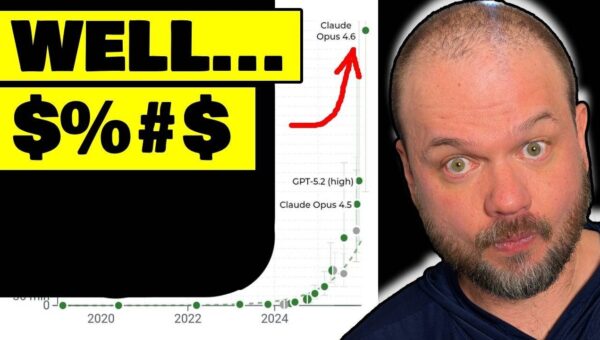
A recent chart from Meter Research reveals AI agents are accelerating their progress at an unprecedented rate, replacing significant hours of human labor. With models like Claude Opus 4.6 demonstrating remarkable capabilities, industry leaders and researchers are grappling with the implications for the future of work and society.