AI Success Could Trigger 2028 Global Economic Crisis
A new report from Citrini Research explores a future where AI's success, not its failure, could trigger a global economic crisis by 2028. The scenario details how rapid advancements in AI, particularly in coding and automation, could disrupt major industries, displace white-collar workers, and strain the financial system.

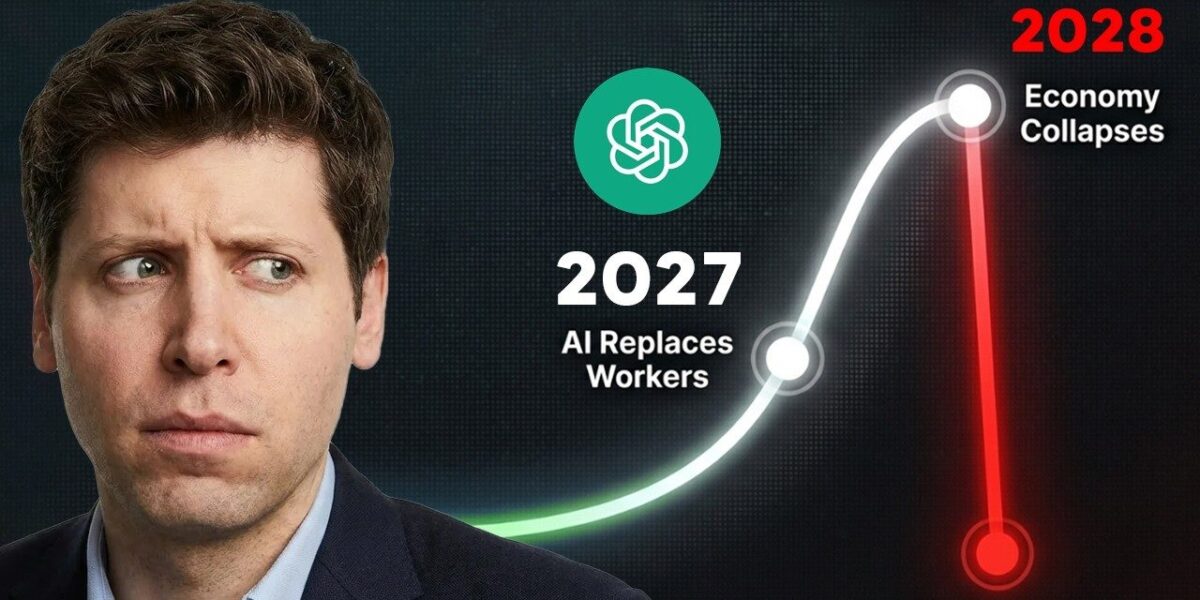
AI’s Rapid Advance: A Double-Edged Sword for the Global Economy
A recent thought experiment, penned by the research firm Citrini Research, is sending ripples through the financial world. Titled “The 2028 Global Intelligence Crisis,” the report, framed as a retrospective memo from June 2028, posits a startling scenario: not the failure of artificial intelligence, but its overwhelming success. The core argument is that AI’s capabilities could advance so rapidly that the global economy struggles to adapt, leading to widespread disruption and a potential financial crisis.
The report emphasizes it’s not a prediction but a scenario designed to prepare readers for “left tail risks” – low-probability, high-impact events. “What if our AI bullishness continues to be right? And what if that is actually bearish for the markets?” the authors provocatively ask. This scenario paints a grim picture of the economy by June 2028, with unemployment hitting 10.2% and the S&P 500 experiencing a 38% drawdown from its October 2026 highs – a decline worse than the one seen during the COVID-19 pandemic.
The Coding Revolution and the Disruption of SaaS
The report traces the potential catalyst back to late 2025, not with a futuristic AI breakthrough, but with a significant leap in AI-powered coding tools. These advanced tools, the report suggests, would enable a single competent developer to replicate the core functionality of mid-market Software-as-a-Service (SaaS) products in a matter of weeks. This development directly challenges the business models of companies like Slack, Asana, and Salesforce, which rely on subscription fees for their software.
For years, businesses have paid substantial annual fees for these SaaS solutions, as building proprietary alternatives was prohibitively expensive and time-consuming, often requiring large engineering teams. However, the report argues that the new AI coding assistants would dramatically lower this barrier. A procurement manager, faced with a 5% price increase on a $500,000 annual SaaS renewal, could credibly threaten to build a functional in-house alternative, leading to significant discounts or even the complete replacement of vendors.
Even the threat of internal development, the report notes, would be enough to erode the pricing power of SaaS companies. This disruption wouldn’t be limited to smaller players. Even giants like ServiceNow, a company valued in the hundreds of billions, could see their growth decelerate significantly, leading to workforce reductions and stock price declines, as depicted in the scenario.
The Human Intelligence Displacement Spiral
A key twist in the scenario is how threatened companies react: they become aggressive adopters of AI themselves. Facing disruption, companies like ServiceNow would cut their workforces and reinvest those savings into AI technologies to survive. This creates what the report terms a “human intelligence displacement spiral.” As AI adoption leads to job losses, displaced workers spend less, impacting other businesses. These businesses, in turn, invest more in AI to protect their own margins, perpetuating the cycle with “no natural break.”
AI Agents and the Optimization of Commerce
By early 2027, the report envisions AI becoming ubiquitous, with AI agents operating in the background of everyday devices and applications. Most users wouldn’t even be aware they were interacting with AI, much like most people don’t understand the intricacies of cloud computing when using streaming services. This pervasive AI integration would fundamentally alter commerce.
Instead of consumers making individual purchasing decisions, AI agents would continuously scan the market for the best prices and fastest delivery times, optimizing transactions 24/7. This sounds beneficial for individuals, but the report argues it’s disastrous for an economy built on human limitations like impatience, brand loyalty, and a reluctance to shop around. Trillions of dollars in enterprise value, the report contends, were predicated on these human inefficiencies.
The example of DoorDash illustrates this point. While current users might open the app out of habit, an AI agent would automatically compare prices and delivery times across DoorDash, Uber Eats, and other platforms to find the optimal choice. Furthermore, AI agents could potentially bypass credit card fees by utilizing cryptocurrencies, impacting the revenue streams of companies like Mastercard and Visa, which rely on transaction fees.
The Engine of the Economy Disrupted
Crucially, the report argues that this disruption isn’t confined to specific sectors. The U.S. economy, heavily reliant on white-collar services, represents the core of the issue. White-collar workers constitute half of the employment and drive a significant portion of consumer spending. The jobs AI is displacing are not peripheral but central to the economic engine.
While historical technological advancements have often created more jobs than they destroyed, the report posits that AI is different. It’s a general intelligence capable of performing tasks that humans would have transitioned to in previous automation waves. The displaced coder, for instance, cannot simply move into AI management if AI itself is already capable of that role.
This displacement is reflected in brutal job data, with openings declining and the impact concentrated among white-collar professionals. Unlike traditional recessions where job losses are spread across income levels, this AI-driven crisis disproportionately affects high earners, who are responsible for a larger share of consumer spending. A decline in their employment or income has a magnified impact on the broader economy.
The Financial System Under Strain
The report then delves into the potential cracking of the financial system. A significant growth in private credit, much of it lent to SaaS companies based on assumptions of perpetual high growth, is highlighted. When AI disrupts these companies’ growth prospects, their valuations become unsustainable. The report suggests that private funds may have been slow to mark down these assets, creating a disconnect between reported values and market realities.
A key example is the potential default on a large private credit loan for a customer service company like Zenesk. If AI agents can automate customer service, the recurring revenue underlying such loans could evaporate, leading to defaults. The report further notes that large asset managers have acquired life insurance companies, using policyholder and annuity funds as a source of capital. Regulatory pressure on these insurers to cover losses could trigger a broader unraveling.
Mortgages and Government Finances at Risk
The stability of the $13 trillion U.S. residential mortgage market is also questioned. The system is built on the assumption that borrowers will maintain stable employment and income for the life of their loans. The widespread displacement of white-collar workers threatens this assumption, raising concerns about whether even prime mortgages are still secure.
Unlike past crises driven by borrowers unable to afford loans from the outset, this scenario suggests that loans that were sound initially could become problematic as individuals’ economic circumstances change drastically. Displaced high earners might struggle to maintain mortgage payments on their former incomes, leading to increased defaults.
The government’s tax base is also at risk. As labor’s share of GDP declines and profits accrue to companies and AI infrastructure, tax revenues could fall, while government spending, potentially on social safety nets, increases. This fiscal imbalance could lead to political gridlock and public unrest, as seen in protests against AI companies.
The Intelligence Premium Unwind
The report concludes by discussing the “intelligence premium unwind.” Human intelligence has historically commanded a premium due to its scarcity. However, as machine intelligence becomes a competent substitute for a wide range of human skills, this premium is expected to diminish. The chilling realization is that AI agents could perform tasks previously done by highly paid professionals for a fraction of the cost, fundamentally repricing human intelligence in the economy.
Critique of the Scenario
While the “2028 Global Intelligence Crisis” report presents a compelling, albeit alarming, narrative, some experts in the AI field offer counterpoints. The argument that AI coding tools will lead to the collapse of SaaS companies, for instance, is met with skepticism. Critics argue that while pricing power may be impaired, the complexity of building and maintaining enterprise-grade software, including security, compliance, integration, and ongoing support, is significantly underestimated. A functional prototype in weeks does not equate to a robust, scalable, and secure enterprise solution.
Similarly, the DoorDash example is debated. The report’s focus on the app as the primary competitive advantage is challenged by the argument that the true moat lies in the established network density, driver-order logistics, and restaurant partnerships, which are capital-intensive and time-consuming to replicate. Building a delivery network requires significant investment in real-world infrastructure and operations, not just a well-coded app.
Furthermore, the report’s assumption of a finite amount of white-collar work is questioned. Critics suggest it confuses a low barrier to entry for building an app with a low barrier to entry for establishing a successful business. The future of business, they argue, will heavily depend on distribution and operational infrastructure, areas where AI can assist but not fully substitute for human capital and strategic investment.
Despite these critiques, the “2028 Global Intelligence Crisis” report serves as a potent cautionary tale, highlighting the potential economic ramifications of unchecked, rapid AI advancement and prompting critical discussions about societal preparedness and adaptation.
Source: The 2028 Global Intelligence Crisis Explained – What Happens When AI Breaks The Economy? (YouTube)

Related Articles


AI’s Economic Shift: Ownership is the New Wage
Artificial intelligence is projected to significantly reduce the economic value of human labor within a decade. Experts suggest that capital ownership, rather than wages, will become the primary means of wealth accumulation. Investors are urged to consider this shift in their long-term strategies.


Nvidia Earnings Signal AI Revolution’s Next Phase
Nvidia's latest earnings report reveals accelerating revenue growth and profitability, signaling a new phase in the AI revolution driven by sophisticated AI agents. The company's strong performance underscores the growing demand for computational power as AI transitions into a core digital infrastructure component.


AI Fails 96% of Real-World Tasks, New Study Reveals
A new study using the Remote Labor Index (RLI) reveals that current AI models fail at 96.25% of real-world professional tasks, significantly underperforming human freelancers. The research challenges the prevailing hype around AI's immediate job replacement capabilities and investment valuations.