AI Simulates Impossible Sand Physics
A new simulation technique uses numerical homogenization to model the complex physics of billions of granular particles, enabling previously impossible simulations of sand and other granular materials with unprecedented realism.

AI Simulates Impossible Sand Physics
Researchers have developed a groundbreaking simulation technique that tackles the long-standing challenge of accurately modeling the behavior of granular materials, like sand. This new method, detailed in a recent research paper, allows for highly realistic simulations of billions of particles interacting, a feat previously considered computationally impossible without immense resources or simplified models.
The Granular Challenge
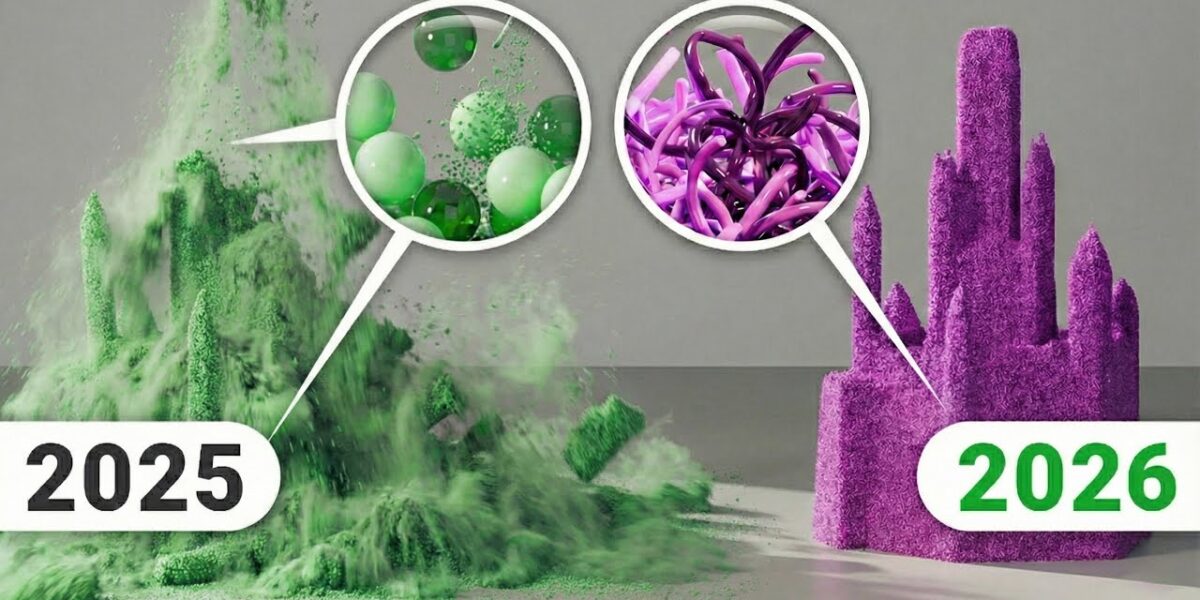
Simulating granular materials, such as sand, soil, or even small objects like ball bearings, presents a significant computational hurdle. The sheer number of individual particles and their complex interactions make direct simulation incredibly resource-intensive. Traditional methods often rely on simplified models like the Drucker-Prager model, which treats particles as smooth and uniform, akin to slippery marbles. While useful for some applications, this model fails to capture the intricate ways real-world grains, with their irregular shapes and surface textures, lock together and slip against each other.
A more advanced model, Mohr-Coulomb, acknowledges the jagged nature of grains and their tendency to clump. However, even this model struggles when dealing with billions of particles, especially when simulating dynamic behaviors like collapsing structures or fluid-like flow. The core problem lies in simulating the complex friction and interlocking forces between countless irregularly shaped objects in real-time.
A New Approach: Numerical Homogenization
The breakthrough presented in the paper, from Professor Chris Wojtan’s lab, utilizes a technique called numerical homogenization. Instead of simulating every single grain in a massive scene, the researchers developed a clever shortcut. They first take a small, representative volume of material – containing just a few thousand grains – and subject it to various forces and pressures in a virtual environment. By observing how this small volume deforms and resists pressure under thousands of different scenarios, they can derive the material’s bulk mechanical properties, such as its average resistance to compression and shear.
This meticulously characterized small volume is then treated as a repeating unit, akin to a 3D wallpaper. This homogenized material property is then applied to a much larger simulation. This means the simulation doesn’t track individual grain collisions for billions of particles; instead, it uses the pre-calculated bulk behavior of the homogenized material to predict how the entire mass will behave.
Simulating the Unsimulatable
The researchers demonstrated the power of this technique by simulating various scenarios that were previously intractable:
- Collapsing Structures: They simulated collapsing cylinders and bridges made of different grain shapes. Spherical grains, as expected, flowed freely. However, irregularly shaped grains, like hexapods (six-armed star shapes) and dodecafangs (twelve-fang-like shapes), exhibited remarkable cohesion. These shapes interlocked so effectively that the simulated material behaved more like a solid, elastic body than loose sand.
- Hourglass Flow: The simulation showed how irregularly shaped grains could clump and resist flowing through an hourglass, creating a bottleneck effect, while spherical grains flowed smoothly.
- Sand Bridges: When simulating a sand bridge supported by a virtual structure, spherical grains caused an immediate collapse upon removal of support. Dolosse (a type of interlocking concrete block used in coastal defense) showed slightly better structural integrity due to their shape, leading to a steeper heap. The hexapod grains, however, formed a cohesive lump that resisted collapse far better, and the dodecafangs created a structure so stable it could withstand significant impact.
- Siege Warfare: Perhaps the most dramatic demonstration was firing a virtual projectile at castles made of different grain shapes. Castles made of spheres disintegrated instantly. Those made of dolosse offered slightly more resistance. Castles made of hexapods crumbled in cohesive lumps. Astonishingly, a castle made of dodecafangs not only survived the impact but bounced, absorbing the energy like a solid, elastic object.
The Math Behind the Magic
The underlying mathematics involves complex concepts like the Cauchy stress tensor and tensor products. In essence, these mathematical tools allow the researchers to aggregate the forces and pressures experienced by individual grains within the small, homogenized volume into a single, representative value for the entire material. Instead of calculating the stress on every single grain, they measure the forces on the boundaries of the small volume and use mathematical constructs to derive the overall material behavior. This drastically reduces computational load.
Why This Matters
This breakthrough has significant implications across various fields:
- Engineering and Construction: More accurate simulations of soil and granular materials can lead to better designs for foundations, tunnels, retaining walls, and coastal defenses. Understanding how different materials will behave under stress is crucial for safety and efficiency.
- Manufacturing: Industries dealing with powders, grains, or small components, such as pharmaceuticals, food processing, and electronics manufacturing, can benefit from improved simulation tools to optimize handling, mixing, and packaging processes.
- Scientific Research: This technique opens new avenues for studying complex physical phenomena involving granular flows, such as avalanches, landslides, and the behavior of matter under extreme conditions.
- Entertainment and Gaming: The ability to simulate realistic granular physics with complex shapes can lead to more immersive and dynamic environments in video games and visual effects for films.
Limitations and Future Directions
While revolutionary, the technique is not without its limitations. The initial computation to derive the homogenized properties for a single grain shape can be extremely time-consuming; for the pink hexapod grains, it took approximately 705 hours. Furthermore, the current method assumes grains are rigid and does not account for deformation or squishiness, limiting its application to materials like jelly beans. However, the researchers emphasize that this is a significant first step, and future work will focus on optimization and expanding the method’s capabilities.
This work, though not utilizing AI directly, showcases the power of human ingenuity and advanced mathematical modeling to solve problems that were once thought impossible, pushing the boundaries of what can be simulated in the digital world.
Source: They Said It Was Impossible… This Simulation Solved It (YouTube)

Related Articles


AI Simulates Societies: Similey Raises $100M Seed Funding
Similey, a new AI venture founded by Stanford researcher Jun Park, has raised $100 million to build entire simulated societies powered by LLMs. Building on earlier "Smallville" experiments, Similey aims to offer unprecedented insights into social, economic, and behavioral dynamics by creating and running complex digital worlds populated by AI agents.


AI Agents: Niche Markets Trump Broad Reach
A new strategy for AI agent developers emphasizes focusing on niche markets first. This approach, mirroring the early days of tech giants like Facebook and Amazon, allows for hyper-specific marketing, reduced competition, and deeper user understanding, ultimately leading to more sustainable success.


Google Exec Proposes Novel AGI Test: Beyond Benchmarks
Google DeepMind CEO Demis Hassabis proposes a novel test for Artificial General Intelligence (AGI): can an AI independently derive scientific breakthroughs like Einstein's General Relativity from a historical knowledge cutoff? This benchmark aims to differentiate true reasoning from pattern matching, highlighting the limitations of current AI and the need for further breakthroughs in areas like continual learning and multimodal understanding.