AI Job Interviews: Your Next Boss Might Be a Bot
AI agents are now conducting job interviews, promising efficiency but raising concerns about the human element. Platforms like Humanly and Code Signal offer distinct approaches to AI-driven recruitment, from uncanny avatars to realistic question sets.

AI Job Interviews: Your Next Boss Might Be a Bot
The future of hiring is here, and it’s speaking to you from your screen. Artificial intelligence is rapidly moving beyond chatbots and into the critical process of job interviews. We’ve seen AI assistants draft emails and summarize documents, but now, AI agents are conducting actual interviews, asking candidates about their skills, experience, and even how they handle difficult situations. This shift promises efficiency and objectivity but also raises significant questions about the human element in recruitment.
Humanly: The Uncanny Valley Interviewer
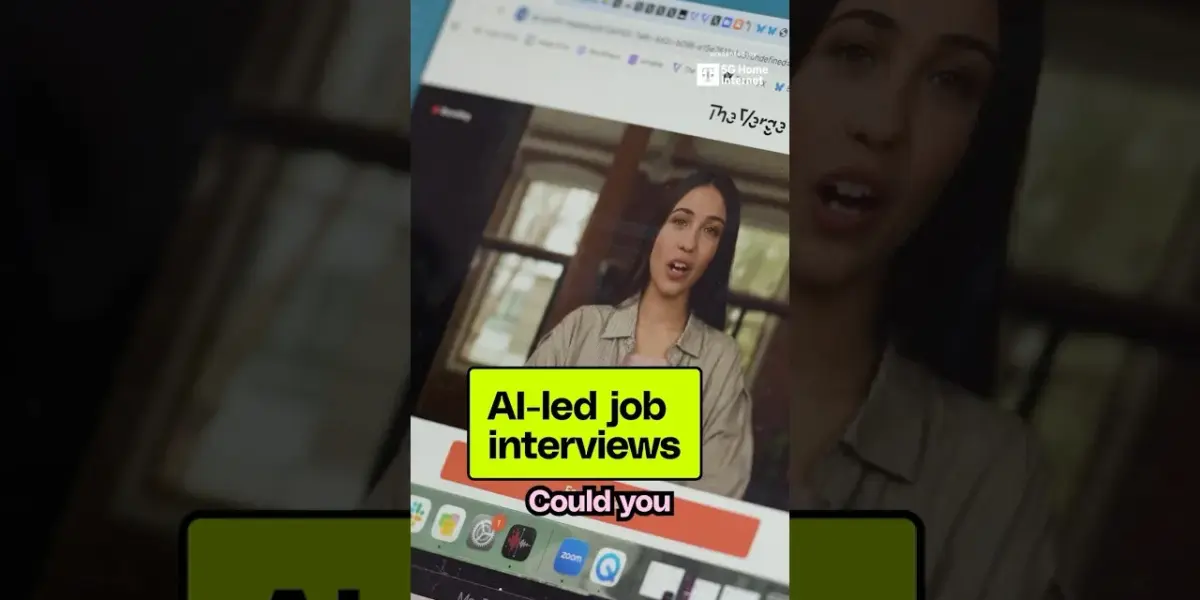
One of the AI platforms making waves is Humanly. The company claims its AI interviewer, presented as an avatar, encourages candidates to speak more, averaging around 200 words per response – more than a typical human phone screener. During a demonstration, the Humanly AI avatar asked questions and engaged in a back-and-forth. However, the visual representation of the avatar bordered on the ‘uncanny valley,’ a phenomenon where a near-perfect human likeness becomes unsettling. The reviewer found the avatar’s appearance distracting, needing to look away to focus on formulating answers. While the AI’s ability to elicit longer responses is a noted feature, the visual presentation might hinder, rather than help, the candidate experience.
Code Signal: Realistic Questions, Digital Interviewer
Another contender in this space is Code Signal. While the demonstration didn’t involve a live video conversation with an AI avatar, it did use a photo of an AI avatar for the interaction. Code Signal’s strength lies in the realism of its interview questions. The AI posed questions about technical fluency in AI and hardware, and methods for staying current in the field. Notably, the AI demonstrated an understanding of industry-specific lingo, even asking about handling a situation with a communication person who disagreed with an article’s outcome. Code Signal’s approach focuses heavily on the content of the candidate’s answers, stating they primarily evaluate ‘what you said’ rather than ‘how you said it.’ This focus on verbal responses allowed the candidate to answer naturally, similar to a human interview, though the overall experience of being interviewed by an AI remains a point of contention for many.
The Promise and Peril of AI in Hiring
The appeal of AI in job interviews is clear: scalability, consistency, and potentially reduced bias. AI can process a high volume of candidates quickly, ask standardized questions, and evaluate responses based on predefined criteria, theoretically removing human subjectivity. Companies like Humanly aim to increase candidate engagement and gather more detailed information than a brief phone screen. Code Signal’s focus on realistic, content-driven questions seeks to provide a more accurate assessment of technical skills.
However, the rapid deployment of this technology brings a host of concerns. The ‘uncanny valley’ effect seen with Humanly’s avatar highlights the challenges in creating AI that is both functional and comfortable to interact with. More profoundly, as AI systems become more sophisticated, questions arise about their long-term impact on job seekers and the hiring process itself. Subtle or overt biases can still be encoded into AI algorithms, potentially perpetuating or even amplifying existing inequalities. The impersonal nature of an AI interview might also discourage candidates or fail to capture the nuances of human interaction and soft skills that are crucial in many roles.
Who Should Care and Why?
Job Seekers: If you’re in the market for a new role, especially in tech or industries adopting AI rapidly, you may soon encounter AI-driven interviews. Understanding these platforms, their strengths, and their potential quirks is crucial for preparation. Familiarity with how to respond to AI prompts and how to navigate potentially awkward AI interactions can be a significant advantage.
Hiring Managers and Recruiters: AI offers tools to streamline the initial stages of recruitment. However, it’s vital to consider the ethical implications, candidate experience, and the potential for algorithmic bias. A balanced approach, using AI to augment rather than replace human judgment, is likely the most effective strategy.
AI Developers and Companies: The development of AI interview platforms presents a significant market opportunity. The focus must be on creating systems that are not only efficient but also fair, transparent, and respectful of the candidate experience. Addressing the ‘uncanny valley’ and ensuring robust bias mitigation are key challenges.
The Road Ahead
AI in job interviews is no longer a futuristic concept; it’s a present reality. Platforms like Humanly and Code Signal are pushing the boundaries of what’s possible, offering new efficiencies and assessment methods. While the technology holds immense promise for revolutionizing recruitment, it’s essential to proceed with caution, prioritizing fairness, transparency, and the human element. As these tools evolve, the conversation will undoubtedly shift towards finding the optimal balance between AI-driven efficiency and the irreplaceable value of human connection in the hiring process.
Specs & Key Features
- Humanly: AI interviewer with avatar, aims for increased candidate response length (avg. 200 words), potential ‘uncanny valley’ visual effect.
- Code Signal: AI interviewer focusing on realistic questions and evaluating the content of responses, uses photo-based AI interaction in demo, understands industry lingo.
Availability and Pricing: Specific pricing and availability details for these platforms were not detailed in the provided transcript.
Source: The Verge’s Hayden Field, speaks to a handful of AI agents that are now conducting job interviews (YouTube)

Related Articles


Sora’s Future Uncertain Amidst AI Video Strife
OpenAI's highly anticipated Sora text-to-video model may be facing internal delays, casting doubt on its public release. This comes as competitors rapidly advance their own AI video generation technologies, intensifying the race for AI supremacy in content creation.


AI Sparks Trust Crisis in Publishing and Law
AI's growing capabilities are causing significant trust issues in both the publishing and legal industries. A novel was canceled over AI writing claims, while courts are seeing an increase in fabricated legal citations. These incidents highlight the urgent need for verification and oversight as AI becomes more integrated into professional workflows.


ChatGPT Adds Library Tab, Google Overhauls AI Studio
This week's AI news highlights significant updates from major players. ChatGPT now features a Library tab for easier document management, while Google has overhauled its AI Studio, merging it with an app builder to simplify the creation of multiplayer experiences. We also look at Midjourney V8's performance, user hopes and fears about AI from an Anthropic study, and quick updates from Gamma, OpenAI, and Claude.