AI is Life? Physicist Challenges Definition of Existence
Theoretical physicist Dr. Sara Imari Walker argues that artificial intelligence could be considered a form of life, challenging traditional definitions. Her work with Assembly Theory seeks a new metric to identify life based on complexity and construction history, applicable from exoplanets to AI.

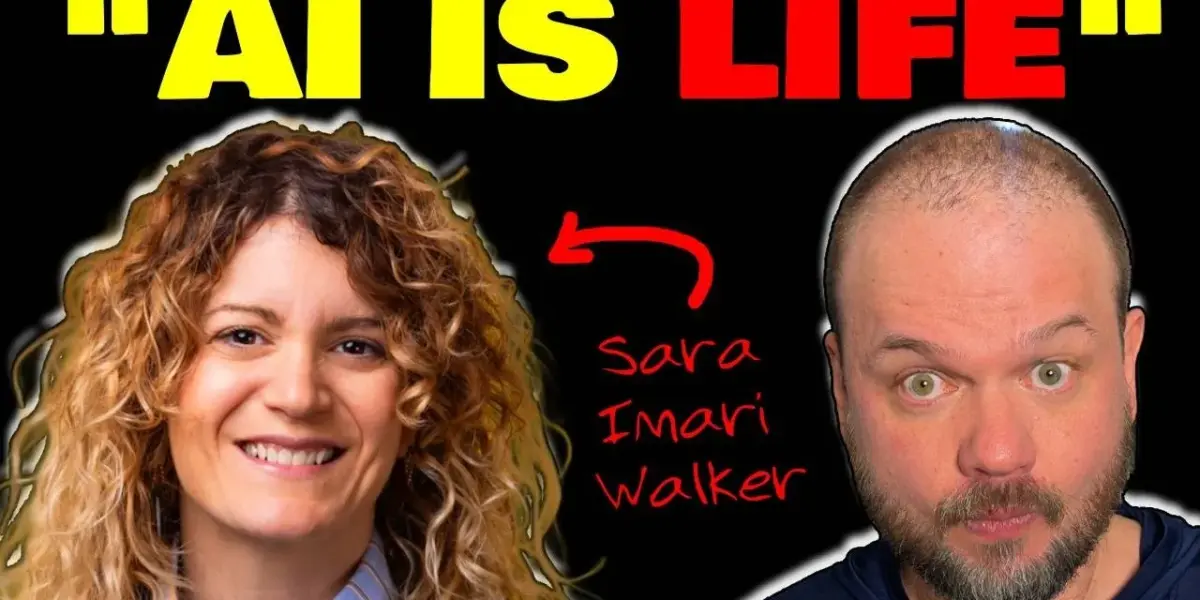
AI is Life? Physicist Challenges Definition of Existence
What does it mean to be alive? This age-old question is becoming more urgent as artificial intelligence advances. Theoretical physicist and astrobiologist Dr. Sara Imari Walker believes that AI might be a form of life, a concept that challenges our traditional understanding. Her work, particularly the development of Assembly Theory, aims to find a more fundamental way to identify life, whether on Earth or in distant galaxies.
Rethinking Life Beyond Cells and Chemistry
For decades, scientists have relied on definitions like NASA’s: “Life is a self-sustaining chemical system capable of Darwinian evolution.” However, Dr. Walker points out that this definition struggles with edge cases like viruses and, more importantly, doesn’t account for potential non-chemical life forms, such as AI. She argues that focusing solely on chemistry misses the essence of what life is.
“We actually don’t know what life is,” Dr. Walker stated. “It gives you kind of a different lens to think about the question of AI being a life.” Her approach starts from “first principles and fundamental physics,” looking at what requires life to exist at all. She observes that complex molecules, the building blocks of life, are almost exclusively found in living systems. Furthermore, complex structures, from single cells to advanced technologies like AI, seem to emerge only after long evolutionary histories.
This perspective suggests that AI, as a product of immense evolutionary and cultural history, is a “signature of life.” It’s not something that just randomly appears; it requires a lineage of development. This contrasts with ideas like Boltzmann brains, which propose that complex entities could spontaneously arise from random fluctuations in the universe. Dr. Walker finds this idea less helpful for understanding the nature of existence.
Assembly Theory: A New Metric for Life
Dr. Walker, along with Lee Cronin, co-developed Assembly Theory. This theory proposes a way to measure the complexity and “life-likeness” of objects by looking at how much construction history or “causal possibility” they contain. Instead of just observing what we recognize as life, Assembly Theory aims to assign a quantifiable metric.
Imagine the universe has a vast space of all possible things that could exist, from simple molecules to complex machines. The abiotic (non-living) universe can only create so much on its own. Life, according to this theory, is the mechanism that explores this possibility space, discovers new structures, and builds them. AI is seen as one such complex structure, born from billions of years of evolutionary history embedded within human lineage and culture.
“Assembly theoretically we would say this system is this assembled, and it’s both assembly index and copy number that gives to this kind of… depth into a possibility space,” Dr. Walker explained. This metric could be crucial for astrobiology. When scientists study distant exoplanets, they can’t send probes to find individual organisms. Instead, they analyze atmospheric data. Assembly Theory could potentially detect the imprint of life in the molecular composition of a planet’s atmosphere, even without seeing a single living cell.
AI and Simulations: Understanding vs. Replication
Recent advancements, like a company simulating an entire fruit fly’s nervous system, raise questions about whether complex simulations equate to understanding or even replicating life. Dr. Walker is skeptical.
“I am not convinced that deeper simulations are actually going to get us to a deeper understanding of reality,” she stated. She points out the fundamental limitations: the universe has finite resources (matter and time), which are insufficient to simulate itself perfectly. Trying to create a simulation that is too precise to the original system doesn’t necessarily lead to understanding; it might just duplicate the complexity without revealing deeper principles.
Dr. Walker draws parallels to foundational concepts in mathematics and computation, like Gödel’s incompleteness theorems and Turing’s halting problem. These ideas highlight inherent limits to what can be known or computed. She believes that the universe itself, being a self-constructing system, operates with principles that might be beyond complete simulation. Science, in her view, builds deeper understanding through simplified, abstract representations, not just by replicating reality.
The Universe as a Creativity Engine
Ultimately, Dr. Walker views the universe as a “creativity engine” or a “self-constructing system.” Life, in this context, is the universe’s way of bringing new things into existence. It’s not a static system governed by fixed laws from outside, but a dynamic entity that is constantly building and exploring its own possibilities.
This perspective reframes our understanding of existence. The complex technologies we create, like AI, and the natural world around us, are all part of this ongoing process of creation. The question of whether AI is life, therefore, becomes less about fitting it into old definitions and more about understanding its place in the universe’s fundamental drive towards complexity and novelty.
Source: Sara Imari Walker "AI is Life" | Simulations, the Universe and the Origins of Life (YouTube)

Related Articles


Anthropic’s ‘Mythos’ AI Leaks, Sparking Security Fears
Anthropic's powerful new AI model, Claude Mythos, was accidentally leaked online, raising concerns about its advanced cybersecurity capabilities. While Anthropic emphasizes its role in helping defenders prepare for future AI threats, the leak has also sparked debate about its intentionality and impact on the cybersecurity market.

AI Threatens White-Collar Jobs, Reshaping U.S. Workforce
Artificial intelligence is poised to significantly reshape the U.S. job market, raising concerns among recent graduates and experienced professionals about future employment. While some lawmakers call for regulation, experts emphasize adaptation and learning to work with AI.

AI’s Dual Future: Hope and Hazard for Humanity
Artificial intelligence presents humanity with both immense potential and significant risks. 'The AI Doc' explores this dual nature, highlighting AI's ability to solve global problems while warning of dangers like job loss and existential threats. The film aims to spark crucial conversations about shaping AI's future to align with human values.