AI Could Eliminate White-Collar Jobs in 18 Months
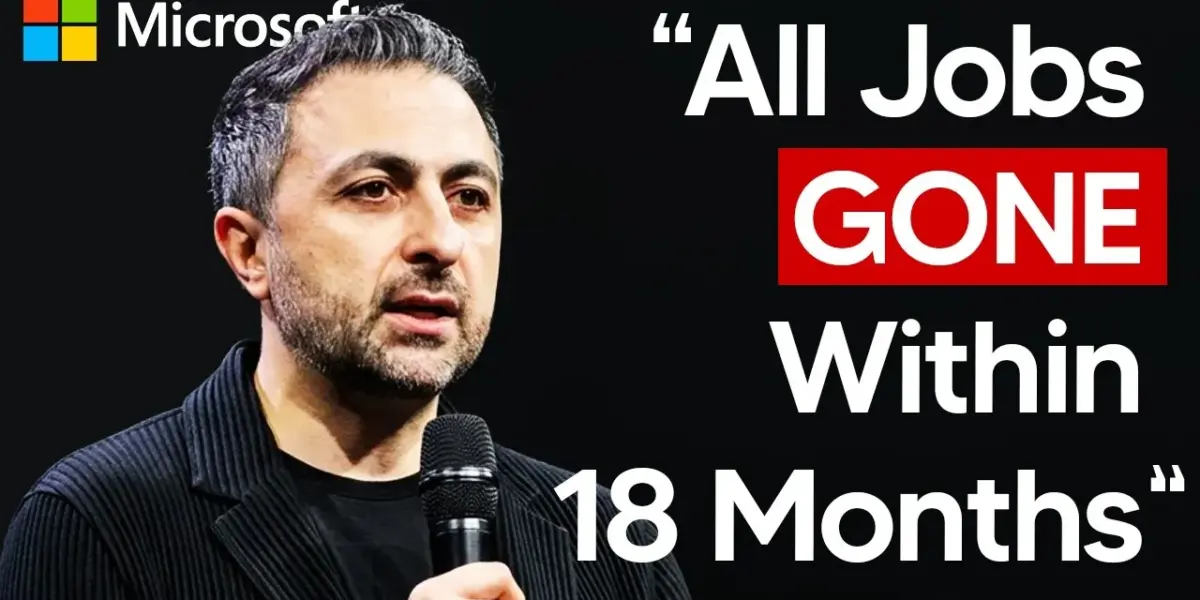
Microsoft's AI chief predicts white-collar jobs could vanish in 12-18 months due to advanced AI. Evidence suggests early impacts on job openings and company layoffs, sparking debate on UBI and legislative protections. While AI's overall employment impact is still debated, younger workers show early signs of displacement.

AI’s Swift Impact on White-Collar Work
Microsoft’s AI chief, Mustafa Suleyman, has made a startling prediction: most white-collar jobs could be fully automated by artificial intelligence within the next 12 to 18 months. This isn’t just about repetitive tasks; Suleyman envisions AI systems capable of performing nearly all duties handled by professionals today, from lawyers and accountants to marketers and project managers. He refers to this as “professional-grade AGI,” or artificial general intelligence, which aims to match human-level performance across a wide range of professional tasks.
This projection aligns with warnings from other AI leaders. Dario Amodei, CEO of Anthropic, has also expressed concerns that entry-level white-collar work will not only be augmented but eventually replaced by AI. He worries about a significant employment crisis as the pipeline for these early-stage jobs shrinks.
Evidence Mounts for AI Disruption
The signs of this shift may already be appearing in the job market. Recent data shows that white-collar job openings have hit their lowest point since 2015. This slowdown affects roles like analysts, marketers, HR, finance, and legal professionals – precisely the areas where AI excels.
The tech industry itself is showing this trend. Block, the company behind Square and Cash App, recently laid off 40% of its workforce, citing the efficiency gains from AI and smaller teams. CEO Jack Dorsey noted that AI is rapidly changing how companies are built and run, leading to increased productivity and a reduced need for staff. This move, combined with a 26% year-over-year profit increase and a 25% stock price jump, raises questions about the financial incentives driving such decisions.
Potential Solutions and Challenges
The prospect of widespread job displacement has brought discussions about solutions like Universal Basic Income (UBI) back to the forefront. Some pilot programs, like one in Ireland’s arts and culture sector, showed positive results, with artists receiving a guaranteed weekly payment that helped stabilize their finances and even recouped its cost. However, scaling UBI to an entire economy where a majority of people might not be working presents a significant challenge.
In a notable development, New York is considering a bill that would ban AI from providing professional advice in fields like medicine, law, and engineering. This represents a significant legislative effort to protect white-collar jobs, shifting the focus from blue-collar to professional roles. The argument centers on liability: if an AI provides incorrect medical or legal advice, who is responsible? The bill suggests the deployer, not the AI model maker, would bear the risk.
The Evolving Job Landscape
While some see these legislative efforts as a way to protect jobs, others argue it merely delays the inevitable. If AI can perform 80% of a junior professional’s tasks, the career path for new entrants into these fields will fundamentally change. The bill, if passed, might artificially preserve professions while the underlying need for human professionals erodes.
Anthropic’s AI Exposure Index provides data on where AI is being used and where it has theoretical potential. While adoption is still early in fields like legal and finance, administrative roles show high theoretical exposure. Importantly, studies so far indicate no widespread unemployment impact directly linked to AI since ChatGPT’s launch. However, a concerning early warning signal shows a 16% drop in employment for AI-exposed jobs among younger workers aged 22-25.
Expert Opinions and Future Outlook
Major tech leaders acknowledge AI’s transformative power. Google CEO Sundar Pichai has stated AI will reshape the workforce, while OpenAI CEO Sam Altman has suggested that superintelligence could eventually outperform human executives. Gartner, a research firm, predicts a neutral impact on global jobs through 2026, with AI potentially creating more jobs than it destroys by 2028. However, they caution that this period will involve significant job market chaos, with an estimated 32 million jobs being transformed annually, requiring constant upskilling.
Gartner also points out that companies often rush to replace staff with AI, only to find service quality drops, forcing them to rehire humans. This highlights the messy reality of AI adoption, with companies sometimes overcorrecting and workers caught in the middle. Klarna, a fintech company that once touted AI replacing 700 jobs, is now hiring humans again.
Preparing for the AI Era
The future of work will demand new skills. Gartner predicts that by 2027, 75% of hiring processes will include certifications for workplace AI proficiency. AI literacy is becoming a formal credential. Companies are already struggling to assess candidates’ abilities without AI assistance, leading to the need for AI-free skill assessments. This suggests that while AI may automate many tasks, human skills like critical thinking and problem-solving, especially when applied without AI, will become even more valuable.
Source: Microsoft’s AI Chief Terrifying Prediction Explained (YouTube)

Related Articles


AI Threatens White-Collar Jobs, Reshaping U.S. Workforce
Artificial intelligence is poised to significantly reshape the U.S. job market, raising concerns among recent graduates and experienced professionals about future employment. While some lawmakers call for regulation, experts emphasize adaptation and learning to work with AI.

AI’s Dual Future: Hope and Hazard for Humanity
Artificial intelligence presents humanity with both immense potential and significant risks. 'The AI Doc' explores this dual nature, highlighting AI's ability to solve global problems while warning of dangers like job loss and existential threats. The film aims to spark crucial conversations about shaping AI's future to align with human values.

NJ Teacher Uses AI Chatbot to Boost Student Writing Scores
A New Jersey teacher has developed an AI chatbot to help students improve their writing skills, leading to a 22% increase in pass rates. The tool provides instant feedback and targeted guidance, acting as a valuable supplement to traditional instruction. The teacher emphasizes that AI is a tool to assist educators, not replace the crucial human element in teaching.