AI Bots Now Conduct Job Interviews: A Review
AI bots are conducting job interviews, promising efficiency and reduced bias. My experience with platforms like Humanly, CodeSignal, and Eightfold reveals a mixed bag of advanced technology and deep ethical concerns about bias and transparency.


AI Takes the Interview Seat: A New Frontier in Hiring
The job search landscape is rapidly evolving, and the latest advancement is as unsettling as it is inevitable: Artificial Intelligence is now conducting job interviews. Companies like Meta, Netflix, MasterCard, and Domino’s are integrating AI interviewers into their initial screening processes, aiming to engage with a larger pool of applicants than human recruiters can manage. While the promise is efficiency and potentially reduced bias, my firsthand experience reveals a complex reality that is both impressive and deeply concerning.
The Rise of the AI Interviewer
The core value proposition from creators of these AI tools is scalability. “Most of our customers are unable to get humans out to about 95% of applicants,” one representative explained. The hope is that by having an AI screen virtually everyone, companies can identify the most promising candidates more effectively. Furthermore, proponents claim these AI systems operate with less bias, as they are emotionless and objective. However, this claim hinges on the AI itself being free from inherent biases.
My Experience: Humanly, CodeSignal, and Eightfold
AI interviews typically manifest as one-on-one video calls with an AI agent. I tested three platforms: Humanly, CodeSignal, and Eightfold.
Humanly: The Uncanny Valley
Humanly featured a fully rendered AI avatar designed to resemble a human. While the AI asked pertinent questions and facilitated a decent back-and-forth, the avatar’s appearance veered into the uncanny valley, proving distracting. “Compared to the other tools I tried, Humanly’s AI avatar asked pretty good questions and we had an okay back and forth, but the appearance of the avatar itself was approaching the uncanny valley for me. It could be pretty distracting,” I noted. Humanly claims its AI encourages longer responses, averaging “about 200 words per response to the avatar, which is more than a human doing a phone screen.”
CodeSignal: Realistic Questions, Minimal Distraction
CodeSignal offered a different approach, using a static photo of an AI avatar rather than a dynamic, animated one. This proved less distracting. “CodeSignal was the best one I tried because the interview questions were the most realistic,” I found. The AI focused on the content of the responses, not the delivery: “We do not currently look at how you said things, mostly what you said. So really focused on the words that you use to describe and answer the questions.” It even incorporated industry-specific scenarios, asking about challenging interactions with editors, which felt surprisingly natural despite the AI interface.
Eightfold: Robotic and Direct
Eightfold’s software felt the most robotic of the three. Its default setting presented a pulsating circle, which, while not visually distracting, offered a starkly impersonal experience. “Out of the three I tried, it did feel the most robotic and least human-like,” I observed. When asked about AI trends for 2026, the AI responded, “Understood. Moving on.” Eightfold emphasizes its proprietary algorithm for consistent and less biased scoring, stating, “Every candidate will uh be asked the same question, same rating score, very consistent during the interview, and it will be depending on the responses.”
The Bias Conundrum
A central tenet of AI interviewers is the reduction of human bias. However, the very foundation of these AI systems is data trained on the internet, which is inherently rife with human biases, including sexism and racism. “The reason for that is because these systems are trained on large swaths of the internet. And obviously large swaths of the internet are human-made and they contain sexism, racism, and a ton of other biases,” explains an expert. Furthermore, the decision-making processes of many AI models remain opaque “black boxes,” making it difficult to understand how or why certain decisions are made. This lack of transparency is so significant that Eightfold is currently facing a lawsuit from plaintiffs seeking greater insight into its algorithms.
Transparency and Audits
Eightfold, when contacted, stated they use applicant-submitted information and data authorized by their customers, denying the use of social media scraping. They expressed confidence in their bias mitigation, claiming no need for “course correction” in their algorithms. Both CodeSignal and Humanly reported conducting regular bias audits, often with third parties or internal industrial-organizational psychology teams, to assess how their systems perform across different demographic groups. They also highlighted their commitment to security and privacy standards like SOC2 and ISO certification.
Who Should Care and Why?
Job seekers are the primary audience here. Facing an AI interviewer means adapting your approach. Clarity, strategic use of keywords and metrics, and asking thoughtful questions at the end could be crucial. Companies considering these tools must grapple with the ethical implications of AI bias and the need for transparency. The outcome of the Eightfold lawsuit could set a significant precedent for the entire industry.
The Future of Hiring?
While the efficiency gains are undeniable, the human element of job seeking cannot be overstated. The stress of interviews, the desire to connect and convey personality, and the inherent vulnerability of seeking employment are all challenged by the prospect of conversing with a machine. “I’m apprehensive. It’s already such a tough process to apply for a job, to feel like a number in the system already, to feel nervous, to have to talk about your experience and why you’re the best fit. And I just can’t see it being easier to do all of that with an AI system on the other end rather than a human,” I concluded. Surprisingly, many companies report that some candidates actually *prefer* speaking with an AI over a human interviewer, a claim that warrants further investigation and discussion.
Specs & Key Features
- Humanly: Full AI avatar, customizable interview length and tone, claims higher candidate engagement (word count). Potential for uncanny valley effect.
- CodeSignal: Static AI avatar image, realistic question phrasing, focus on keywords and content over delivery. Less visually distracting.
- Eightfold: Minimalist interface (pulsating circle), proprietary algorithm for consistent scoring. Faces litigation over algorithmic transparency.
- Common Features: Aim to increase screening efficiency, reduce human bias (claimed), focus on candidate responses.
- Concerns: Inherent AI bias from training data, lack of transparency (‘black box’ algorithms), potential for dehumanizing the hiring process.
Availability and Pricing
Information on specific pricing for these platforms was not detailed in the transcript, but they are being adopted by major corporations, suggesting enterprise-level solutions.
Source: AI bots are now conducting job interviews. I tried it (YouTube)

Related Articles

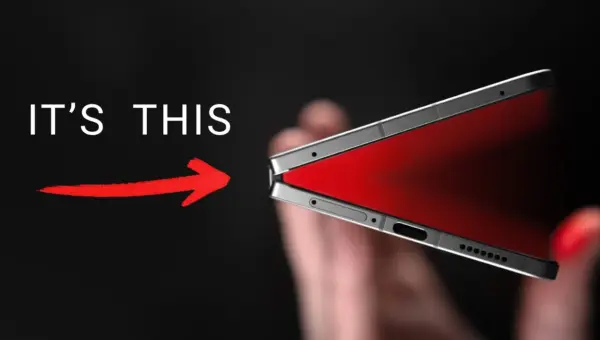
OPPO’s Secret Hinge Tech Erases Foldable Crease Woes
OPPO's Find N6 introduces a revolutionary 'zero feel' crease, utilizing advanced 3D printing on its titanium hinge and innovative screen technology to eliminate a major flaw in foldable phones. With a 1 million fold rating and triple IP certification, it sets a new industry standard for durability and user experience.

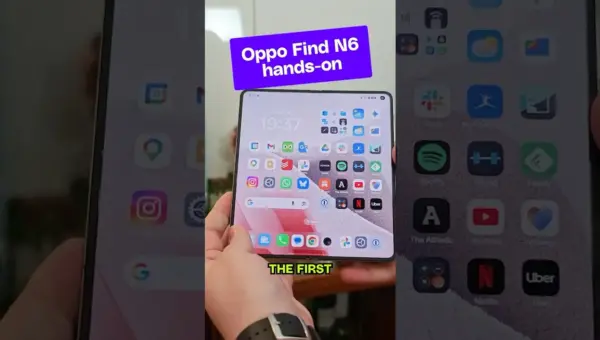
Oppo Find N6 Arrives: The Creaseless Foldable Dream?
Oppo's Find N6 foldable is set to launch March 17th, boasting a "zero-field crease" technology that promises the shallowest crease on a foldable yet. Early impressions show a remarkably minimal crease, making it a strong contender in the foldable market.

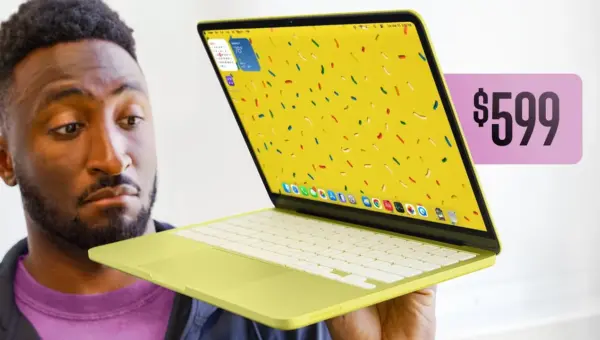
MacBook Neo Stuns: Apple’s Disruptive $499 Laptop?
Apple's new MacBook Neo, starting at $599, is a game-changer. Featuring iPhone-grade performance and a premium build, it challenges the entry-level laptop market and offers incredible value for students, writers, and casual users.