AI Achieves Hyper-Realistic Digital Humans
A new AI technique uses Gaussian splatting and Zonal Harmonics to create hyper-realistic digital humans, accurately simulating light interaction with skin and hair. While current capture methods are expensive, future advancements promise widespread accessibility.

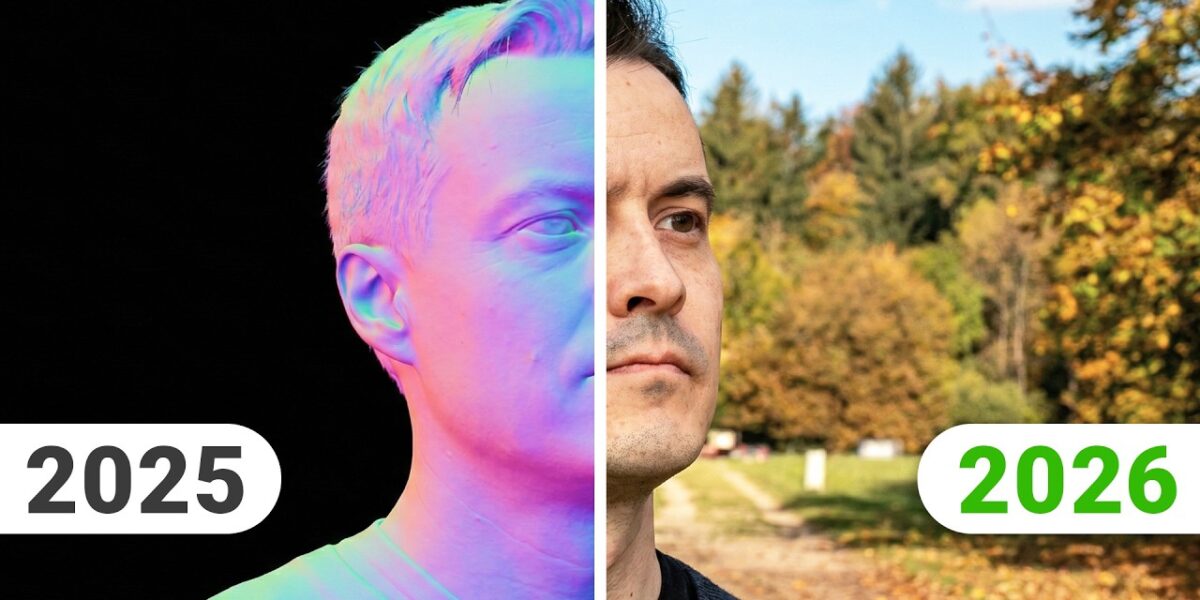
AI Breakthrough Creates Uncannily Lifelike Digital Avatars
For decades, the pursuit of realistic digital humans in video games and virtual environments has been a central challenge for computer graphics. Characters often fell into the “plastic doll” uncanny valley, with artificial-looking skin and hair that failed to mimic the complexities of real-world light interaction. Now, a new research paper introduces a groundbreaking technique that promises to bridge this gap, generating virtual avatars so lifelike they can fool the human brain.
The Magic of Subsurface Scattering and Gaussian Splatting
The core of this innovation lies in its ability to accurately simulate subsurface scattering, a phenomenon where light penetrates surfaces like skin, bounces around internally, and emerges elsewhere. This effect is crucial for achieving natural-looking skin tones but is notoriously difficult to compute. The new method leverages a technique called Gaussian splatting, which represents scenes not with traditional triangles but with millions of tiny, elliptical 3D bumps, or Gaussians.
Unlike rigid meshes, these Gaussians can overlap and possess varying transparencies, allowing them to capture fuzzy details and complex structures like hair with unprecedented fidelity. This approach enables the avatars to react dynamically to light, their appearance changing realistically based on the environment and light sources, whether it’s a simple point light or a full scene illumination.
Rendering Realistic Hair and Skin
The results showcased are striking. The virtual hair, a notoriously difficult element to render realistically, appears incredibly lifelike, often indistinguishable from real hair to the naked eye. This is achieved through the advanced representation capabilities of Gaussian splatting, which can handle the intricate details and light interactions of individual strands.
For skin rendering, the researchers moved beyond traditional methods that treat skin like a flat surface. Instead, their Gaussians are equipped with sophisticated light sensors. These sensors detect incoming light and determine how much glow to emit in various directions, effectively simulating the translucency of real skin. Early attempts at this involved complex calculations akin to “disco balls” with many mirrors, leading to a cubic computational complexity. The new paper introduces a significant optimization called Zonal Harmonics, which simplifies this by using a fixed number of “laser pointers” instead of numerous mirrors. This drastically reduces the computational load, making the complex simulation of light scattering on skin far more manageable.
Neural Networks for Shadows
To further enhance realism, the technique incorporates a convolutional neural network to handle shadow rendering. This neural network analyzes the avatar’s pose to accurately predict where shadows should fall, adding another layer of depth and believability to the digital representation. While convolutional neural networks are an established technology, their application here is optimized for speed and low memory usage, proving effective in conjunction with the novel rendering techniques.
The “Bad News” and Future Potential
While the visual results are astonishing, there is a significant hurdle for widespread adoption: data capture. The current system requires a room-sized dome equipped with 500 high-resolution cameras and a thousand controllable lights. This sophisticated setup is estimated to cost hundreds of thousands, potentially up to a million dollars, not including the substantial computing power needed to process the vast amounts of data.
However, the researchers emphasize that this is typical for pioneering research. The initial goal is to prove the concept is possible. Subsequent research phases aim to optimize the process, making it faster and more affordable. The “First Law of Papers,” as alluded to in the research discussion, suggests that with a few more advancements, similar quality could eventually be achievable using everyday devices like smartphone cameras.
Why This Matters
This breakthrough has profound implications across various industries. In gaming, it promises a new era of immersive experiences with characters that feel truly alive. For virtual and augmented reality, it could enable hyper-realistic digital twins for social interactions, training simulations, and remote collaboration. The film and animation industries could see accelerated workflows for creating digital actors and special effects. As the technology matures and becomes more accessible, we can expect to see “Hollywood-quality” digital humans integrated into our daily digital lives, blurring the lines between the real and the virtual in ways previously confined to science fiction.
Source: This Broke My Brain – These Humans Aren’t Real (YouTube)

Related Articles


AI’s Economic Shift: Ownership is the New Wage
Artificial intelligence is projected to significantly reduce the economic value of human labor within a decade. Experts suggest that capital ownership, rather than wages, will become the primary means of wealth accumulation. Investors are urged to consider this shift in their long-term strategies.

Germany’s Fake Laws: AI Disinformation Campaign Exposed
Viral AI-generated videos falsely claim Germany has enacted absurd laws, including fines for flushing toilet paper. Experts reveal a disinformation campaign aiming to portray Germany as chaotic, with potential commercial or political motives behind the fabricated content.

Google’s Reddit Deal Fuels Marketer Shift
Google's exclusive data access deal with Reddit, reportedly worth hundreds of millions, is transforming search results by prioritizing authentic user discussions. This strategic move positions Reddit content at the forefront of Google searches and AI answers, creating new opportunities and challenges for marketers.