A Tale of Two Safety Nets: Germany vs. USA in Social Welfare
A recent comparison highlights the stark differences between Germany and the United States' social safety nets, revealing Germany's emphasis on universal security through robust healthcare, parental leave, and education, versus the U.S.'s focus on individual mobility and private solutions. The data underscores divergent philosophies in how these nations support their citizens, with significant implications for daily life and economic stability.

A Tale of Two Safety Nets: Germany vs. USA in Social Welfare
In an increasingly interconnected world, the comparison of social safety nets across developed nations offers profound insights into differing societal values and economic philosophies. A recent presentation highlighting the stark contrasts between Germany and the United States in areas ranging from healthcare to housing security has ignited discussions on the efficacy of market-driven approaches versus universal welfare provisions. The data reveals not just numerical differences but fundamentally divergent paths in how these two economic powerhouses prioritize the well-being and security of their citizens.
At its core, the comparison underscores a philosophical chasm: Germany, with its robust social market economy, tends to prioritize a universal floor of security for all its citizens, ensuring basic needs are met regardless of income or circumstance. In stark contrast, the United States, largely rooted in a liberal market economy, emphasizes individual upward mobility and relies heavily on private solutions, often leaving significant gaps in its social safety net. This examination delves into the specifics of these systems, exploring the implications for everyday life, economic stability, and the overall social fabric of each nation.
Healthcare: Disparate Spending, Divergent Outcomes
Perhaps no area illustrates the divergence between Germany and the U.S. more vividly than healthcare. The figures presented paint a striking picture: the United States spends an astounding $12,555 per capita annually on healthcare, yet struggles to provide universal access to its population. Germany, on the other hand, manages to offer universal access to its citizens while spending significantly less, at approximately $7,383 per person per year. This disparity immediately raises questions about efficiency, priorities, and the very nature of healthcare provision.
The commentator’s observation regarding the ‘free market’ not working as intended in healthcare resonates deeply with critics of the American system. The foundational premise of a competitive market is that it drives down costs through consumer choice and provider competition. However, in emergency medical situations, individuals are often in no position to compare prices or negotiate services. When facing a life-threatening injury, the immediate need for care overrides any market-based decision-making, effectively negating the theoretical benefits of competition. This unique characteristic of healthcare, where demand is often non-discretionary and urgent, challenges the applicability of pure free-market principles.
The U.S. healthcare system is a complex tapestry of private insurance, employer-sponsored plans, and government programs like Medicare and Medicaid, yet millions remain uninsured or underinsured. High deductibles, co-pays, and out-of-network charges contribute to medical debt being a leading cause of personal bankruptcy. The system’s emphasis on private insurance means that access to care is often tied to employment, leaving vulnerable populations at risk. Furthermore, the administrative overhead associated with managing a multitude of private insurers is significantly higher than in single-payer or multi-payer universal systems, contributing to inflated costs without necessarily improving outcomes.
Germany, by contrast, operates a multi-payer universal healthcare system, often referred to as a ‘social health insurance’ model. Most citizens are covered by statutory health insurance (Sickness Funds), which are non-profit entities funded by mandatory contributions from employees and employers. A smaller percentage of high-income earners can opt for private insurance. This system ensures universal access, comprehensive benefits, and significant cost controls through collective bargaining with providers and pharmaceutical companies. While patients have choice among providers and sickness funds, the underlying principle is one of solidarity, where contributions are based on income, and access to care is based on need, not ability to pay. This approach demonstrates that universal access does not necessarily equate to higher costs, but rather to a more equitable and potentially more efficient allocation of resources.
Nurturing Families: Parental Leave and Child Support
The support systems for new parents and families also highlight a vast ideological divide, with Germany offering substantially more robust provisions than the U.S.
Germany’s Comprehensive Parental Support
Germany provides up to 14 months of paid parental leave at 65% of salary, a benefit available to both mothers and fathers. This comprehensive policy allows parents to share the responsibility of childcare and maintain their careers. Beyond the initial paid leave, fathers are entitled to up to three years of unpaid, job-protected parental leave per child, which can be taken until the child’s eighth birthday. While the commentator expressed surprise at the length of this unpaid leave, noting that few might take the full three years, it nonetheless signifies a powerful legal protection for parental roles. Furthermore, there are ongoing efforts to introduce a mandatory 10-day paid leave for the second parent (typically the father), indicating a continuous evolution towards greater inclusivity and support for shared parenting responsibilities. Many German fathers do indeed take a couple of months off, utilizing a portion of the federally funded paid family leave, known as Elterngeld.
The American Parental Leave Landscape
In stark contrast, the United States stands alone among advanced economies with zero weeks of mandated paid parental leave at the federal level. The Family and Medical Leave Act (FMLA) is the primary federal law, graciously (as the commentator sarcastically notes) granting eligible workers up to 12 weeks of *unpaid*, job-protected leave for family or medical reasons. While FMLA ensures job security, the lack of pay often makes it financially unfeasible for many families, particularly those in low-wage jobs, to take the full duration. The transcript highlights the harsh reality for workers in sectors like retail, where not only are wages often low, but paid time off for childbirth is non-existent, creating immense financial strain during a critical life event.
For those in higher-paying jobs, some employers might offer three months of paid leave, typically at around 65% of salary, mirroring Germany’s paid leave percentage but for a much shorter duration. American fathers often resort to using their limited vacation days (typically two weeks per year) as paternity leave, sacrificing their own rest and recuperation time. This piecemeal approach to parental leave in the U.S. reflects a societal and policy gap that impacts child development, maternal health, workforce participation, and gender equality. Studies consistently show that paid parental leave leads to better health outcomes for mothers and children, increased female labor force participation, and reduced gender wage gaps.
Direct Aid vs. Tax Credits: Supporting Children
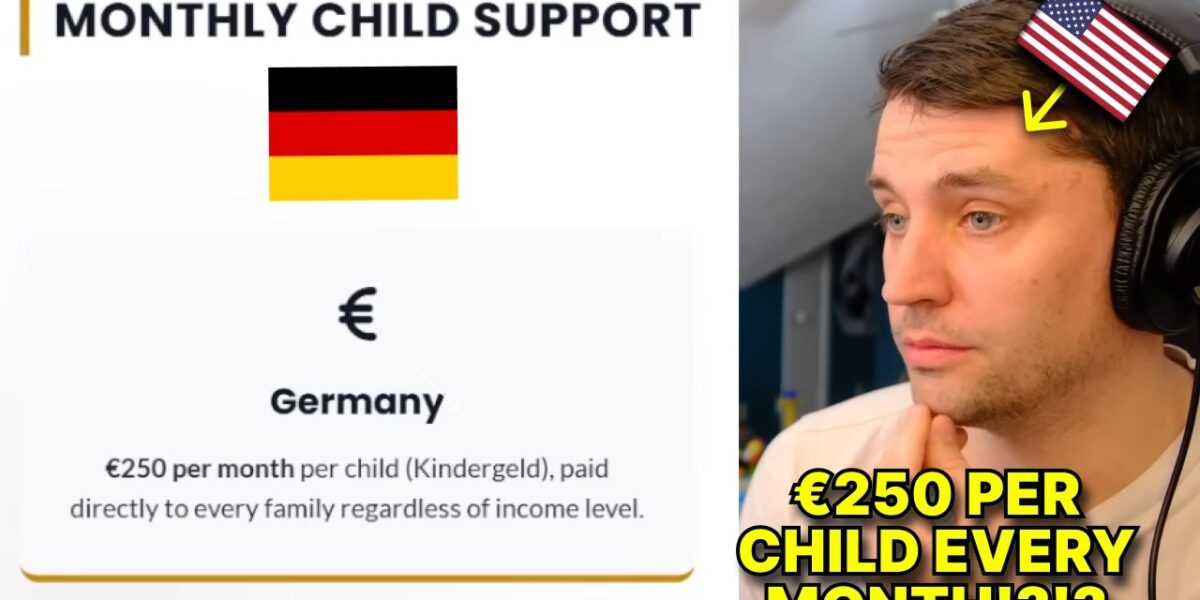
The approach to direct financial support for children also varies significantly. Germany provides a monthly child benefit (Kindergeld) of €250 (approximately $300 USD) per child, regardless of the parents’ income level. This direct, consistent payment offers tangible support to families, helping to offset the considerable costs of raising children.
The U.S. utilizes a Child Tax Credit, which, while offering up to $1,700 per child as a refund (even for those with no tax liability), is disbursed annually or as a tax reduction. The commentator aptly points out that while it is a form of financial aid, it feels less ‘tangible’ than a monthly direct deposit. An annual lump sum or tax reduction, equating to roughly $140 per month, provides less immediate and consistent relief compared to Germany’s system. The discussion also touches upon the broader societal need for increasing birth rates to support future social security systems and elderly care, framing child benefits as an investment in the nation’s demographic future. The high cost of raising children in the U.S. combined with insufficient financial support contributes to declining birth rates and exacerbates child poverty, further highlighting the urgency of robust family-friendly policies.
Investing in the Future: Education and Worker Protections
Access to education and fundamental worker rights represent further areas of divergence, shaping opportunities and economic security for citizens in both countries.
The Cost of Knowledge: University Tuition
Higher education in Germany operates under a philosophy that views knowledge as a public good, not a commodity. Consequently, public university tuition is effectively zero, making higher education accessible to all qualified students regardless of their socioeconomic background. This policy ensures that financial barriers do not impede intellectual development or career aspirations.
In stark contrast, the average public university tuition in the United States stands at $10,940 per year. While in-state tuition is often half this amount, attending an out-of-state university can double the cost. The commentator notes that this average might be skewed downwards by the inclusion of community colleges, with larger universities often costing significantly more. The rising cost of higher education in the U.S. has led to a national student debt crisis, with millions of graduates burdened by substantial loans. This debt often delays major life milestones such as homeownership, marriage, and starting families, and has broader implications for economic growth and social mobility. The disparity in tuition costs reflects fundamentally different national investments in human capital and the long-term economic well-being of their populations.
Time Off: Vacation and Unemployment Benefits
Worker protections, particularly regarding paid time off, also underscore the differing approaches. Germany legally mandates a minimum of 20 days of paid vacation per year, with 30 days being the common standard. This generous allowance promotes work-life balance, reduces burnout, and contributes to overall employee well-being and productivity. The U.S., uniquely among advanced economies, mandates zero days of paid vacation. While the standard practice is for employees to accrue around 14 days annually, even in jobs like retail, this is not legally required and can vary significantly based on employer policy and tenure. The lack of mandatory paid leave can lead to overworked employees, lower morale, and a less competitive workforce.
Regarding unemployment benefits, Germany typically provides benefits for 12 months (longer for older workers) at 60-67% of net income. This extended duration offers a substantial safety net, allowing individuals adequate time to find suitable re-employment without facing immediate financial ruin. The U.S. provides unemployment benefits for 26 weeks (approximately 6-7 months). While the commentator found this duration ‘reasonable,’ it is significantly shorter than Germany’s and can be insufficient in prolonged economic downturns or for individuals in specialized fields requiring longer job searches. The discussion also touches upon the complexities and potential for abuse within welfare systems, particularly referencing the unique circumstances of the COVID-19 pandemic where some individuals temporarily received more in unemployment benefits than their previous wages. This highlights a constant tension in social policy: designing systems that provide adequate support without disincentivizing work, a challenge both nations grapple with, albeit with different primary durations.
Securing Later Life: Retirement and Financial Fresh Starts
Retirement security and the path to financial recovery after bankruptcy are critical components of a social safety net, providing peace of mind and avenues for second chances.
Retirement Security: A Percentage Game
The pension replacement rate, which measures the percentage of pre-retirement income replaced by retirement benefits, reveals another disparity. Germany’s net replacement rate is approximately 53%, while the U.S. Social Security system replaces about 39% of the average worker’s earnings. While this difference might not seem ‘huge’ at first glance, as the commentator notes, it represents a significant portion of income that retirees must adjust to. The commentator also astutely points out that if the average salary in the U.S. is higher than in Germany, the nominal amount received by pensioners might be similar, but the *relative* reduction in income for U.S. seniors is more substantial. This necessitates a greater reliance on personal savings, 401(k)s, and other private retirement vehicles in the U.S. Many older Americans also possess significant home equity, which can serve as a substantial asset in retirement, though it is not liquid cash. This contrasts with Germany’s more robust public pension system, which forms a larger part of a retiree’s income, offering a more predictable and secure retirement floor.
The challenges to Social Security in the U.S. are well-documented, with ongoing debates about its long-term solvency due to demographic shifts. Germany’s system, while also facing demographic pressures, is structured with a greater emphasis on intergenerational solidarity and a more comprehensive approach to funding, often including a broader range of contributions and adjustments. The higher replacement rate signifies a greater societal commitment to maintaining a certain standard of living for its elderly population, reducing the burden on individual savings and the potential for poverty in old age.
The Paths to Financial Recovery: Bankruptcy
In the realm of personal bankruptcy, the U.S. actually offers a quicker path to a ‘fresh start’ compared to Germany. In the U.S., the typical duration for a personal bankruptcy discharge is four to six months. This relatively swift process is designed to allow individuals to shed overwhelming debt and re-enter the economy. The philosophy is geared towards debtor protection and facilitating entrepreneurship, allowing individuals to take risks with the knowledge that a safety net exists if a venture fails. However, as the commentator correctly points out, this ‘fresh start’ is often tarnished, significantly impacting credit scores and requiring the liquidation of assets, especially if personal guarantees were made on loans.
Germany’s bankruptcy process, in contrast, typically takes three years. This longer duration reflects a core philosophy centered more on creditor repayment. While it ultimately offers a path to debt relief, the extended period means debtors remain under financial scrutiny for a longer time, potentially impacting their ability to rebuild their lives and take new financial risks. This difference highlights a fundamental tension in economic policy: balancing the interests of debtors who need a second chance against the rights of creditors to recover their losses. The U.S. system, for all its flaws, does provide a relatively swift mechanism for individuals to clear their slate, which can be seen as a strength in fostering a dynamic, risk-taking economy.
Shelter and Stability: Housing Security
Housing security is another crucial aspect of a social safety net, determining not just physical shelter but also community stability and economic well-being.
Renters’ Rights vs. Market Forces
Germany is characterized by strong renters’ rights, featuring indefinite contracts and rent increase caps as the norm. This regulatory environment provides significant stability for tenants, protecting them from arbitrary evictions and sudden, unaffordable rent hikes. Such policies contribute to lower eviction rates and foster long-term community ties, as residents are less frequently displaced.
The U.S., conversely, operates a largely market-driven housing system, which, while offering higher mobility for some, also results in significantly higher eviction rates. The commentator acknowledges the common perception that evictions primarily occur due to non-payment of rent, and while this is often true, the market-driven nature means that tenants have fewer protections against rising costs or landlord decisions. The discussion also touches on the flip side: landlords in the U.S. can face challenges with non-paying tenants, sometimes being legally obligated to house them for a period even without rent payment. This highlights a complex balance between tenant protections and landlord rights, a balance that the U.S. system, with its emphasis on market forces, often tilts towards less security for renters.
The lack of robust rent control and tenant protections in many U.S. jurisdictions exacerbates housing insecurity, particularly for low-income individuals and families. High eviction rates are linked to numerous negative outcomes, including job loss, educational disruption for children, and increased homelessness. Germany’s approach reflects a view of housing as a fundamental right, where stability and affordability are prioritized through regulation, leading to a more secure living environment for a larger segment of its population.
Underlying Philosophies: Universal Security vs. Individual Opportunity
The bottom line, as articulated in the presentation, encapsulates the core philosophical distinction: Germany prioritizes a universal floor of security, while the U.S. champions individual upward mobility and private solutions. This stark contrast is not merely academic; it translates into tangible differences in the daily lives and long-term prospects of citizens in each country.
Germany’s social market economy, a blend of capitalism and social welfare, is built on the principles of solidarity and social justice. Its robust safety net ensures that basic needs — healthcare, education, parental support, retirement, and housing stability — are largely met, reducing the individual burden of risk and providing a foundation upon which citizens can build their lives. This approach is often seen as fostering greater social cohesion and reducing income inequality, but it comes with higher tax burdens and more extensive government regulation.
The U.S. model, often described as a liberal market economy, emphasizes individual responsibility, competition, and limited government intervention. The belief is that a dynamic, less regulated market fosters innovation and provides ample opportunities for individuals to achieve success through their own efforts. While this system can lead to significant wealth creation and individual achievement, it also generates greater income inequality and leaves many vulnerable to economic shocks, as the safety net is often fragmented and reliant on private provisions or means-tested programs.
The Cost of Compassion
The commentator rightly notes that Germany’s superior safety net ‘needs to be paid for with real resources.’ Indeed, the comprehensive nature of Germany’s welfare state is funded through higher taxes, particularly social contributions from both employers and employees. These collective contributions fund the sickness funds, pension insurance, unemployment insurance, and long-term care insurance, creating a system where social risk is pooled across the population. In exchange for these contributions, citizens receive a high degree of social protection and peace of mind.
The U.S., with its lower overall tax burden compared to many European nations, places more responsibility on individuals to secure their own healthcare, retirement, and other social needs through private means. This can be a strength for those with high incomes and access to robust employer benefits, but it creates significant vulnerabilities for lower-income individuals, those in precarious employment, or those facing unexpected life events. The trade-off is often between perceived economic dynamism and broad social equity.
Conclusion
The comparison between Germany and the United States’ social safety nets is not merely an exercise in data collection; it is a profound reflection on national priorities and the role of government in its citizens’ lives. Germany’s model champions a collective responsibility to ensure a baseline of security and opportunity for all, from cradle to grave. Its comprehensive systems for healthcare, parental leave, education, and retirement aim to mitigate life’s uncertainties and foster social cohesion.
The United States, while offering a unique environment for individual enterprise and a quicker path to financial recovery through bankruptcy, often leaves its citizens more exposed to the vagaries of the market. The emphasis on private solutions and individual responsibility means that opportunities and security are often tied to employment status and economic success, creating a more stratified society with significant disparities in access to essential services. Both systems have their strengths and weaknesses, but the evidence overwhelmingly suggests that Germany’s approach provides a more robust and universal safety net, offering its citizens a greater sense of security and stability throughout their lives, albeit at a higher collective cost.
Source: American reacts to Germany VS USA Social Safety net (YouTube)

Related Articles

Germany on US-Israel Strikes: No “Lecturing” Partners
Germany's Chancellor Scholz calls on Iran to end its attacks and nuclear program but refrains from "lecturing" US-Israel on international law regarding recent strikes. Berlin increases security for Jewish institutions amid fears of retaliation.


Germany’s Fake Laws: AI Disinformation Campaign Exposed
Viral AI-generated videos falsely claim Germany has enacted absurd laws, including fines for flushing toilet paper. Experts reveal a disinformation campaign aiming to portray Germany as chaotic, with potential commercial or political motives behind the fabricated content.


Middle East on Edge: Iran Retaliates Amid Regional Instability
Iran has launched retaliatory strikes against Israel and US bases in the Gulf following the reported assassination of Supreme Leader Ayatollah Ali Khamenei. The attacks have resulted in US casualties and heightened regional anxiety, with neighboring countries bracing for potential spillover effects. The escalating crisis has exposed divisions within Iran and prompted diplomatic efforts to prevent a wider conflict.