Trump Saw Iran Strike as ‘Too Good to Pass Up,’ Says Ex-Chief of Staff
Former White House Chief of Staff Mick Mulvaney revealed that the Trump administration viewed the strike on Iran not as a planned initiative, but as a unique opportunity that was "too good to pass up." He discussed the confluence of factors leading to the decision and drew parallels to past interventions, suggesting a preference for targeted actions over prolonged conflicts. The potential economic impact, particularly on oil prices, was also a key consideration.

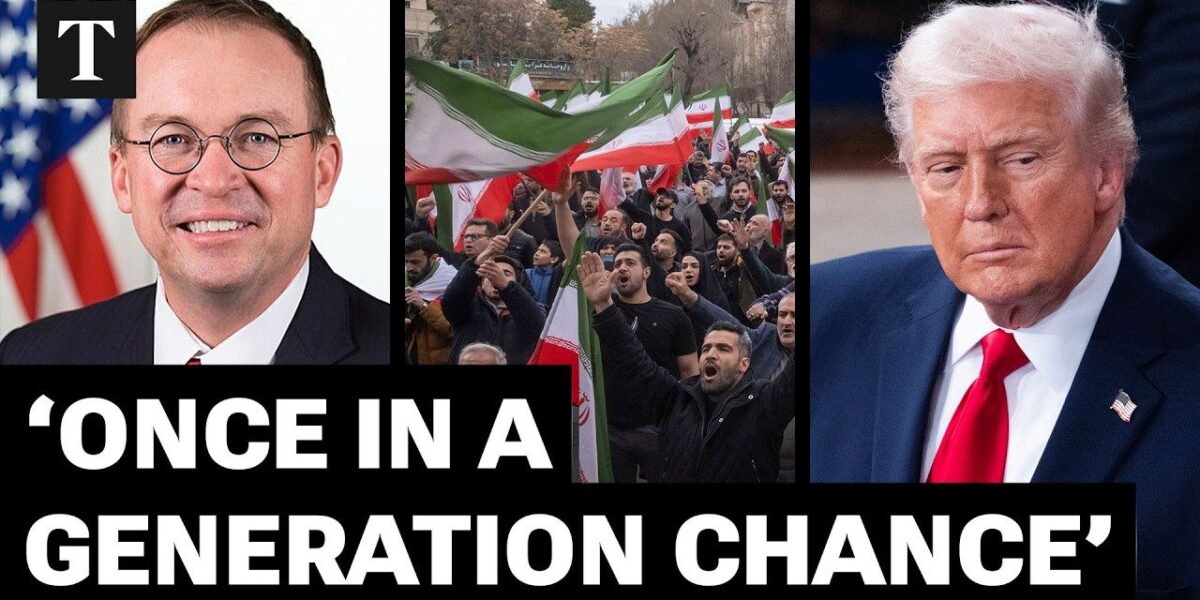
Trump Administration Seized Iran Opportunity, Says Mick Mulvaney
In a candid assessment of the Trump administration’s approach to foreign policy, former White House Chief of Staff Mick Mulvaney revealed that the decision to strike Iran was not a premeditated plan, but rather an opportune moment the administration felt compelled to seize. Speaking in a recent interview, Mulvaney suggested that while Donald Trump did not enter office with the explicit intention of attacking Iran, a confluence of factors presented what was perceived as a “once in a generational chance to change the arc of history in the Middle East.”
A Confluence of Factors Led to the Strike
Mulvaney elaborated on the circumstances that led to the strike, noting that the situation on the ground had evolved significantly. He highlighted the impact of the ongoing conflict in Gaza, a recent attack on a “Natans facility,” and a shifting political landscape within Iran as key elements that contributed to the administration’s decision-making. Furthermore, intelligence indicating that senior Iranian leadership was gathered in a single location presented what was seen as a unique, albeit seemingly counterintuitive, opportunity.
“I think what they saw was what they considered to be an opportunity that was simply too good to pass up,” Mulvaney stated. He contrasted the current situation with the views of former National Security Adviser John Bolton, who Mulvaney noted had advocated for such action for decades and believed it should have occurred during Trump’s first term. Mulvaney, however, emphasized the changed dynamics that made the timing different.
“I think all of those things came together and then they had the intelligence as I think it’s been broadly reported now on most of the senior leadership being together in one place. That makes no sense to me but they paid the price for that. So, you put it all together and I think it was just something that the Trump administration couldn’t pass up on.”
Learning from Past Interventions: The Venezuela Model?
The discussion also touched upon the broader implications of regime change and the lessons learned from past interventions, particularly in Iraq. Mulvaney drew a parallel between the potential approach in Iran and the U.S. strategy in Venezuela, where a more surgical removal of leadership was employed.
“I think at least the American intelligence community the leadership the military establishment learned a lesson in Iraq when they went through debathification,” Mulvaney explained. He suggested that the administration would likely aim to avoid the pitfalls of removing the entire leading class, as seen in Iraq, which led to a “quasi failed state.” Instead, the hope is for the emergence of a domestic leadership in Iran that is more “compatible with international values.”
Mulvaney indicated that the preferred model would involve minimal “boots on the ground,” with potential exceptions for operations related to Iran’s nuclear program. The focus, he suggested, would be on encouraging “domestic political development” aligned with international norms, drawing inspiration from the Venezuelan example.
Economic Repercussions: Oil Prices and Global Markets
A significant concern raised was the potential impact of the strike on global oil prices, given Iran’s strategic position and its ability to disrupt traffic through the Strait of Hormuz. Mulvaney acknowledged that the action could have a “dramatic impact on the price of oil.”
“Prices are going to go up in the short term. I think if you asked Trump to sum it up one sentence, he would say that it was worth it,” Mulvaney commented, projecting potential price increases to as much as $100 a barrel.
However, he also noted that the administration’s objective would be to “get Iran back into the business of making oil as quickly as we possibly can.” This could involve lifting sanctions if a “favorable” new leadership emerges. The administration might also point to increases in oil production from Venezuela as a factor that could help mitigate the overall impact on global supply, even if the oil types and applications differ.
Trump’s Foreign Policy Orthodoxy: Non-Interventionism with Exceptions
Mulvaney characterized Donald Trump’s foreign policy as rooted in a deep-seated non-interventionist stance, stating, “He is not an neoconservative.” He asserted that Trump’s approach is not about engaging in prolonged foreign wars but rather executing targeted actions.
He described the strike on Iran, like the action in Venezuela, as a “one-off,” a “surgical strike,” and not the beginning of an “endless foreign war.” However, Mulvaney conceded that the recent reports of American military casualties in relation to the Iran activity would make it more difficult for Trump to politically categorize this action in the same vein as Venezuela or the earlier “Natans facility” strike.
Despite this, Mulvaney suggested that if the operation leads to “quick successes” and “rapid” positive developments, Trump could frame it as a decisive action rather than a protracted conflict. The ultimate success and political framing, he concluded, remain to be seen, acknowledging that the situation in Iran presents a more complex challenge than previous interventions.
What Comes Next?
The coming days and weeks will be critical in observing Iran’s reaction and the subsequent response from the Trump administration and its allies. The potential for de-escalation or further retaliation will shape not only the geopolitical landscape of the Middle East but also the global economic outlook, particularly concerning oil markets. Furthermore, the domestic political ramifications for the Trump administration, especially in light of any potential casualties, will be closely scrutinized.
Source: Trump Didn’t Plan Iran Attack But ‘Couldn’t Pass It Up’, Says His Former Head Of Staff Mick Mulvaney (YouTube)

Related Articles
Iran War Disliked, But Public Outrage Muted: Analysts Weigh In
Despite widespread disapproval of the Iran war, public protests remain muted in the US. Analysts cite fear of reprisal, the prolonged nature of anti-war movements, and America's energy independence as key factors. The conflict's economic impact and the lack of clear objectives continue to fuel public skepticism, though widespread suffering is not yet felt domestically.
Trump’s Blockade Fails, Allies Shun Mission: A Pattern?
A reported failure of Donald Trump's blockade of the Strait of Hormuz, with ships passing through unimpeded, raises questions about policy effectiveness. This incident, coupled with allies' reluctance to join the mission, suggests a pattern of unintended consequences and strained international relations.
Trump’s Wild Claims Fuel GOP Chaos and Public Doubt
Donald Trump's recent erratic statements and Republican figures' defense strategies are causing political turmoil. Concerns over economic misrepresentation and the handling of the Jeffrey Epstein case are mounting, leading to a public demanding more accountability and truth.