Progressive Voices Demand More Aggressive Democratic Strategy
Progressive influencer Adam Mockler criticizes the Democratic Party's cautious approach, urging for more aggressive tactics and a stronger stance against Republican norm violations. He highlights concerns over special interests, corporate influence, and the need for greater transparency within the party.


Progressive Influencer Calls for Bold Democratic Action
In a recent interview on IHIP News, 23-year-old progressive influencer Adam Mockler articulated a strong critique of the current Democratic Party’s approach, advocating for a more aggressive and less risk-averse strategy. Mockler, known for his appearances on CNN where he often engages with conservative commentators like Scott Jennings, expressed frustration with what he perceives as a consistent double standard applied to progressive voices compared to established political figures.
“Why are you holding me and Trump to the same standard?” Mockler questioned, referencing his frequent debates with Jennings. “Dude, I’m a 23-year-old dude who makes YouTube videos.” He highlighted this as a perfect illustration of the double standards prevalent in political discourse. Mockler stated his goal on cable news is to be more aggressive than he sees other Democrats, lamenting the tendency of older, more moderate Democrats to “play by the rules” while Republicans, in his view, have abandoned them.
“For the past few years, I’ve turned on cable news and I see older Democrats in a suit and tie being very cordial and trying to play by the rules and I’m just like, why why can’t we just punch back and be a little bit more aggressive when we’re out in these spaces, right?”
Critique of Democratic Leadership and Norms
Mockler extended his critique to the highest levels of Democratic leadership, expressing profound disappointment in figures like Hakeem Jeffries and Chuck Schumer. He argued that democratic norms function on mutual consent, and when one party consistently violates them, the other’s adherence to those norms becomes a disadvantage.
“For the past decade, Republicans have repeatedly smacked down any type of norm,” Mockler asserted, citing examples such as the Merrick Garland Supreme Court nomination and the handling of the 2020 election. “There are no norms on the Republican side.
So then when you come over to Hakeem Jeff and Chuck Schumer, they’re the ones playing by the norms time and time again. They’re trying to uphold a level of normality that just isn’t there anymore.”
While clarifying he is not advocating for adopting Donald Trump’s tactics, Mockler stressed the importance of utilizing available leverage. He pointed to the DHS funding negotiations as an example where Democrats used leverage but, in his opinion, their demands were sometimes too modest. He expressed a desire for Democrats to be less risk-averse, less beholden to special interests, and more willing to actively challenge their opponents.
Concerns Over Special Interest Influence and Funding
The conversation delved into the pervasive influence of special interests and corporate donations within the Democratic Party. Mockler cited Hakeem Jeffries’ acceptance of a $25,000 donation from Palantir, a company owned by Peter Thiel and Alex Karp, as a concerning example. He also raised questions about the influence of AIPAC, particularly in light of progressive voters’ concerns about unconditional aid to Israel.
“Politicians work just like any other human in the sense that the incentives around them will guide how they act,” Mockler explained. “Currently the incentives in our institutions, there’s this institutional rot where the incentives aren’t pointing our politicians towards helping the average person, but they’re pointing our politicians towards uh basically like fating these donors, being as nice as possible to these donors, always appeasing the donors first and foremost.”
Mockler highlighted his initiative, Project 2029, which aims to combat corruption and special interest control by fundamentally rewiring the incentive structures that guide politicians. Proposed measures include banning congressional stock trading and developing a broader platform to realign political incentives away from corporate interests and towards the public good.
DNC ‘Autopsy’ and the Need for Transparency
The discussion also touched upon the leaked DNC ‘autopsy’ report, which analyzed the reasons behind Democratic electoral losses. The decision by DNC chair Ken Martin to withhold the report from the public was criticized as patronizing and antithetical to the party’s claim of transparency.
“Like, you don’t get to know the truth, but we want your vote anyway. Like, that was really insulting to me,” Mockler stated, emphasizing that the party must either embrace transparency or abandon the claim. The leak reportedly indicated that progressive voters stayed home or voted third party due to issues like the “blank check” to Israel, a topic Mockler noted is not as popular on the right as some might assume, despite its vocal proponents on both sides.
Gavin Newsom and the Progressive Coalition
The interview then turned to potential future leaders, with Gavin Newsom identified as a prominent figure. Mockler acknowledged Newsom’s electability in a general election but expressed disappointment in his perceived reluctance to tax billionaires and his decision to engage with conservative media figures like Ben Shapiro and Charlie Kirk, rather than progressive voices like Hassan Piker.
“I want to list off some special interest groups. And will you say yes or no if it’ll take money from them? …
What about Apac? … Apac never have and will never will.”
Mockler shared a clip from his interview with Newsom, where the California Governor stated he would not take money from Big Oil, Big Tobacco, or AIPAC. Mockler noted that while Newsom’s answers on these issues showed some evolution, he hoped for more refined responses, particularly regarding AIPAC. Mockler proposed a framework for foreign aid, questioning if a country is “the good guys” and if they have a “chance of losing,” suggesting this approach should be applied universally, contrasting the situations in Ukraine and Israel.
Mockler also addressed criticisms of Newsom’s engagement with Shapiro and Kirk, acknowledging that while Newsom has championed progressive policies in California, such as making it a sanctuary state for transgender people, his outreach to controversial figures can alienate vulnerable communities.
The Rise of Anti-Establishment Populism
The conversation concluded with an analysis of the success of figures like Ritchie Torres, who ran an anti-establishment, populist campaign. Mockler suggested that Torres’s appeal lies in his charisma, his ability to connect with voters on intuitive policy ideas, and his anti-establishment stance, which resonates with a broad spectrum of the electorate, regardless of precise ideological positioning.
“It’s not about how far left you are because there was a poll recently… People thought that Kamala Harris was basically like the same on policy as Ritchie Torres.
They thought they were both the same far left,” Mockler observed. He concluded that on the national stage, a charismatic, anti-establishment, populist candidate with intuitive policy ideas presents a potent campaign strategy.
The interview underscored a desire among progressive voices for a Democratic Party that is bolder, more transparent, less influenced by special interests, and more willing to challenge the status quo. The upcoming electoral cycles, they argue, necessitate a strategic shift towards a more combative and principle-driven approach to politics.
Source: I’m gonna say it… (YouTube)

Related Articles


Dems Weigh Embracing MAGA Voters: Omar Says Yes, Data Mixed
Democrats are debating whether to welcome voters who previously supported the MAGA movement. Strategists weigh the potential benefits of appealing to these voters against the risks of association with polarizing figures. Data shows shifts in the electorate, with some voters crossing party lines.


US Military Strength: Tactical Wins, Strategic Gaps?
The U.S. military demonstrates incredible tactical skill, capable of executing complex missions. However, this prowess is often undermined by unclear political goals and shifting strategies set by civilian leadership. Experts argue that holding elected officials accountable for these decisions is crucial, as the military cannot compensate for flawed governance.

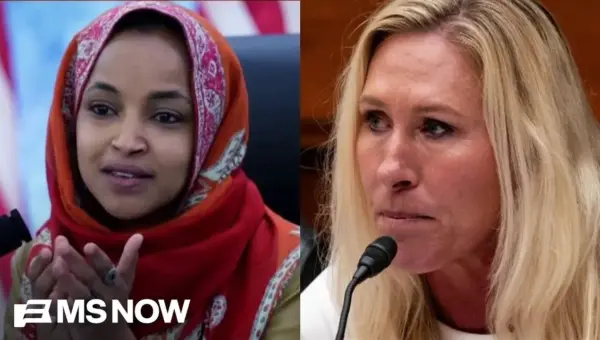
Omar Urges Democrats to Welcome Ex-MAGA Figures
Rep. Ilhan Omar is urging Democrats to embrace former Trump allies like Marjorie Taylor Greene who are now breaking with the former president. Omar believes these individuals deserve credit for their "wake-up call" and should be welcomed to help save the country. This call comes as Democrats explore strategies to broaden their coalition and appeal to disillusioned Republicans.