The Illusion of ‘My Truth’: Embracing Objective Reality
This analysis explores the argument against the notion of "my truth" and "your truth," advocating instead for a singular objective reality. It delves into the implications of prioritizing subjective experience over verifiable facts and the potential consequences for societal discourse and accountability.

The Illusion of ‘My Truth’: Embracing Objective Reality
The assertion that “there is no such thing as my truth and your truth” challenges a pervasive modern notion. It posits that the concept of subjective realities, often framed as “my truth” or “your truth,” is not only a fallacy but a tool that has historically been wielded to obscure and even oppress. Instead, the argument champions the existence of a singular, objective reality, with all other perspectives relegated to the status of mere opinions.
Deconstructing Subjectivity
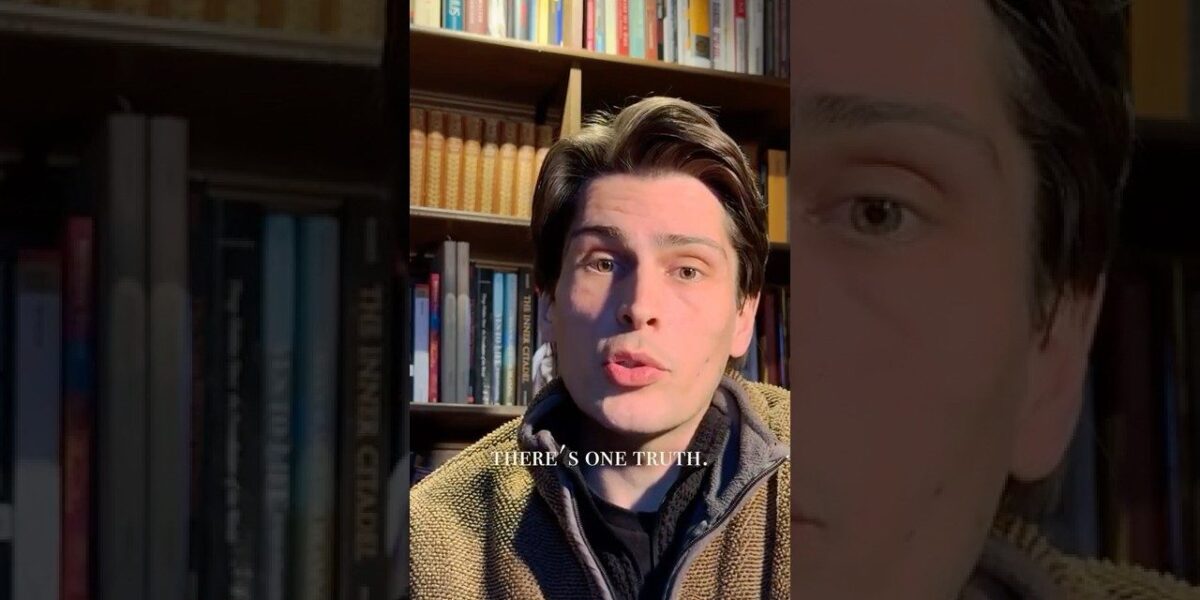
At its core, the argument hinges on a fundamental distinction between lived experience and objective fact. The speaker uses a personal anecdote about rescuing a stray animal to illustrate this point. The act of taking in, feeding, and rehoming an animal is presented as an event that occurred within a shared reality, regardless of whether it was witnessed by others. The intention behind the act, the speaker’s love for creatures, and their commitment to justice, honesty, truth, goodness, and beauty are framed as personal convictions and actions that exist independently of external validation. The crucial insight is that the internal state or the unobserved action does not alter the objective reality of what transpired or the nature of the individual involved.
The speaker contends that clinging to the idea of disparate “truths” – whether personal, national, or temporal – is a distraction from this singular reality. It suggests that by focusing on individual narratives, we risk losing sight of a common ground, a shared factual basis upon which understanding and progress can be built. This perspective implicitly criticizes the postmodern tendency to elevate subjective experience to the level of objective fact, arguing that such a move can lead to an inability to establish common understanding or to hold individuals accountable to a shared set of principles.
Historical Context and the Rise of Subjectivity
The contemporary emphasis on “my truth” can be traced, in part, to philosophical shifts that began to question grand narratives and universal truths. Postmodernism, in particular, brought a critical lens to power structures and the ways in which dominant narratives could silence marginalized voices. This led to an increased valorization of individual experience and perspective, as a means of reclaiming agency and challenging established norms. The intention was often to validate experiences that had been historically dismissed or ignored.
However, as the speaker suggests, this well-intentioned move may have inadvertently created a landscape where objective reality becomes secondary to personal interpretation. In certain contexts, the phrase “my truth” has been used to dismiss factual evidence or to shut down dialogue by framing any disagreement as an invalidation of one’s personal experience. This can manifest in political discourse, interpersonal relationships, and even in broader societal debates, leading to polarization and a breakdown in constructive engagement.
Why This Matters
The distinction between objective reality and subjective opinion is not merely an academic debate; it has profound implications for how we navigate the world, make decisions, and interact with one another. If we abandon the pursuit of a shared reality, we risk descending into a cacophony of irreconcilable viewpoints, where facts are malleable and accountability becomes impossible. This can erode trust in institutions, in expertise, and in each other.
Moreover, the idea of a singular truth, while challenging to grasp fully, provides a necessary foundation for ethical frameworks and legal systems. Justice, fairness, and accountability are predicated on the understanding that certain actions have objective consequences and that individuals can be judged against a common standard of conduct. If “my truth” becomes the ultimate arbiter, then the very concept of wrongdoing becomes subjective and context-dependent, making it difficult to establish and enforce rules that protect the common good.
Implications, Trends, and Future Outlook
The trend towards prioritizing subjective narratives over objective facts is visible in the increasing fragmentation of media consumption and the rise of echo chambers online. Individuals can curate their information intake to reinforce existing beliefs, making it harder to encounter and engage with differing perspectives or objective data that might challenge their worldview.
The future outlook depends on our collective ability to re-emphasize critical thinking, media literacy, and a commitment to evidence-based reasoning. While acknowledging and valuing diverse experiences is crucial for a just society, this must be balanced with a rigorous pursuit of objective truth. The challenge lies in fostering an environment where personal narratives are heard and respected, but not at the expense of verifiable facts. The speaker’s argument serves as a potent reminder that while our interpretations and feelings are valid aspects of our individual experience, they do not, in themselves, constitute a separate reality. The pursuit of a common, objective reality remains an essential endeavor for meaningful communication, problem-solving, and societal progress.
Ultimately, the speaker’s firm stance suggests a call to re-ground ourselves in the tangible, observable world, to prioritize integrity and honesty in our actions and our discourse, and to recognize that while our inner lives are unique, the reality we share is singular and demands our respect.
Source: No such thing as your truth, my truth (YouTube)

Related Articles

Michael Pollan Explores Consciousness Beyond the Brain
Michael Pollan's latest work challenges the idea that consciousness is merely the brain's computation. He explores the mystery of subjective experience and questions if our current scientific methods can truly grasp the inner world. Pollan suggests that modern life pollutes our consciousness, but moments of awe and certain substances might offer pathways to deeper awareness.


MAGA Parents’ Beliefs Tested by Their Children
A YouTube series, 'The Necessary Conversation,' features children challenging their MAGA-supporting parents' views on current events. Clips show parents struggling to defend claims about Trump's statements on Iran, responsibility in tragic deaths, and presidential conduct, highlighting a generational clash over political beliefs.


Man Claims Women Are Evil, Then Says He Follows Them
A man's surprising statements about women, leadership, and morality reveal a complex personal philosophy. He initially questions women's roles but later admits he follows them, deriving his sense of good from them.