US Weighs War with Iran Amid Shifting Justifications
The United States appears poised for military action against Iran, yet the justifications remain unclear and shifting, ranging from nuclear ambitions to ICBM development. Despite expert skepticism on key claims, the administration is reportedly testing public narratives for a potential conflict, while international evacuations signal imminent escalation.


US Escalates Tensions with Iran, Rationale Unclear
As the United States significantly increases its military presence in the Middle East and several nations urge their citizens to evacuate Israel and Iran, a critical question looms: why is the Trump administration seemingly on the brink of war with Iran, and what are the defined objectives? Reports suggest a strategic vacuum, with one analyst noting, “We are kicking off a war in search of a strategy.” The administration’s recent public statements appear to be testing various justifications for military action, seeking a narrative that resonates with the American public.
Shifting Justifications: Nuclear Program and ICBMs
President Trump, in a recent State of the Union address, highlighted the Iranian nuclear program as a primary concern, stating, “It’s the Iranian nuclear program. They can’t have a bomb.” He asserted that Iran continues to pursue nuclear weapons despite previous efforts to dismantle such programs. However, this claim was immediately countered by Iran’s Foreign Minister, who stated that Iran would “under no circumstances ever develop a nuclear weapon.” This juxtaposition raises questions about the administration’s framing, especially since Iran had previously acknowledged this specific verbal commitment.
Adding another layer to the administration’s evolving rationale, Secretary of State Mike Pompeo later cited Iran’s development of intercontinental ballistic missile (ICBM) capabilities as a threat. He claimed Iran is working towards missiles capable of striking the United States, referencing satellite launches and increased missile ranges.
This assertion, however, marked a departure from previous U.S. Intelligence assessments and statements from European governments, which indicated Iran could eventually develop ICBMs using its space program as cover, but without evidence of imminent progress. A Defense Intelligence Agency report from the previous year suggested Iran might possess the capability by 2035 if it chose to pursue it, but noted no dramatic new advancements.
Expert Disagreement on Nuclear Advancement
The administration’s claims regarding Iran’s nuclear enrichment progress have also faced scrutiny. Special envoy Steve Wickoff suggested Iran was “getting close” to developing bomb-making material, enriching uranium to 60%—well beyond civilian needs.
Yet, a report by The Wall Street Journal, citing nuclear experts and diplomats, indicated that Iran’s atomic program had not significantly advanced since previous international actions. Experts like David Albright, a former UN weapons inspector, stated they saw “no evidence that they are trying to reconstitute their nuclear weapons program.” Robert Einhorn, a former State Department official, concluded there was a “de facto suspension of enrichment,” and Gary Samore, a former White House official, noted that while Iran might possess hidden materials for a small facility, there was no known reconstruction of such a program.
Legitimate Concerns vs. Public Case-Making
Despite the discrepancies in public statements, the article acknowledges that legitimate reasons for potential military action against Iran exist. These include Iran’s support for regional proxies responsible for American casualties, its ballistic missile program, and the broad issue of the Iranian regime itself, which some argue is the root cause of regional instability. The possibility of regime change is presented as a viable, though politically contentious, argument.
However, the core issue highlighted is the lack of a clear, sustained, and transparent case being made to the American public. Drawing parallels to the lead-up to the Iraq invasion, the author emphasizes the danger of relying on intelligence that may be exaggerated or false. The article quotes The Wall Street Journal editorial board urging the President to “explain his thinking on Iran to the American people,” emphasizing that while “excellent reasons” for action may exist, a sustained public argument has not been presented.
Political Calculus and Strategic Messaging
The article digs into the political considerations driving the administration’s approach. A Politico report suggests that some senior advisors privately favor Israel striking Iran first, believing an Israeli attack would create public support for a U.S. Response.
This calculus is based on polling data indicating public support for regime change in Iran but reluctance to risk U.S. Casualties. The administration appears to be prioritizing the optics and framing of any potential conflict.
The failure of recent indirect negotiations between Iran and the U.S. Over Iran’s nuclear program further heightens tensions. Iran’s insistence on continuing uranium enrichment and lifting sanctions, while refusing to discuss its missile program or proxy activities, suggests a diplomatic route was unlikely to yield substantial results. The article posits that the negotiations may have been a procedural step to demonstrate an attempt at diplomacy before military action.
Evacuations and Escalating Risks
Amidst the escalating tensions, non-emergency U.S. Personnel and their families are being authorized to leave Israel due to safety risks. Similar advisories have been issued by numerous other countries, including China, Canada, Sweden, India, Poland, Germany, and Brazil, urging their citizens to leave Iran and Israel. This widespread evacuation indicates a serious concern among governments about imminent conflict.
Iran’s Response and Proxy Network
Iran has warned that any attack, regardless of its scale, would be considered a trigger for all-out war. While Iran’s military capabilities and proxy network have been degraded, particularly since October 7th, the potential for retaliation remains significant.
Analysts suggest that any retaliatory strikes could focus on disrupting the Red Sea shipping lanes and targeting U.S. Naval assets. The article also discusses the possibility of Iran issuing a “doomsday order” to its proxies—Hezbollah, the Houthis, Hamas, and various militias—to launch coordinated attacks.
However, the effectiveness and coordination of Iran’s proxy network are questioned, with evidence suggesting that individual militias may prioritize their own interests over direct Iranian command. Recent retaliatory actions against U.S. Forces in Iraq and Syria, followed by U.S. Responses, led some groups to scale back their attacks, indicating a potential reluctance to engage in a wider conflict that could jeopardize their own survival. The article also touches upon the possibility of Iran decentralizing missile launch authority, which could increase the risk of multiple simultaneous launches if conflict erupts.
Uncertainty and Imminent Action
As the weekend approaches, with President Trump historically favoring action when U.S. Markets are closed, the possibility of military strikes in the coming days or weeks appears increasingly likely. The lack of a clear public justification, coupled with significant military posturing and diplomatic failures, creates an atmosphere of profound uncertainty regarding the path forward and the potential consequences of escalating conflict with Iran.
Source: Why Are We Going to War With Iran? (YouTube)

Related Articles

US Strikes on Iran: Legal Debate Ignites
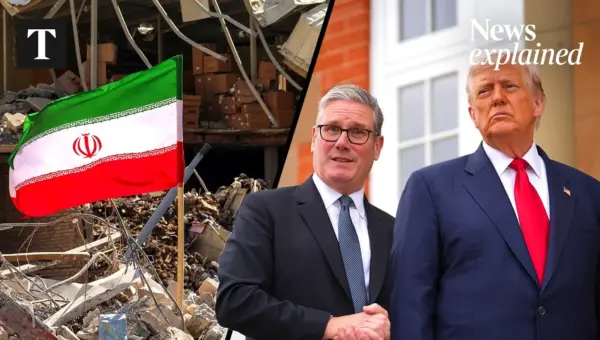
Recent US and Israeli strikes on Iran have ignited a debate over their legality, focusing on international law and the UN Charter. While a UN Security Council resolution is the gold standard for authorizing force, such approvals are rare. Nations often rely on arguments of self-defense, a justification that has become central to the current conflict.
Carrier Power Hits Iran’s Strait of Hormuz Tactics
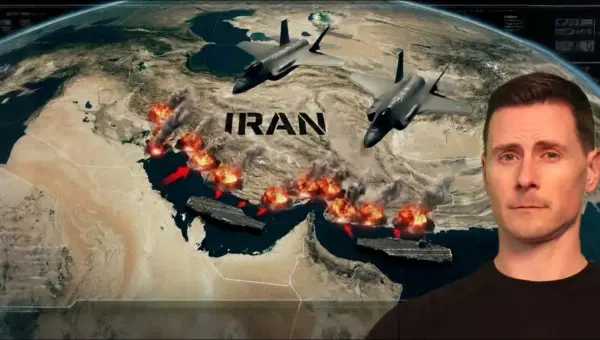
The U.S. Navy's USS Abraham Lincoln is launching relentless fighter jet waves against Iran's Strait of Hormuz tactics. Aircraft are targeting drone sites and coastal facilities to counter Iran's disruption of global shipping lanes. This operation aims to secure vital maritime trade routes.


China Backs US Blockade, Squeezing Iran’s Oil Lifeline
China's backing of a U.S. naval blockade is effectively cutting off Iran's oil exports. This move aims to pressure Iran into negotiations but carries significant political risks for the U.S. president, especially with high gas prices impacting voters.