Cuba on the Brink: An Imminent Energy Crisis Threatens Decades of Stability
Cuba faces an imminent, severe energy crisis, driven by the cessation of Venezuelan oil supplies and U.S. economic pressure, according to geopolitical strategist Peter Zeihan. This acute fuel shortage, evidenced by Havana running out of aviation fuel, threatens to trigger a systemic collapse, de-industrialization, and a mass migration wave to the United States, with profound and unpredictable consequences for the region.


Cuba on the Brink: An Imminent Energy Crisis Threatens Decades of Stability
In a stark warning delivered from Colorado, geopolitical strategist Peter Zeihan has painted a grim picture for Cuba, asserting that the island nation is rapidly approaching a systemic collapse fueled by an acute energy crisis. Following the United States’ strategic maneuvers against Venezuelan President Nicholas Maduro, the long-anticipated ripple effect is now manifesting in Havana, threatening to unravel decades of entrenched political and economic structures and unleash a cascade of regional instability.
Zeihan’s analysis centers on Cuba’s profound vulnerability, a consequence of its geographic proximity to the United States, its long-standing adversarial relationship with Washington, and its crucial alliance with Russia. However, the most immediate and devastating threat stems from its near-total reliance on discounted energy supplies from Venezuela. With Venezuela’s capacity to supply oil severely curtailed by U.S. sanctions and internal disarray, Cuba finds itself in an unprecedented predicament, facing a future devoid of its primary energy lifeline.
The Venezuelan Pivot: Unraveling Cuba’s Energy Lifeline
For decades, Venezuela has been the economic lynchpin for Cuba, particularly after the collapse of the Soviet Union. Through initiatives like Petrocaribe, Venezuela supplied Cuba with oil at preferential rates, often in exchange for Cuban medical personnel and other services. This arrangement allowed Cuba to maintain a degree of economic stability, despite the enduring U.S. embargo. However, the political and economic turmoil in Venezuela, exacerbated by stringent U.S. sanctions aimed at ousting the Maduro regime, has systematically dismantled this critical energy pipeline.
The U.S. strategy, as Zeihan notes, was to remove Maduro from the equation, and the subsequent question was always, “what’s next?” For Zeihan, the answer was unequivocally Cuba. The logic is simple yet devastating: by neutralizing Venezuela as a reliable, cheap energy source, the U.S. effectively pulls the rug out from under Cuba’s energy security. Any alternative fuel procurement for Cuba now means purchasing on the open market, at prices at least double what they paid Venezuela. This sudden, massive increase in cost is a burden Cuba’s already fragile economy is ill-equipped to bear.
Beyond the direct impact of Venezuela’s diminished capacity, the United States has actively leaned on regional players to further isolate Cuba. Zeihan specifically highlights U.S. pressure on Mexico to cease selling energy products to the Cubans. This concerted effort leaves Cuba with severely limited options for regional energy procurement. The only other non-American suppliers in the immediate vicinity are a handful of Dutch-owned refineries in the ABC islands (Aruba, Bonaire, Curaçao). While theoretically, Brazil could offer some relief, it is itself an energy importer, making it an unlikely and insufficient alternative.
The Anatomy of an Imminent Crisis: Havana Runs Dry
The abstract threat of an energy crisis has rapidly materialized into tangible, alarming realities. Zeihan underscored this urgency with a critical recent development: Cuban authorities informed all airlines that they would be unable to refuel in Havana, as the capital city had completely run out of aviation fuel. This isn’t merely an inconvenience for travelers; it’s a stark indicator of a systemic failure at a national level.
For an island nation, the logistics of importing fuel are already complex. Without regional suppliers, Cuba must look to the Eastern Hemisphere. Even if the Cuban government could miraculously secure the necessary cash to buy open-market fuel from distant continents, the logistical challenges are immense. A month or more of transit time across oceans adds not only to the cost but also to the inherent vulnerability of the supply chain. For a relatively small country, the idea of a single tanker bringing aviation fuel across the Atlantic is not a sustainable or viable long-term solution.
This aviation fuel shortage is merely the tip of the iceberg. Zeihan warns that Cuba’s electricity system was already operating on the brink, described vividly as “running on duct tape and bailing wire.” This suggests a dilapidated, inefficient infrastructure, prone to frequent outages even under normal circumstances. A prolonged fuel crisis will inevitably exacerbate this, leading to widespread, extended blackouts across the island. The implications for daily life are catastrophic: loss of refrigeration, disruption of essential services like hospitals and water pumps, paralysis of what little industry remains, and a general breakdown of societal order.
In the best-case scenario, Zeihan predicts a “prolonged energy crisis” for the Cuban government. This optimistic outlook assumes no further U.S. intervention or pressure on its allies to prevent fuel shipments. However, given the demonstrated U.S. resolve, a more aggressive stance to further tighten the noose on Cuba’s energy supply remains a distinct possibility, turning a protracted crisis into an accelerated collapse.
The Futility of External Rescue: China, Russia, and the Geopolitical Chessboard
In times of crisis, nations often seek succor from allies or geopolitical rivals of their adversaries. For Cuba, the obvious candidates are China and Russia. However, Zeihan meticulously dissects why neither nation is in a position to offer a viable lifeline.
China: The Distant Dragon
China, a global manufacturing powerhouse, is indeed a major exporter of refined petroleum products. Theoretically, it possesses the capacity to supply Cuba. However, the sheer geography presents an insurmountable hurdle. China is located on the far side of the Pacific Ocean, meaning any shipments to Cuba would necessitate traversing the Panama Canal. This critical maritime choke point, Zeihan points out, is an area where “the United States is in the process of asserting more direct control over.” While the U.S. does not ‘control’ the canal in the traditional sense, its immense geopolitical influence and strategic interests in the region mean that it can effectively monitor and, if necessary, disrupt shipping that violates its sanctions or policies. The U.S. has a long history of leveraging its naval power and economic influence to enforce its will in the Western Hemisphere. For China, navigating these waters with fuel intended for a sanctioned Cuba would be a high-risk, high-cost endeavor, making it an economically and politically unappealing option.
Russia: The Embattled Bear
Russia, Cuba’s historical Cold War ally, might seem like a natural rescuer. However, Russia is currently embroiled in a full-scale war in Ukraine, a conflict that has placed immense strain on its resources and infrastructure. The war has not only diverted significant portions of its energy output for domestic consumption and military operations but has also seen Ukrainian forces actively targeting Russian refining infrastructure. This has led to domestic shortages of refined products within Russia itself, severely diminishing its capacity to export, let alone undertake long-distance, high-volume shipments to Cuba. Even if Russia desired to help, its current strategic priorities and practical limitations render it incapable of providing the sustained energy lifeline Cuba desperately needs.
With these two major powers effectively sidelined by geography, geopolitics, and internal strife, Cuba is left with virtually no significant external patron willing or able to step into Venezuela’s shoes. This isolation amplifies the severity of the impending crisis, transforming it from a mere economic challenge into a potential existential threat.
The Domino Effect: From Energy Shortage to Societal Collapse
The implications of an energy-driven collapse in Cuba extend far beyond the immediate economic disruption. Zeihan warns against celebrating the potential fall of the Cuban government too quickly, regardless of political leanings, because the aftermath could be far more chaotic and detrimental than the status quo.
De-industrialization and Governance Decay
An energy shortage of this magnitude is not merely an inconvenience; it is a “de-industrializing event.” When a nation’s energy supply grinds to a halt, its productive capacity—factories, agriculture, transportation—collapses. The existing infrastructure, already fragile, will further degrade. Even if a new government were to emerge, the capacity to effectively govern, provide services, and rebuild an economy would be severely compromised. Zeihan draws a chilling parallel to Venezuela, where the removal of the top leader without establishing a broad-based, functional government merely left “existing thugs in place,” plunging the nation into a “multi-year, maybe even multi-decade period where Venezuela is basically going to be running through chaos.” Cuba, facing an energy-based collapse, would likely follow a similar, if not more severe, trajectory.
The absence of reliable electricity means hospitals cannot function, food cannot be preserved, and communication networks fail. Agriculture, heavily reliant on fuel for machinery and transport, would suffer immensely, leading to widespread food shortages. The social fabric, already strained by decades of economic hardship, would likely fray completely, paving the way for widespread unrest, crime, and a power vacuum that opportunistic actors could exploit.
Mass Migration: A Humanitarian and Political Tsunami
Perhaps the most immediate and politically charged consequence for the United States will be a mass exodus of Cuban migrants. Cuba has a long history of its citizens fleeing economic and political hardship, with waves of migrants – from the Mariel boatlift in 1980 to the Balseros crisis in the 1990s – crossing the Straits of Florida to seek refuge in the U.S., particularly Miami. Zeihan unequivocally states that if the lights go out and stay out, a new, unprecedented wave of migration will ensue, measuring “in the hundreds of thousands at a minimum.”
This potential migration crisis arrives at a time when the United States government is demonstrably “rapidly anti-migration.” Current immigration policies are stringent, and the political rhetoric surrounding border security is highly charged. A mass influx of Cuban refugees would pose an immense challenge for Florida, a state already grappling with its own political divisions and resource constraints. Zeihan questions whether the federal government, currently in an uncooperative mood regarding migration, would be willing or able to provide the necessary support to manage such a humanitarian crisis. The prospect of hundreds of thousands of desperate individuals attempting to reach U.S. shores could trigger a severe humanitarian crisis at sea, further straining U.S. Coast Guard resources and potentially leading to tragic loss of life.
The political ramifications within the U.S. would be profound. Florida, a key swing state, would be at the epicenter of this crisis, potentially leading to increased political polarization and an escalation of anti-immigrant sentiment. The federal government would face immense pressure to respond, balancing humanitarian concerns with domestic political pressures and border security imperatives.
The U.S. Strategy and its Unintended Consequences
Zeihan’s analysis implies a deliberate U.S. strategy of economic pressure, a “nudging Cuba in the direction of economic collapse.” While the stated goal might be regime change or to weaken an adversarial government, the practical outcome, as articulated, is a protracted rolling crisis with severe humanitarian costs. The U.S. has long employed economic sanctions against Cuba, but the current strategy, leveraging Venezuela’s collapse, appears to be an acceleration towards a definitive, if chaotic, outcome.
The question arises whether the U.S. has fully considered the long-term consequences of such a collapse. While the removal of a hostile government might be seen as a victory, the ensuing instability, mass migration, and potential for a failed state in its immediate neighborhood could create a far more complex and enduring problem than the one it sought to solve. The parallels with Venezuela serve as a cautionary tale: regime change without a robust plan for post-collapse governance often leads to prolonged chaos, not stability.
The geopolitical landscape of the Caribbean would be irrevocably altered. A chaotic Cuba could become a haven for illicit activities, a source of regional instability, and a persistent humanitarian emergency. The U.S. would be forced to dedicate significant resources to manage the fallout, diverting attention and funds from other strategic priorities.
Conclusion: A Show of Unfolding Crisis
In summation, Peter Zeihan’s assessment paints a picture of an island nation teetering on the precipice. Cuba’s deep structural vulnerabilities, exacerbated by the calculated withdrawal of Venezuelan energy supplies and active U.S. economic pressure, have set the stage for an unprecedented energy crisis. The recent exhaustion of aviation fuel in Havana is not an isolated incident but a harbinger of a broader, more profound collapse.
The inability of global powers like China and Russia to intervene effectively leaves Cuba isolated and exposed. The ensuing de-industrialization and governmental decay promise an era of severe internal instability, echoing the protracted chaos seen in Venezuela. Crucially, the inevitable mass fleeing of hundreds of thousands of Cubans will present a humanitarian and political challenge of immense proportions for the United States, particularly Florida, testing the limits of its immigration policies and resource capabilities.
Regardless of the specific unfolding details, Zeihan guarantees “there’s going to be a show.” And given that Cuba has already run out of jet fuel, he concludes, “it’s probably not going to be all that long from now.” The world watches as the strategic geopolitical chess moves of yesteryear converge to create a looming crisis in the heart of the Caribbean, with profound and unpredictable consequences for all involved.
Source: Cuba Is Running Out of Time || Peter Zeihan (YouTube)

Related Articles


Greenland’s Leader: Trump’s Threats Make Citizens Unsafe
Greenland's Prime Minister revealed that citizens felt unsafe and angry after then-President Trump's 'threats' to buy the island. The comments highlight the human impact of geopolitical discussions on national sovereignty.

Iran Shuns Trump’s Deal Demands, Escalating Global Tensions
Iran has rejected President Trump's demands in ongoing negotiations, leading to heightened global tensions. Pakistan has stepped in as a mediator amid fears of escalating conflict. Meanwhile, the White House press briefings presented mixed messages on the economy and policy, facing scrutiny over strategy and communication.

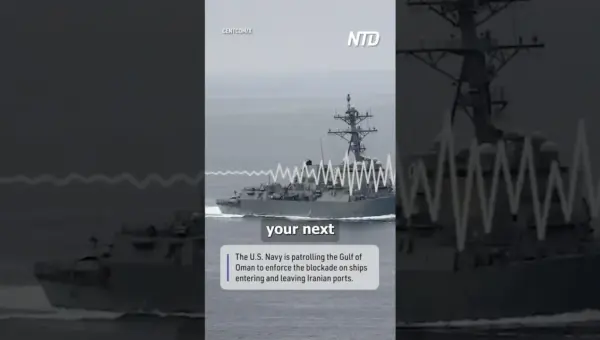
Navy Tightens Grip: US Enforces Strict Blockade on Iran
The US Navy has formally declared a blockade on Iranian ports, warning all vessels to turn back or face boarding and seizure. This significant move aims to exert economic and political pressure on Iran, with explicit threats of force for non-compliance.