Beyond the Brink: Unpacking the Global Stakes of a Potential Chinese Economic Collapse
Geopolitical strategist Peter Zeihan debunks the idea of profiting from a Chinese economic collapse through speculative yuan loans, citing China's strict capital controls and historical precedents of currency worthlessness. Instead, he advises long-term strategic investment in physical infrastructure and industrial capacity in other nations, anticipating a global reorientation of supply chains away from China. This approach emphasizes resilience and strategic positioning over short-term financial gambles in an unpredictable world.


Beyond the Brink: Unpacking the Global Stakes of a Potential Chinese Economic Collapse
In an increasingly interconnected world, the health of major economies reverberates globally. Few economies hold as much sway as China’s, a nation whose rapid ascent has reshaped global trade, manufacturing, and geopolitics. The prospect of a significant economic downturn or even a systemic collapse within China, while a subject of intense debate, raises profound questions about potential global ramifications and the strategies for navigating such an unprecedented event. Geopolitical strategist Peter Zeihan recently addressed a common, albeit speculative, query regarding the feasibility of profiting from such a collapse, offering a sobering assessment that underscores the complexities and inherent risks involved.
The Illusory Promise of a Yuan Loan: Why Speculation Falls Flat
The notion of taking a substantial loan in Chinese yuan, converting it to a more stable currency like the U.S. dollar, and then waiting for the yuan to devalue post-collapse appears, on the surface, to be a clever financial maneuver. However, Zeihan quickly dismisses this strategy as fundamentally flawed, primarily due to the tightly controlled nature of China’s financial system. “Over 99% of the yuan is locked within mainland China,” Zeihan explains, highlighting the stringent capital controls that define the Chinese economic landscape. This crucial detail means that any yuan loan secured within China would, in almost all likelihood, be impossible to transfer out of the country.
China’s Iron Grip: Capital Controls and the Yuan’s Dual Nature
China maintains a complex system of capital controls designed to manage its currency’s value, prevent capital flight, and ensure the Communist Party’s overarching control over the economy. Unlike freely convertible currencies, the yuan exists in two main forms: the onshore yuan (CNY), traded within mainland China, and the offshore yuan (CNH), traded in international markets, predominantly Hong Kong. The vast majority of economic activity and financial assets, including loans, are denominated in CNY, which is subject to strict regulatory oversight. This distinction is critical because while the CNH offers some international liquidity, it represents a fractional portion of the total yuan in circulation. The Chinese government views its financial system not merely as an economic engine but as a vital political tool, making the free movement of capital a direct challenge to its authority.
The role of Hong Kong in this equation is particularly noteworthy. For decades, Hong Kong served as China’s primary financial gateway to the world, facilitating foreign investment into the mainland and managing a significant portion of offshore yuan trading. However, with Beijing’s increasing assertion of control over Hong Kong, the city’s unique financial autonomy has come under pressure. This erosion of autonomy further complicates any theoretical attempt to leverage offshore markets for converting large sums of yuan, as the channels themselves are increasingly subject to Beijing’s influence or could be swiftly curtailed in a crisis scenario.
Therefore, any individual or entity contemplating a yuan-denominated loan within mainland China would find themselves trapped with an inconvertible asset should a financial crisis unfold. The primary objective of such controls is to insulate the domestic economy from external shocks and maintain stability, even at the cost of international financial integration. This fundamental structural barrier renders the speculative loan strategy null and void from the outset.
The Specter of Worthlessness: Lessons from Historical Collapses
Even if one were to miraculously circumvent China’s capital controls, the next hurdle would be the catastrophic devaluation of the currency itself in the event of a systemic collapse. History offers stark warnings. “When their system breaks their currency becomes not just soft but nearly worthless,” Zeihan cautions, citing examples from the past 40 years.
The Post-Soviet Ruble: A Case Study in Economic Disintegration
The collapse of the Soviet Union in 1991 provides a chilling precedent. The Soviet ruble, once the currency of a vast empire, rapidly lost almost all its value. Despite a significant amount of rubles circulating internationally due to the USSR’s extensive hydrocarbon and raw material exports, they became virtually worthless overnight. This economic disintegration was driven by a perfect storm of factors: the dissolution of central authority, the breakdown of state-controlled industries, hyperinflation fueled by uncontrolled money printing, and a complete loss of public and international trust in the government’s ability to manage its finances. Citizens watched their life savings evaporate, and the transition to a market economy was fraught with immense hardship, characterized by rampant poverty and economic instability for years.
Venezuela’s Descent: From Riches to Ruin
A more contemporary and equally dire example is Venezuela. Once among the wealthiest nations in the Western Hemisphere, Venezuela’s oil-rich economy spiraled into catastrophe under the socialist policies of Hugo Chávez and his successor, Nicolás Maduro. Pre-Chávez, Venezuela leveraged its vast petroleum wealth to invest significantly in social programs, education, and its own sophisticated oil industry, even building refineries in the United States designed to process its specific crude oil. These investments were made with hard currencies earned from oil exports, allowing the nation to build a substantial portfolio of overseas assets.
However, Chávez’s populist agenda, characterized by widespread nationalization, price controls, and heavy social spending unsupported by sustainable economic policies, began to erode the nation’s economic foundations. Maduro’s tenure saw an acceleration of this decline, marked by rampant corruption, gross mismanagement of the state-owned oil company (PDVSA), and a complete disregard for economic fundamentals. The result was hyperinflation on an unprecedented scale, severe shortages of basic goods, mass emigration, and a humanitarian crisis. The Venezuelan bolívar became virtually worthless, with citizens resorting to bartering or using stable foreign currencies like the U.S. dollar for everyday transactions. The national currency’s collapse wiped out savings, crippled trade, and plunged millions into poverty, demonstrating how quickly a once-stable currency can become an economic relic.
The parallels to a potential Chinese collapse, though on a vastly different scale, are instructive. A breakdown of central authority, coupled with a loss of confidence in the financial system and the state’s ability to maintain order, would inevitably lead to a rapid and severe devaluation of the yuan. Any attempt to profit from a yuan loan would be negated by the currency’s inherent worthlessness in such a scenario, making conversion utterly pointless.
The Fate of Overseas Assets: Nationalization and Receivership
Beyond the domestic currency, the fate of China’s extensive global investments presents another layer of complexity. China is a massive global investor, with an estimated $10 trillion in overseas assets. Approximately one-third of this sum comprises Foreign Direct Investments (FDI), meaning hard assets like industrial plants, infrastructure, real estate, resource extraction operations, and even agricultural lands spread across continents. Zeihan anticipates a scenario similar to Venezuela’s post-collapse experience, but on a dramatically larger scale.
Venezuela’s Overseas Holdings: A Blueprint for Dispossession
As Venezuela’s economy crumbled, its ability to service and operate its sophisticated overseas assets, including its U.S. refineries, vanished. These assets, once symbols of Venezuelan economic prowess, became liabilities. Eventually, they fell into a form of receivership, often brokered by the U.S. government, and were either spun off into independent firms or acquired by third parties. The original Venezuelan owning entity effectively lost functional control and economic benefit.
China’s Colossal Global Footprint: A Geopolitical Chessboard
China’s $10 trillion global investment portfolio dwarfs Venezuela’s by orders of magnitude. These investments are strategic, ranging from ports in Greece and Sri Lanka, mines in Africa and Latin America, agricultural land in Australia, to technology companies in Europe and infrastructure projects across the Belt and Road Initiative (BRI). In a scenario of Chinese systemic collapse, the owning entities – primarily the Chinese Communist Party (CCP) and its myriad affiliated state-owned enterprises (SOEs) – would cease to exist functionally or would be denied legitimate ownership by the governments in host countries. This denial of ownership would likely stem from a combination of factors: the lack of a recognized, stable government in Beijing to assert claims, the inability to service debts or manage operations, and the inherent geopolitical imperative of host nations to secure critical infrastructure and resources.
At that point, the typical course of action for host governments would be to nationalize these assets, assuming control to prevent economic disruption or exploitation. Subsequently, these nationalized assets would likely be auctioned off or sold to domestic entities or other international bidders. The proceeds from such sales would then remain within the host country, potentially used to offset debts or stimulate local economies. For anyone holding a speculative yuan loan, this outcome would still yield nothing, as their contract would have been with a defunct or unrecognized entity in Beijing.
The scale of such an event would trigger an unprecedented global scramble for assets. Countries that have become heavily reliant on Chinese investment, particularly those in the developing world that are integral to the BRI, would face immense economic and political challenges. The implications for global supply chains, resource markets, and international finance would be staggering, potentially leading to widespread economic restructuring and new geopolitical alignments.
The Real Path to Profit: Strategic Investment in a Post-China World
If financial speculation is a dead end, what then is the viable strategy for those looking to position themselves for the aftermath of a potential Chinese collapse? Zeihan’s advice is decidedly long-term, industrial, and decidedly un-glamorous: “Invest in the physical infrastructure and the industrial plant that will have to replace what the Chinese are doing now.”
Rebuilding Global Supply Chains: The Era of De-globalization and Friend-shoring
China’s role as the world’s factory floor is a product of specific historical and demographic conditions that are now rapidly changing. Decades of globalization led to an extreme concentration of manufacturing capacity in China, driven by cheap labor, economies of scale, and favorable trade policies. However, this model is increasingly fragile. Geopolitical tensions, particularly between the U.S. and China, the vulnerabilities exposed by the COVID-19 pandemic, and China’s own demographic challenges (a rapidly aging population and shrinking workforce) are compelling multinational corporations and governments to rethink their supply chain strategies.
The future, according to Zeihan and many other analysts, lies in a process of de-globalization or regionalization, often termed “friend-shoring” or “near-shoring.” This involves relocating manufacturing and critical supply chain components closer to end markets or to politically allied nations. This shift is not merely about cost efficiency but about resilience, security, and reducing dependence on a single, potentially volatile, source.
Targeting Key Sectors and Regions
The industries that stand to benefit most from this strategic reorientation are those currently dominated by Chinese production. This includes a vast array of sectors: electronics, textiles, automotive components, pharmaceuticals, rare earth processing, heavy machinery, and consumer goods. Investing in the physical infrastructure means building new factories, developing advanced logistics networks, upgrading port facilities, and investing in energy infrastructure in alternative locations.
Which regions are poised to become the new manufacturing hubs? Zeihan’s broader work often points to countries with favorable demographics, stable political environments, and geographic proximity to major consumer markets. Potential candidates include:
- North America: Mexico, with its young workforce and proximity to the U.S. market, is a prime candidate for near-shoring. Reshoring initiatives within the United States itself, particularly in high-tech and strategic industries, are also gaining traction.
- Southeast Asia: Vietnam, Indonesia, and Malaysia have already attracted significant manufacturing investment as companies seek to diversify away from China.
- South Asia: India, with its massive and young population, presents a long-term opportunity, though it faces its own infrastructure and regulatory challenges.
- Eastern Europe: Countries like Poland, Czech Republic, and Romania offer skilled labor, EU market access, and relatively lower costs compared to Western Europe.
- Latin America: Beyond Mexico, other nations in Central and South America could emerge as manufacturing bases, particularly for goods destined for regional markets.
The key is to act “earlier rather than later.” Establishing these new industrial capacities requires significant lead time, capital investment, and strategic planning. Those who build out these alternative supply chains and manufacturing plants ahead of a potential Chinese disruption will be in a prime position to capture market share and generate substantial profits when the existing system falters. This is not a quick financial flip, but a long-term, industrial, and strategic play.
Broader Implications of a Chinese Collapse: A Global Earthquake
While Zeihan focuses on specific investment strategies, the broader implications of a Chinese collapse would be nothing short of a global earthquake. China’s sheer size and integration into the global economy mean that such an event would send shockwaves across every continent.
Economic Fallout and Geopolitical Shifts
A Chinese collapse would trigger a severe global recession, impacting trade volumes, commodity prices, and financial markets worldwide. Countries heavily reliant on Chinese demand for their raw materials (e.g., Australia, Brazil, African nations) would face immediate economic contraction. Global supply chains, already stressed, would experience unprecedented disruption, leading to shortages and inflation. The international financial system would grapple with massive defaults and a crisis of confidence.
Geopolitically, a power vacuum could emerge. The existing international order, which has largely accommodated China’s rise, would be fundamentally challenged. Regional powers might assert greater influence, and the United States, along with its allies, would face complex decisions regarding humanitarian aid, economic stabilization, and security in the Indo-Pacific. The internal dynamics within China itself—potential social unrest, regional fragmentation, and mass migration—would present an immense humanitarian crisis with global repercussions.
Conclusion: Strategic Foresight in an Unpredictable World
Peter Zeihan’s analysis offers a stark and pragmatic view of a potential Chinese economic collapse. It debunks simplistic financial speculation, emphasizing the structural barriers of China’s capital controls and the historical precedent of currency worthlessness in systemic breakdowns. More importantly, it highlights the immense complexity surrounding the fate of China’s vast overseas assets, which would likely be nationalized by host governments.
The real winners, Zeihan contends, will not be speculators but those who exhibit strategic foresight, investing in the physical infrastructure and industrial capacity that will be essential in a post-China manufacturing world. This long-term, industrial reorientation reflects a broader global trend towards supply chain resilience and regionalization, driven by demographic shifts, geopolitical tensions, and the lessons learned from recent global disruptions. While the precise timing and nature of any potential Chinese crisis remain uncertain, the imperative to prepare for a dramatically reshaped global economic and geopolitical landscape is becoming increasingly clear.
Source: The Real Winners After a Chinese Collapse || Peter Zeihan (YouTube)

Related Articles


Oil Prices Surge to $91 Amid Geopolitical Tensions
Oil prices have surged to $91 a barrel, driven by disruptions in the Strait of Hormuz. This is leading to higher gas prices across the U.S., with California facing particularly steep costs. The situation is fueling debate on energy policy, exports, and the transition to renewable fuels.


China’s Iran Gambit: Deception or a New World Order?
President Trump claims China will stop sending weapons to Iran, but deep skepticism remains due to China's past support and use of spy satellites to aid Iran. This move could be a strategic ploy to weaken the US military.

China Aids Iran Amid US Conflict Escalation
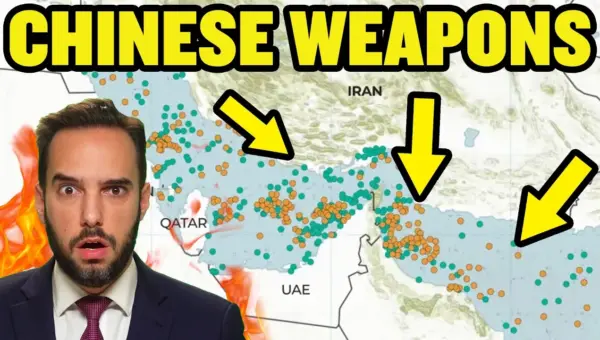
Recent intelligence suggests China is secretly supplying Iran with weapons like MANPADS and sharing critical intelligence, a significant escalation from its previous stance. This move, if confirmed, could deepen regional conflict and lead to severe US economic retaliation, while highlighting long-standing strategic ties between Beijing and Tehran.