Mastering Investment Property Math: 6 Key Metrics
Savvy real estate investors prioritize data over "vibes." This article breaks down the six essential financial metrics—Current Value, Equity, ARV, Rent Comps, Holding Costs, and Cash Flow/Cash-on-Cash Return—that are crucial for evaluating investment properties and building sustainable wealth.

Mastering Investment Property Math: 6 Key Metrics for Savvy Investors
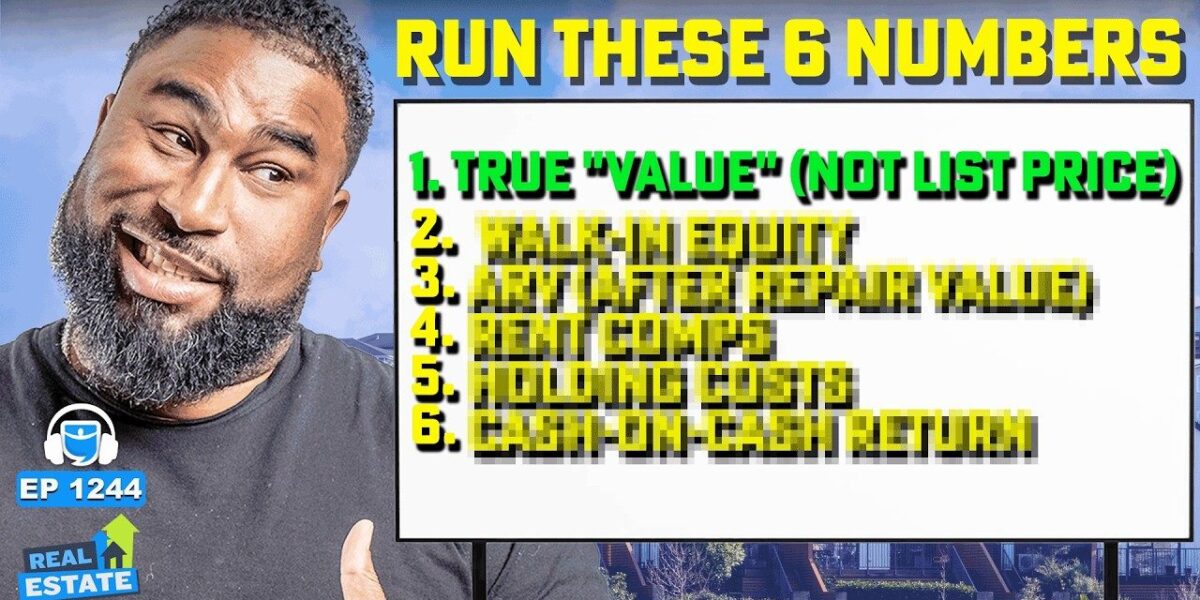
In today’s dynamic real estate market, making investment decisions based on gut feelings or speculative future appreciation is a recipe for financial stagnation. As seasoned investors Dave Meyer and Henry Washington emphasize, a robust understanding of key financial metrics is paramount to building wealth and achieving financial freedom. They outline six critical numbers that every real estate investor, from novice to experienced, must meticulously calculate and understand before acquiring any rental property.
1. Current Value: The Foundation of Smart Investing
The first and perhaps most crucial number is the property’s current value, often referred to as the “as-is” value. This is distinct from the list price, which is merely an asking price and not indicative of the property’s true worth. Overpaying for a property, even by a small margin, can significantly hinder future profitability, especially in a market with fluctuating values. “The golden rule of investing is to buy low and sell high,” Meyer states. “If you buy at the high point, it’s going to make it very hard for you to sell at a higher point.”
Determining current value requires more than just looking at online estimates. While algorithmic tools can offer directional insights, a professional appraisal or a comparative market analysis (CMA) conducted by an experienced real estate agent is essential. Crucially, the agent must be adept at evaluating the property’s condition and finishes, comparing it to similar properties in similar condition, not just the most updated ones. This ensures the valuation reflects the property’s actual state and marketability.
2. Equity: The “Juice” of Real Estate Wealth
Equity is defined simply as the difference between a property’s value and the amount owed on it. For instance, a $400,000 property with a $300,000 mortgage has $100,000 in equity. Meyer calls equity the “juice” and the “nest egg” of real estate investing, emphasizing that he has never bought a deal without equity on day one. Equity represents the wealth built through smart acquisitions and market appreciation.
There are two primary ways to build equity:
- Walking into Equity: This occurs when a property is purchased for less than its current market value. For example, buying a property for $50,000 below market value provides immediate equity, even before considering the down payment.
- Forced Appreciation (Value-Add): This involves renovating a property to increase its value beyond the cost of the improvements. Buying a property for $200,000, investing $50,000 in renovations, and seeing its value increase to $350,000 creates $100,000 in equity.
This immediate equity acts as a cushion, protecting investors against market downturns and providing a foundation for future growth.
3. After Repair Value (ARV): Projecting Future Worth
After Repair Value (ARV) is the projected market value of a property after renovations or improvements are completed. For flippers, ARV is critical for determining offer prices and potential profits. For buy-and-hold investors, it’s essential for refinancing or eventual sale strategies. “ARV is the number I need to know to make sure I don’t screw that up,” Washington explains. “It’s going to drive profitability for you and it’s going to drive your offer prices.”
Calculating ARV involves a similar process to determining current value, focusing on comparable properties that have recently sold after being renovated. However, ARV forecasting is inherently more speculative, as it predicts future market conditions. Investors are advised to be conservative, using the middle-to-low end of comparable sales rather than the highest figures to ensure a realistic profit margin and avoid potential losses.
4. Rent Comps: The Engine of Rental Income
For rental property owners, rent comparables (rent comps) are arguably the most critical metric. This metric determines the potential rental income a property can generate. “It’s basically the ARV for rent,” Meyer states. Accurate rent comps are vital for underwriting deals, ensuring that the projected rental income supports the investment goals, particularly after renovations and stabilization.
Investors should approach rent comps with a degree of conservatism, discounting agent or property manager estimates by a reasonable percentage (e.g., 10-20%) to account for potential market fluctuations or longer-than-expected vacancy periods. Understanding local vacancy rates and turnover costs is also crucial. The goal is to secure reliable tenants at a realistic rate, rather than banking on optimistic projections that might lead to negative cash flow.
5. Holding Costs: The Hidden Drain on Profits
Holding costs encompass all the expenses incurred while owning a property, whether for renovation or during the rental period. These costs can significantly erode profits if not accurately budgeted. For flippers, holding costs primarily include debt service on loans (often at high interest rates from hard money lenders), utilities, property taxes, and insurance during the renovation and sales period. Underestimating the duration of the project and the associated interest payments can be financially devastating.
For landlords, holding costs are more diverse and include:
- Maintenance and Repairs: Routine upkeep and unexpected issues.
- Capital Expenditures (CapEx): Funds set aside for major replacements like roofs or HVAC systems.
- Vacancy: Lost rental income during tenant turnover periods. Budgeting for 5-10% vacancy is common, but can be adjusted based on local market conditions.
- Property Management Fees: Even if self-managing initially, factoring in the eventual cost of professional management (typically 8-10% of gross rent) is prudent.
- Turnover Costs: Expenses related to preparing a unit for a new tenant, such as painting and carpet replacement.
Failing to account for these expenses means that perceived cash flow is merely gross revenue, not actual profit.
6. Cash Flow and Cash-on-Cash Return: Measuring Efficiency
Cash flow is the net profit generated by a rental property after all expenses, including mortgage payments, taxes, insurance, maintenance, vacancy, and property management, are paid. While a positive cash flow indicates the property is covering its own costs, the absolute dollar amount can be misleading without context.
This is where Cash-on-Cash Return becomes the more important metric. It measures the annual cash flow as a percentage of the total cash invested in the deal. For example, $8,000 in annual cash flow on a $100,000 investment yields an 8% cash-on-cash return. This metric highlights the efficiency of the investment – how effectively the capital is generating returns. Meyer advises prioritizing a high cash-on-cash return, as it means achieving financial goals with less capital and effort, ultimately leading to a higher quality of life and more efficient wealth building.
The Bottom Line
Understanding and accurately calculating these six numbers—Current Value, Equity, ARV, Rent Comps, Holding Costs, and Cash Flow/Cash-on-Cash Return—is not just good practice; it’s the bedrock of successful real estate investing. By diligently analyzing these metrics and making conservative assumptions, investors can move beyond speculation and make informed decisions that pave the way to financial freedom.
Source: Calculate These 6 Numbers Before Buying ANY Investment Property (YouTube)

Related Articles


Real Estate Prices Mirror 2008 as Opportunities Emerge
Experienced investors Ken and Denil McElroy see current market conditions as a prime buying opportunity, with property prices mirroring 2008 levels. While the single-family market shows little distress due to low mortgage rates, the multifamily sector presents deeply discounted assets for those willing to negotiate and reposition properties. Their advice centers on fixed-rate debt, low loan-to-value ratios, and a focus on cash flow to navigate market cycles.


Buy Below Median for Safer Investment Returns
Buying investment properties above the median home price carries significant risk of financial loss, even at a discount. Smart investors focus on lower-priced homes to ensure positive cash flow and insulate themselves from market downturns.


Cash Flow Beats Debt Freedom for Security
While paying off all debt offers peace of mind, generating consistent cash flow may provide greater financial security. This income stream can cover living expenses and offer flexibility in uncertain economic times, challenging the traditional focus on debt freedom.