Shadows of Dissent: Unpacking the Coded Challenges to Xi Jinping’s Rule During China’s Lunar New Year
During China's recent Lunar New Year, subtle acts of dissent and coded critiques of President Xi Jinping's rule emerged through various cultural channels, from viral online polls and subversive couplets to an abruptly cancelled provincial television gala. These incidents, particularly a poetic segment hinting at military action against Xi, underscore deep-seated public discontent and raise questions about political stability amidst pervasive censorship and internal tensions within the People's Liberation Army.

Shadows of Dissent: Unpacking the Coded Challenges to Xi Jinping’s Rule During China’s Lunar New Year
The Lunar New Year, traditionally a time for joyous family reunions and auspicious beginnings in China, has recently transformed into a politically charged period, rife with veiled criticisms and coded messages challenging the authority of President Xi Jinping. Amidst an environment of pervasive censorship, ordinary citizens and cultural events alike have become unexpected conduits for deep-seated public discontent, culminating in a dramatic state television incident that sent shockwaves through the nation’s political landscape.
This year’s celebrations, ostensibly marking the Year of the Horse, revealed a sophisticated tapestry of linguistic subversion and symbolic defiance, suggesting a populace adept at navigating the strictures of state control to express their anxieties and aspirations. From viral online polls to subtly altered couplets and even an abruptly cancelled provincial gala, the festive atmosphere was punctuated by unsettling undertones of political instability and a growing challenge to the Communist Party of China (CCP) leadership.
The Art of Subversion: Language as a Weapon Against Censorship
In a country where direct criticism of the leadership is met with severe repercussions, euphemisms, homophones, and wordplay have long served as vital tools for public expression. The recent Lunar New Year saw this tradition elevated to an art form, with one particular linguistic coincidence becoming a potent symbol of dissent. The Chinese term for New Year’s Eve, “Chúxī” (除夕), bears an uncanny phonetic resemblance to “Chú Xí” (除习), which translates directly to “remove Xi.” This seemingly innocuous homophone instantly transformed a traditional holiday into a subtle, yet widely understood, call for leadership change.
The significance of such wordplay cannot be overstated in China’s highly controlled information ecosystem. When direct discourse is suppressed, citizens turn to shared understandings and veiled references, creating a parallel narrative that circulates beneath the surface of official pronouncements. This collective embrace of linguistic subterfuge highlights both the extent of censorship and the ingenuity of those seeking to circumvent it.
Online Uproar: A Digital Barometer of Discontent
Further evidence of simmering public frustration emerged in the digital realm. On New Year’s Eve, a provocative question appeared on a mainland Chinese online forum: “If killing were not a crime in China, who should be the first to die?” The post exploded, drawing over 100,000 replies. While few dared to name a specific individual directly, the overwhelming consensus, as interpreted by netizens, was a thinly veiled reference to the nation’s top leader. Many simply responded with the words “New Year’s Eve,” an unambiguous nod to the “remove Xi” homophone. This surge of anonymous sentiment, even in a heavily monitored online space, provided a stark glimpse into the collective consciousness, revealing a depth of dissatisfaction that official narratives rarely acknowledge.
The sheer volume of responses, despite the implicit risks of engaging with such a politically sensitive topic, underscores a pervasive sense of frustration. It suggests that while overt protest is stifled, the desire for change and accountability remains strong, finding expression in the anonymous confines of the internet. The rapid spread and subsequent interpretation of this poll demonstrate how digital platforms, even under stringent control, can become unexpected arenas for collective political expression.
Cultural Codes: From Couplets to Mascots
The spirit of subtle defiance permeated various traditional and popular cultural forms during the New Year period:
Subversive Couplets and Street Slogans
Spring Festival couplets, typically adorned with wishes for prosperity and good fortune, took on a new, subversive meaning. One viral couplet, ostensibly a standard New Year greeting, read: “Get rid of the problem, the whole nation celebrates” on one line, and “Remove the bad habit, spring returns to the land” on the other, with a horizontal banner wishing “Peace and prosperity for the nation.” On the surface, it promoted virtue and national well-being. However, in Chinese, “get rid of the problem” (除弊 – chú bì) can sound like “remove Ma” (除马 – chú mǎ), a reference to a historical figure or even a general term for a ‘problematic’ leader, while “eliminate bad habits” (除陋 – chú lòu) closely resembles “remove the bad Xi” (除习 – chú Xí). Netizens quickly decoded this, reading it as: “Remove the problem (Ma), everyone celebrates; Remove the bad Xi, the country gets a fresh start. Only then will the nation know peace.” This ingenious reinterpretation transformed a decorative tradition into a bold political statement.
Similarly, a public street sign, seemingly a benign public service announcement, read: “Say goodbye to backward habits. Shake hands with civilization.” Yet, the phrase “say goodbye to backward habits” (告别陋习 – gàobié lòuxí) was widely interpreted as “say goodbye to backward Xi Jinping” (告别落后习 – gàobié luòhòu Xí), turning a simple civic message into a subtle critique of the current leadership.
The Profane Horse Song
Even popular music was not immune to this wave of coded dissent. A viral song, “Step on the Horse to Welcome Spring” (踏马迎春 – tàmǎ yíngchūn), became a sensation for its seemingly festive lyrics. The phrase “tàmǎ” (踏马), meaning “step on the horse,” was repeated throughout. However, in spoken Mandarin, “tàmǎ” sounds almost identical to a highly common and vulgar swear word. As young singers cheerfully repeated this phrase on national television during a New Year concert, viewers recognized the double entendre, perceiving it as an audacious act of public profanity cloaked in festive cheer. This incident underscored the collective ability to find humor and defiance even in the most tightly controlled public performances.
The Deer in the Horse’s Place: A Classic Critique of Power
A New Year greeting card featuring a deer instead of the expected horse, despite being the Year of the Horse, carried a powerful historical and political message. This visual riddle referenced the classic Chinese idiom “zhǐlùwéimǎ” (指鹿为马), meaning “pointing to a deer and calling it a horse.” The idiom, originating from the story of the eunuch Zhao Gao who manipulated the Qin emperor by forcing courtiers to agree that a deer was a horse, symbolizes the abuse of power to force lies into truth. By subtly replacing the horse with a deer, the greeting card served as a potent, yet deniable, commentary on the manipulation of truth and the arbitrary exercise of authority within the current political climate.
The Hunan Gala: A Red Line Crossed
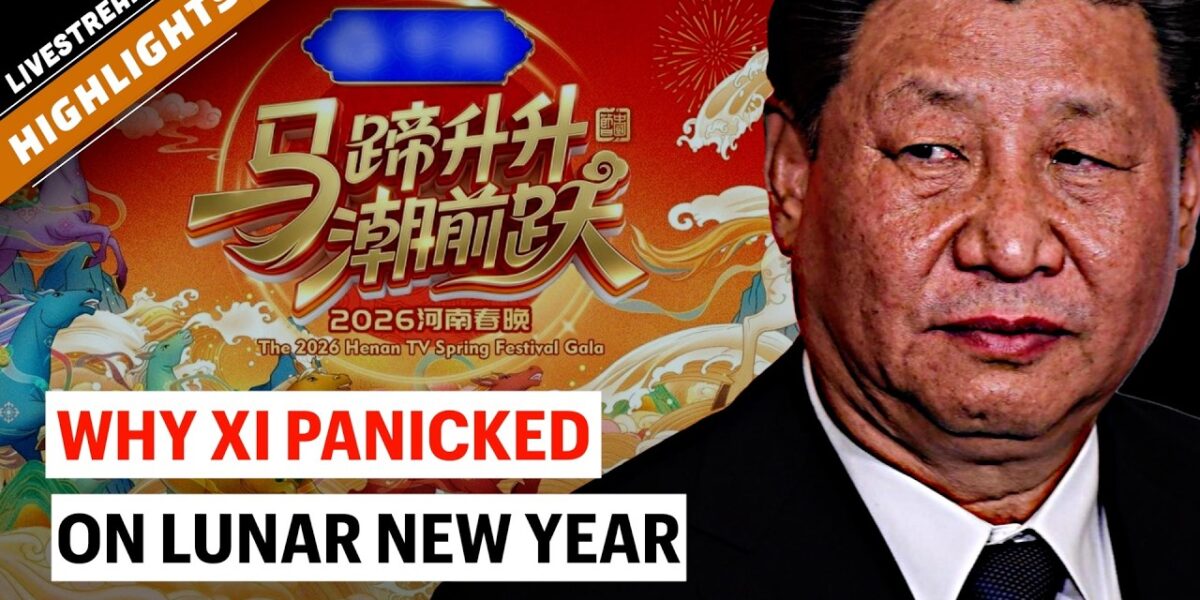
While these instances of coded dissent provided a backdrop of simmering tension, the most dramatic event of the New Year period was the abrupt cancellation of the Hunan Television Lunar New Year gala. Broadcast live on Ding, China’s equivalent of TikTok, the gala garnered immense viewership, peaking at an estimated 8 million concurrent viewers and reaching 40 million total views. Yet, a program promoted as a four-hour spectacle was inexplicably cut off after just 47 minutes. Following the sudden halt, replays of the aired segments were swiftly removed from major platforms like Bilibili, Weibo, and Douyin, with no official explanation offered by authorities. This unprecedented act sparked a public outcry, with many questioning what content could have so rattled the CCP.
Analysis of circulating clips on overseas media platforms revealed several potential triggers for Beijing’s alarm:
Echoes of Shen Yun and Traditional Culture
Firstly, the gala’s overall aesthetic was deeply steeped in traditional Chinese cultural elements. Female dancers portrayed celestial maidens scattering flowers, while male dancers embodied primal deities. This visual style bore a striking resemblance to Shen Yun Performing Arts, the New York-based Chinese performing arts group. Shen Yun’s stated mission is to revive traditional Chinese culture destroyed under CCP rule, often employing the tagline “See China before communism.” Beijing has historically dedicated immense resources to suppress Shen Yun, viewing its cultural revivalism as a direct challenge to the Party’s narrative and ideological control. The Hunan gala’s unadulterated embrace of traditional forms, devoid of modern political slogans or praise for the Party, likely triggered alarm bells within the censorship apparatus, fearing an inadvertent legitimization of a cultural narrative outside state control.
Absence of Party Propaganda
A more fundamental concern was the complete absence of political slogans, praise for the Party, or ritual affirmations of loyalty throughout the gala. In China, major public broadcasts are invariably infused with CCP propaganda, serving as platforms to reinforce ideological conformity. The Hunan gala’s pure focus on traditional artistry, without the expected genuflection to the Party, was a significant political deviation, signaling a degree of cultural independence that Beijing likely found intolerable.
The Explosive Poem: A Call to Arms?
Perhaps the most politically explosive element was a segment featuring battle scenes, depicting warriors from ancient to modern times. When the broadcast was abruptly cut, the screen reportedly froze on a line from this segment: “The long night finally burns away and the land and the moon will see light.” The accompanying voiceover contained even more sensitive language:
“I come through a crack in time and space. Standing amid the fires of war, gazing deep into the heart of history. I have witnessed light rise again and again from the darkest nights. At first light, our generals strike. Like meteors, white feathered arrows are slotted at the waist. Sword flowers bloom like autumn lotuses as blades leave their sheath.”
While seemingly ancient war imagery, this poetic blurb resonates powerfully within China’s current political context. Phrases like “the long night finally burns away” and “light rise again and again from the darkest nights” are widely interpreted as coded references to China’s present political crisis – a society trapped in prolonged turmoil, yearning for a new dawn. This sentiment alone is politically charged, implying widespread dissatisfaction with the status quo.
However, one specific line sent real alarm bells ringing: “white feathered arrows are slotted at the waist.” In Chinese political slang, “white feather” (白羽 – báiyǔ) is a long-standing euphemism for Xi Jinping. This is rooted in the traditional script for his surname, “Xí” (习), which is composed of two radicals: “bái” (白, white) and “yǔ” (羽, feather). When this euphemism is combined with the preceding line, “At first light, our generals strike,” the subtext becomes explosively clear. Netizens quickly interpreted this as a coded call for military commanders to move against “White Feather” – a direct challenge to Xi Jinping’s leadership from within the armed forces.
This interpretation gains significant weight when considering the current climate within the People’s Liberation Army (PLA). Xi Jinping has recently undertaken extensive purges, removing several senior military commanders, including high-ranking officials in the Rocket Force and the Ministry of Defense. These purges have created immense pressure within the officer corps, fueling rumors of resistance, defiance, and even potential rebellions. In this highly charged atmosphere, a public broadcast containing such thinly veiled calls for military action against the supreme leader is not merely poetic coincidence; it is a profound political provocation, one that directly speaks to the anxieties and aspirations circulating within the nation’s military and populace alike.
The Ominous Mascots of the CCTV Gala
Even the main CCTV Spring Festival Gala, the nation’s most watched annual event, was not immune to unsettling symbolism. The four horse mascots unveiled for the purported 2026 CCTV gala, meant to symbolize vigor, momentum, and unstoppable progress, instead triggered widespread online controversy. Named “Chun Xia Qiu Dong” (Spring, Summer, Autumn, Winter), their colors – white, red, black, and gray – bore a striking resemblance to the Four Horsemen of the Apocalypse described in the Book of Revelation. Furthermore, a linguistic coincidence meant that “four horses” (四马 – sì mǎ) sounded uncomfortably close to “dead horses” (死马 – sǐ mǎ) in Chinese.
These associations, whether intentional or coincidental, sparked uneasy reactions across Chinese social media. While some dismissed them as mere happenstance, many viewed the mascots as an ominous sign, reflecting deeper public anxiety and dissatisfaction with the trajectory of the nation. The public’s readiness to find dark omens in official symbols underscores a collective mood of apprehension and a willingness to interpret even benign cultural elements through a lens of political discontent.
Implications for Xi Jinping’s Leadership and China’s Stability
The constellation of these incidents – from the ubiquitous “remove Xi” homophone to the dramatic cancellation of the Hunan gala and the unsettling CCTV mascots – paints a picture of a Chinese society grappling with profound political tensions. Despite President Xi Jinping’s consolidation of power and the pervasive reach of state censorship, these events reveal a vibrant, albeit covert, current of public dissent. They demonstrate that while overt opposition is suppressed, the collective will to express dissatisfaction finds ingenious pathways through linguistic and cultural codes.
The abrupt cancellation of the Hunan gala, in particular, signifies a significant escalation. It suggests that the CCP leadership perceives these coded messages not merely as isolated acts of defiance but as a coordinated threat, especially when they appear to echo the sentiments of internal military discontent. The swift and total eradication of the broadcast from all platforms underscores Beijing’s deep-seated paranoia regarding any perceived challenge to its narrative or Xi Jinping’s authority, particularly from within the military.
This environment of coded resistance, coupled with reported purges within the PLA, raises critical questions about the long-term stability of Xi Jinping’s rule. While the CCP maintains an iron grip on power, the pervasive use of euphemisms and symbolic acts of defiance indicates a deep fissure between the state and segments of its populace. The Lunar New Year, a time meant for unity and celebration, has instead highlighted the growing shadows of dissent and the potential for unexpected challenges to China’s political future.
The ingenious ways in which Chinese citizens are expressing their discontent, often at personal risk, serve as a testament to the enduring human spirit’s desire for freedom and truth, even under authoritarian regimes. These subtle acts of defiance, amplified by social media and shared understanding, collectively form a powerful, if largely unquantifiable, force that the CCP must continuously contend with. As China navigates its complex geopolitical landscape, the coded messages of the Lunar New Year offer a rare and unsettling glimpse into the internal pressures that could shape its destiny.
Source: Is China Heading Toward a Coup? The New Year Signals (YouTube)

Related Articles
China’s Iran Gambit: Deception or a New World Order?
President Trump claims China will stop sending weapons to Iran, but deep skepticism remains due to China's past support and use of spy satellites to aid Iran. This move could be a strategic ploy to weaken the US military.
China Aids Iran Amid US Conflict Escalation
Recent intelligence suggests China is secretly supplying Iran with weapons like MANPADS and sharing critical intelligence, a significant escalation from its previous stance. This move, if confirmed, could deepen regional conflict and lead to severe US economic retaliation, while highlighting long-standing strategic ties between Beijing and Tehran.
China Backs Strait of Hormuz Blockade, Halts Iran Arms
China has agreed not to supply weapons to Iran and is not opposing the U.S. naval blockade in the Strait of Hormuz. This significant development comes as President Trump prepares for a state visit to China and aims to pressure Iran by controlling vital shipping lanes. The move impacts global trade and reshapes regional power dynamics.