OpenAI Eyes Hardware Future: Smart Speaker, Glasses Emerge
OpenAI is reportedly developing a family of AI-powered hardware devices, including a smart speaker and smart glasses, aiming to integrate AI more deeply into daily life. These ambitious plans face significant market, privacy, and technical challenges.

OpenAI’s Ambitious Hardware Push Unveiled
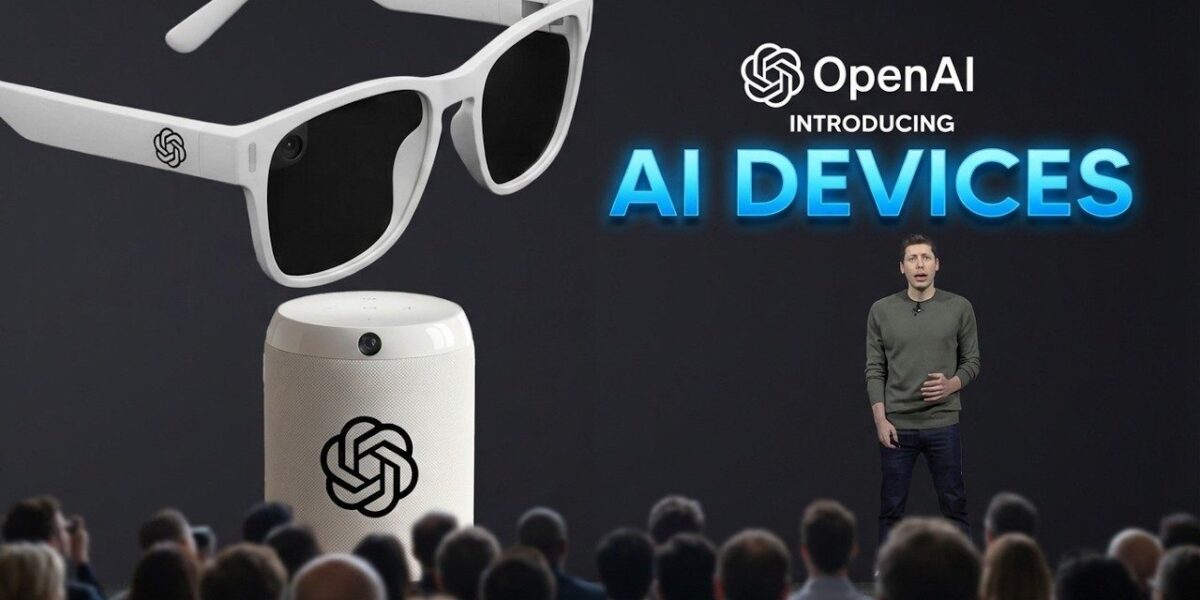
OpenAI, the artificial intelligence research powerhouse, is reportedly developing a suite of AI-powered hardware devices, signaling a significant expansion beyond its software-centric offerings. Citing sources familiar with the company’s plans, reports indicate that over 200 individuals are dedicated to this initiative, which aims to integrate AI more seamlessly into daily life through tangible products.
The First Wave: A Smart Speaker
The initial product in this new hardware family is expected to be a smart speaker, with a projected retail price between $200 and $300. This device is designed to be more than just a voice assistant; it will feature a camera capable of observing its surroundings, including objects and conversations. A key functionality highlighted is facial recognition, enabling users to make purchases akin to Apple’s Face ID system. However, this level of data collection raises immediate privacy concerns, especially given the current public apprehension towards AI surveillance.
The smart speaker is rumored to launch as early as February 2027, with a potential product demonstration and pre-order availability anticipated by mid-2024. This timeline suggests a significant development effort is already underway.
Challenges and Comparisons: Navigating the Hardware Landscape
The path for OpenAI’s hardware ventures is fraught with challenges. The current hardware market is highly competitive and fragmented, and past attempts by major tech companies to introduce similar AI-powered devices have met with mixed success. Amazon’s Alexa-enabled devices, despite years of development and significant investment, have struggled to fully capture consumer imagination, often facing criticism for functionality and privacy issues. OpenAI will need to significantly outperform these established players to gain traction.
A major hurdle for OpenAI will be overcoming consumer skepticism and privacy concerns. The Ring neighborhood watch feature, which faced backlash for its Orwellian implications, serves as a stark reminder of how new technologies can be perceived negatively if not handled with extreme care. Marketing a device that constantly gathers data about users and their environment requires a delicate balance between functionality and trust.
The Compute Conundrum and Hallucination Risks
The continuous operation and contextual awareness of a smart speaker demand substantial computational resources. Unlike typical AI queries submitted to platforms like ChatGPT, a home device would likely make hundreds of small AI calls daily. OpenAI faces the challenge of covering these ongoing compute costs, which could translate to a higher device price, a mandatory subscription service, or a reduction in AI capabilities—any of which could undermine the product’s appeal.
Furthermore, the inherent issue of AI hallucinations—where models generate incorrect or nonsensical information—poses a significant risk. If a smart speaker, especially one priced at $200-$300, fails to perform basic tasks reliably or provides inaccurate information, user frustration could be immense. This could lead to severe negative publicity, potentially mirroring the challenges faced by early devices like the Humane AI Pin.
Pricing and Subscription Strategies
Pricing remains a critical question. With established competitors like Amazon Echo and Google Nest offering devices at lower price points (starting around $30-$40) and integrating AI features for free, OpenAI faces a pricing dilemma. Apple’s approach, bundling free AI services like Siri into its premium ecosystem, further complicates the landscape.
OpenAI might adopt a bundled approach, similar to Amazon Prime or Apple One, where the hardware and service are presented as a single premium AI membership. This strategy could psychologically frame the cost as a unified offering rather than separate hardware and subscription fees, potentially making it more palatable to consumers.
The Future of Smart Glasses
Beyond the speaker, OpenAI is reportedly developing smart glasses, with a potential release in 2028. This timeline places them in a highly competitive future market. By 2028, the smart glasses market is expected to be significantly more mature, with established players like Meta (Ray-Ban Stories) and potential entrants from Apple, Google, and Samsung.
Meta’s Ray-Ban Stories have already demonstrated market viability, selling millions of units by offering a discreet design and integrated AI. OpenAI’s glasses will need to match or exceed Meta’s design and functionality. However, lacking a recognized eyewear brand partnership like Meta’s with Ray-Ban could be a significant disadvantage. Furthermore, Apple is anticipated to launch its own advanced AR glasses around the same time, leveraging its strong ecosystem and brand loyalty.
The competitive landscape in 2028 is projected to include multiple offerings from Meta, Apple, Samsung, Google-backed devices, and various Chinese manufacturers. OpenAI’s entry into this crowded market without prior hardware heritage, an established eyewear partner, or an existing device ecosystem presents a formidable challenge.
OpenAI’s Path to Success: The AI Advantage
Despite the daunting competition, OpenAI’s potential advantage lies in its core AI capabilities. If its AI, particularly within the glasses, proves to be significantly smarter, more conversational, and more agentic than competitors’ offerings, it could differentiate itself. The glasses could then serve primarily as a sophisticated vessel for OpenAI’s advanced models, rather than a hardware spec race.
The success of these hardware ventures is crucial for OpenAI’s financial future. With significant operational costs, the company needs to generate substantial revenue to justify its high valuation and pursue its long-term goals. While hardware sales could contribute significantly, the margins on consumer electronics are often slim, especially for companies new to manufacturing. A successful first product, particularly the smart speaker, is essential to build momentum and avoid the negative PR that could cripple future hardware initiatives.
Why This Matters
OpenAI’s move into hardware signifies a critical evolution for the company and the AI industry. It represents a shift from purely digital AI assistants to integrated, physical devices that interact with the real world. The success or failure of these products could set precedents for AI hardware adoption, privacy standards, and the financial viability of AI-first companies aiming for broad market penetration. The outcome of these ambitious plans will be closely watched as a bellwether for the future of personal AI technology.
Source: OpenAI'S New AI Devices Explained – AI Glasses, Speakers & More (YouTube)

Related Articles


Google Rethinks AI Intelligence Testing
Google DeepMind has introduced a new framework for testing artificial general intelligence (AGI) that functions like an IQ test for AI. It evaluates systems across 10 cognitive abilities, comparing them to human performance to create a detailed profile rather than relying on single scores. This aims to bring scientific rigor to the debate on AI progress.


AI Data Centers Spark Rural Uprising
Rural American towns are fighting back against a surge of AI data centers. These massive facilities threaten water supplies, farmland, and local infrastructure. Residents and lawmakers are pushing for new rules to control their growth and ensure companies bear more of the costs.


AI Misdiagnoses Medical Cases 80% of the Time
A recent U.S. study reveals that AI chatbots are misdiagnosing medical conditions in 80% of cases, highlighting significant risks in relying on artificial intelligence for health advice. Personal stories shared by individuals demonstrate how online self-diagnoses led to incorrect treatments and prolonged suffering, underscoring the irreplaceable value of human medical professionals.