NASA’s Artemis II Mission Blasts Off for Moon Flyby
NASA's Artemis II mission is launching, sending four astronauts on a historic journey around the Moon. This mission marks humanity's first crewed deep-space voyage in over 50 years and is a crucial step in NASA's plan to establish a lunar presence and eventually travel to Mars. The launch signifies a renewed era of lunar exploration amid a global space race.


New Era of Lunar Exploration Begins
NASA’s Artemis II mission is set to launch, marking a significant step in humanity’s return to the Moon. This crewed mission will send four astronauts on a journey thousands of miles beyond the Moon, pushing the boundaries of human space exploration for the first time in over 50 years. The launch, originating from Kennedy Space Center in Florida, signifies a renewed global interest in lunar exploration and sets the stage for future deep-space missions.
Why Go Back to the Moon?
The Moon has captivated humanity for millennia, serving as a source of inspiration, mythology, and scientific curiosity. Beyond its symbolic importance, the Moon holds strategic and scientific value. “It’s important for us to go back and not only learn more about the moon, which is our plan, but also I think eventually develop an outpost there,” explained former astronaut Scott Kelly. This outpost could serve as a vital hub for further exploration, potentially supporting missions to Mars and beyond. The Moon also offers resources like water ice and oxygen locked in its minerals, which could be used for life support and even rocket fuel, making it a potential stepping stone for future space endeavors.
Artemis II: A Giant Leap Forward
Artemis II is the second phase of NASA’s ambitious Artemis program, named after the twin sister of Apollo in Greek mythology. Following the uncrewed Artemis I mission that successfully orbited the Moon, Artemis II will carry a crew of four: American astronauts Reid Wiseman, Victor Glover, and Christina Koch (the first woman to travel to the Moon), along with Canadian astronaut Jeremy Hansen. They will travel farther from Earth than any humans before, completing a trajectory that takes them around the far side of the Moon and back. This mission is crucial for testing the Orion spacecraft’s systems with a human crew before future missions aim to land astronauts on the lunar surface.
The Space Race Rekindled
The drive to return to the Moon is fueled by a renewed global space race. While the original space race in the 1960s was primarily between the United States and the Soviet Union, today’s landscape includes China and India, along with significant contributions from private companies like SpaceX and Blue Origin. China, in particular, is seen as a major competitor, with its own lunar program advancing rapidly. This competition, much like in the Apollo era, spurs innovation and accelerates progress. However, unlike territorial disputes on Earth, space exploration is governed by treaties that prevent nations from claiming lunar territory. The primary prize is scientific prestige and the technological advancements that arise from such endeavors.
Technological Marvels and Challenges
The Artemis II mission utilizes the powerful Space Launch System (SLS) rocket and the Orion spacecraft. The SLS is a massive rocket designed to carry humans deeper into space than ever before. The Orion capsule, though compact—comparable in size to a Ford Transit van—is designed for long-duration deep-space travel. The mission trajectory involves a “slingshot” maneuver, using the Moon’s gravity to propel the spacecraft around it and then back towards Earth, creating a figure-eight path. Despite the excitement, challenges remain. The Artemis I mission experienced minor fuel leaks during a test, leading to a delay. NASA emphasizes that safety is paramount, and the launch will only proceed when the vehicle and the team are fully ready.
A Gateway to Mars and Beyond
The Artemis program is not just about returning to the Moon; it’s a stepping stone towards Mars. The ultimate goal is to establish a sustainable human presence on the Moon, which could then serve as a launchpad for missions to the Red Planet. Scott Kelly highlighted the importance of political will and public support for these long-term, expensive endeavors. “Going to Mars is not about rocket science. It’s about political science,” he noted, emphasizing the need for leaders who believe in science and technology. The benefits of space exploration extend beyond scientific discovery, driving technological innovation that impacts daily life on Earth, from GPS to communication satellites, and inspiring future generations.
Looking Ahead
Following Artemis II, the program aims for Artemis III, which will test lunar lander technology, and Artemis IV, scheduled for 2028, targeting a human landing at the Moon’s south pole. The success of these missions will pave the way for establishing a lunar base and potentially launching crewed missions to Mars in the 2040s. The world will be watching as humanity once again ventures towards the Moon, embarking on a new chapter of exploration that promises to expand our understanding of the cosmos and our place within it.
Source: Artemis II Mission Explained: NASA's Crewed Moon Flyby (YouTube)

Related Articles


Artemis II Astronauts Share Moon Journey; NYC Machete Attack; Iran Peace Talks
Astronauts from the Artemis II mission shared their experiences after returning from their historic journey around the moon. Meanwhile, New York City is investigating a shocking machete attack on a subway platform. High-stakes peace talks are also underway between U.S. and Iranian officials aimed at ending a major regional conflict.

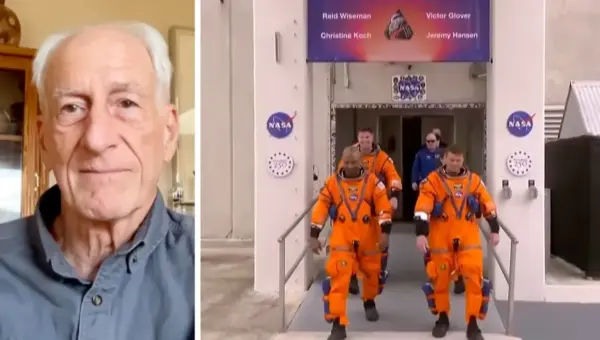
Astronaut Warns: Moon Return Dangers Threaten NASA’s Future
Former astronaut Jeffrey A. Hoffman highlights the extreme dangers of the Artemis II reentry. This critical phase is vital for NASA's future plans to return humans to the Moon and beyond.


US Space Leadership: Artemis Mission Fuels Future Dominance
The Artemis 2 crew's historic return from the moon highlights the critical importance of U.S. leadership in space. Congressman Jay Obernolte discusses how space technology impacts geopolitics, economics, and inspires future generations, emphasizing the necessity of continued investment and public-private partnerships.