Moon Mission Sparks New Space Race
The Artemis II crew's safe return from a lunar orbit mission highlights a new era of space exploration. This successful splashdown underscores the growing international competition and cooperation in space, often referred to as a new space race.

Moon Mission Sparks New Space Race
The recent splashdown of the Artemis II crew marks a significant moment in space exploration. After a journey of 694,481 miles around the Moon, the astronauts returned safely to Earth. This mission, launched from Kennedy Space Center, represents a new chapter in humanity’s quest for the Moon. It highlights the ongoing competition and cooperation among nations in space.
A Perfect Return
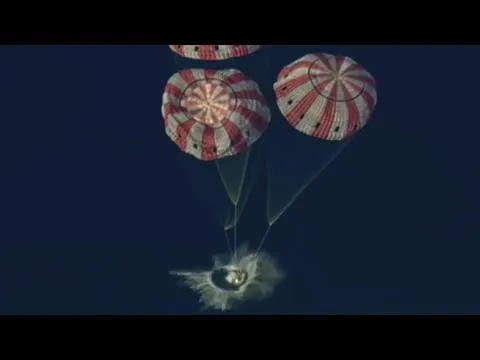
The return journey was carefully managed using a series of parachutes. Pilot parachutes deployed first, followed by main parachutes to slow the spacecraft. These parachutes brought the capsule down at a perfect descent rate. The crew confirmed all systems were working correctly. They passed through 10,000 feet and then 5,000 feet as the main chutes opened. The recovery team was ready and activated upon landing. Three main parachutes were confirmed, guiding the capsule to a safe splashdown. The cabin pressure remained stable, meaning no extra hydration checks were needed. The crew sounded healthy and strong.
Journey Around the Moon
The Artemis II mission spent its time traveling around the Moon. This journey was a critical step in preparing for future lunar landings. The mission tested systems and procedures needed for longer space voyages. It showed that humans can travel to the Moon and return safely. This success builds on decades of space exploration efforts.
The Global Space Race
The Artemis program is led by NASA, the space agency of the United States. However, other countries are also investing heavily in space. China has its own ambitious lunar program. Russia, India, and the European Space Agency are also involved in space exploration. This renewed interest is often called a new space race. Nations are competing to achieve milestones in space, like landing humans on the Moon and exploring Mars. These efforts are driven by national pride, scientific discovery, and potential economic benefits.
Economic and Strategic Interests
Space exploration is not just about science. It also involves significant economic and strategic interests. Countries want to develop new technologies that can be used on Earth. There is also interest in resources that might be found on the Moon or other planets. Controlling key areas in space could also offer strategic advantages. For example, being able to launch satellites or conduct surveillance from space is important for national security. The United States and China are currently the main players in this competition. They are both pushing to establish a stronger presence on the Moon.
Historical Context
This current push into space reminds many of the original Space Race during the Cold War. In that era, the United States and the Soviet Union competed to be the first to reach space milestones. This competition led to major advancements in technology. Today, the players have changed, and the goals are broader. While the US and China are leading, countries like India and Japan are also making important contributions. The Artemis program includes international partners, showing a mix of competition and cooperation.
Why This Reshapes the World Order
The success of missions like Artemis II signals a shift in global power. Space capabilities are becoming increasingly important for a nation’s standing. Countries that lead in space technology can gain economic and strategic advantages. This could lead to new alliances and rivalries. The Moon, in particular, is seen as a stepping stone for further exploration. Establishing a presence there could influence future developments in space. The nations that control access and resources on the Moon may have a significant advantage in the coming decades. This competition will likely shape international relations for years to come.
Future Scenarios
Several future scenarios are possible. One is continued competition, where nations race to achieve specific goals independently. Another is increased cooperation, where countries work together on large projects, sharing costs and expertise. A third scenario involves a mix of both, with nations cooperating on some aspects while competing in others. The path taken will depend on political decisions, economic factors, and technological advancements. The current trend suggests a strong competitive element, but cooperation will likely be necessary for the most ambitious projects.
Source: Splashdown! The Artemis II crew returns to Earth | CUOMO (YouTube)

Related Articles


Navy Readies for Artemis II, Securing Space Mission Success
The U.S. Navy is crucial for the Artemis II mission's success, preparing for the safe return of astronauts. Their expertise in maritime recovery, focusing on sea state and rigorous training, ensures a low-risk operation. This collaboration highlights the vital link between military logistics and civilian space exploration.


Trump Threatens Iran Strikes Amid Trade Court Showdown
Vice President JD Vance attends high-stakes talks with Iran, while former President Trump warns of renewed strikes if no deal is reached. Meanwhile, global tariffs face a legal challenge in trade court, and the Artemis II astronauts prepare for their return to Earth.


Artemis II Crew Nears Earth Splashdown After Lunar Flyby
The Artemis II crew is nearing Earth for a planned splashdown in the Pacific Ocean after a successful lunar flyby. This mission is a critical step for NASA's return-to-the-Moon program and future Mars exploration.