Artemis II Ignites: Astronauts Blast Off for Moon
Artemis II astronauts have successfully launched aboard the powerful Space Launch System rocket, beginning their historic journey around the Moon. This crewed mission marks a significant return to deep space exploration after more than 50 years. It tests vital systems for future lunar landings and Mars missions.


Artemis II Ignites: Astronauts Blast Off for Moon
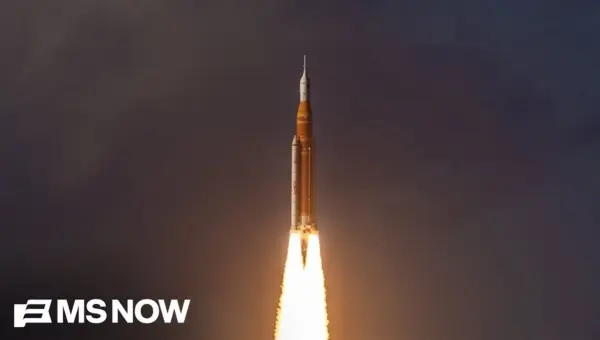
The roar of engines and a brilliant flash of light marked a historic moment as Artemis II astronauts launched toward the Moon. This mission represents a giant leap for humanity’s return to deep space exploration. It is the first crewed flight of NASA’s Orion spacecraft beyond Earth’s orbit in over 50 years. The crew of four will journey around the Moon and return, testing critical systems for future lunar landings.
The powerful Space Launch System (SLS) rocket, the most powerful rocket ever built, lifted off from Kennedy Space Center in Florida. Its 8.4 million pounds of thrust pushed the massive rocket skyward. This incredible force, equivalent to the power of 16 Empire State Buildings stacked on top of each other, was needed to escape Earth’s gravity.
A Journey Decades in the Making
The Artemis program aims to establish a long-term human presence on the Moon. This mission builds on the success of Artemis I, an uncrewed flight that tested the Orion spacecraft and SLS rocket in late 2022. That mission proved the hardware was ready for astronauts. Now, the focus shifts to the human element, ensuring the safety and capabilities of the crew.
For the Artemis II crew – Commander Reid Wiseman, Pilot Victor Glover, Mission Specialist Christina Koch, and Mission Specialist Victor Hoburg – this is the culmination of years of training. They will travel farther into space than any humans before them, reaching speeds of up to 24,500 miles per hour. Their journey will take them to an altitude of about 6,400 miles above the Moon’s far side.
The Mighty SLS Rocket
The SLS rocket is a marvel of engineering. It stands 322 feet tall, taller than the Statue of Liberty. Its core stage alone is 212 feet long and uses 733,000 gallons of super-cold liquid hydrogen and liquid oxygen. These propellants burn to create the immense power needed for launch.
The rocket’s boosters, which ignite for the first two minutes of flight, provide the majority of the initial thrust. These boosters are then jettisoned, falling back to Earth. The core stage continues to burn, pushing the spacecraft higher, before it too separates and falls away. Finally, the rocket’s upper stage, the Interim Cryogenic Propulsion Stage (ICPS), fires to send Orion on its path to the Moon.
Orion: A Home in Space
The Orion spacecraft is designed for deep space missions. It can support astronauts for up to 21 days. For Artemis II, the mission duration is about 10 days. The spacecraft includes a crew module where the astronauts live and work, and a service module that provides power, propulsion, and life support.
During their lunar flyby, the astronauts will get a stunning view of Earth from afar. They will also test Orion’s life support systems, navigation, and communication capabilities under real space conditions. This data is crucial for planning Artemis III, which aims to land astronauts on the lunar south pole.
Looking Ahead: A Stepping Stone to Mars
Artemis II is more than just a trip around the Moon. It is a vital step toward humanity’s long-term goals in space. The technologies and procedures tested on this mission will pave the way for future lunar exploration, including establishing a sustainable base. Ultimately, the Artemis program is seen as a stepping stone for human missions to Mars.
By mastering travel and operations in cislunar space – the region between Earth and the Moon – we gain invaluable experience. This knowledge will be essential for the much longer and more complex journey to the Red Planet. Artemis II brings us closer to a future where humans explore the solar system, pushing the boundaries of what is possible.
Source: The Ultimate 4K / Hi-Fi Audio Artemis II Launch SuperCut (YouTube)

Related Articles


Space Toilet Woes: Artemis II Fixes Clog With Sun Power
Artemis II astronauts faced a frozen waste pipe just after launch, proving space toilets are critical. Mission control used solar heat to thaw the clog, leading to a memorable "go for toilet" announcement. This incident highlights the human realities of space exploration.


Artemis II Astronauts Homebound After Historic Moon Mission
The Artemis II astronauts are nearing Earth after completing a historic mission around the Moon, with splashdown expected tonight. Meanwhile, First Lady Melania Trump has broken her silence on Jeffrey Epstein, and the NFL is under federal investigation for its streaming practices.

Artemis II Crew Faces Fiery Re-entry Amid Heat Shield Concerns
The Artemis II crew faces a perilous re-entry into Earth's atmosphere, with a potentially compromised heat shield posing a significant risk. NASA has adjusted the trajectory to mitigate damage concerns, but experts and astronauts weigh in on the inherent dangers and inspirational value of the mission.