Ukraine War: Brutal Combat Footage Reveals Tactics
Intense combat footage from Ukraine reveals brutal tactics and high casualties. A detailed analysis of battles near Berdychi and the fight for Nadiia showcases combined arms warfare, infantry vulnerability, and the critical role of command and control. The conflict's ongoing nature continues to impact global markets.

Ukraine War: Brutal Combat Footage Reveals Tactics
Recent combat footage from the front lines of the Ukraine war offers a stark look at battlefield tactics and the high cost of conflict. The video analyzes intense engagements, highlighting both Russian and Ukrainian military actions, particularly in the aftermath of the fall of Avdiivka and during battles for key towns like Berdychi and Nadiia.
Early Engagements Near Berdychi
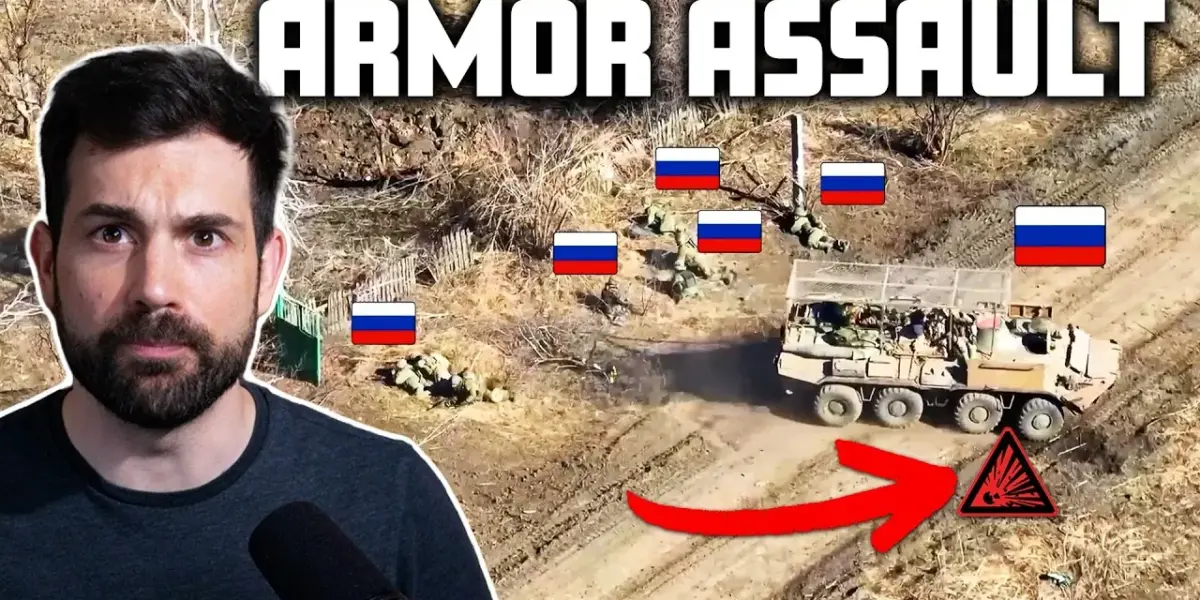
In one observed incident, a Russian BTR armored vehicle advanced under daylight fire. A Ukrainian anti-tank missile detonated just 10 meters to its left, but the vehicle continued its advance. Russian infantry rode on top of the BTR, likely to distance themselves from potential mines below. This maneuver occurred in 2024, shortly after Russian forces captured Avdiivka, as they attempted to quickly expand their gains. The footage was geolocated to the area near Berdychi, west of Avdiivka.
The objective was to establish a foothold in Berdychi, with attacks originating from Stepanivka and Berdychi itself. Russian forces aimed to push their breakthrough as far as possible, reaching a designated drop-off point near some houses. Once the infantry dismounted, they scattered for cover along the roadside, intending to occupy local homes and await reinforcements. However, the BTR departed, leaving the infantry unsupported. The drop-off point was strategically chosen due to its proximity to a river crossing, which the infantry were expected to clear.
Ukrainian Counterattacks and Losses
Shortly after the BTR left, a Ukrainian FPV (First-Person View) drone struck its top, potentially disabling the crew. A second FPV strike on the rear ignited a fire, rendering the vehicle immobile. The drone strikes targeted the armor, aiming to isolate the dismounted Russian troops by cutting off reinforcements and supplies. Following this, a Ukrainian M2 Bradley fighting vehicle approached within 50 to 100 meters of the seven Russian infantrymen. The Bradley opened fire with high-explosive shells, killing the entire Russian squad. Analysts noted a tactical error: the infantry were deployed too far forward without anti-tank weapons.
Second Russian Assault and Heavy Losses
The battle intensified as a second Russian BTR entered the fray. This vehicle struck a landmine at high speed but continued, its armor damaged. It passed the burnt-out remains of two other armored vehicles. This BTR then came under direct fire from a Ukrainian Bradley, which used its 25mm cannon. The Russian vehicle sped towards the drop-off point where a disabled BTR sat. Russian infantry dismounted, but they too were under drone surveillance. Further hits on the disabled BTR and the arriving vehicle caused fires and ejected shrapnel. The direct fire from the Bradley impacted both armored vehicles and the infantry. Reports indicated 13 Russian soldiers were killed, with two survivors attempting to escape.
Shift to Infantry Infiltration Tactics
The transcript notes a shift in Russian tactics following the capture of Avdiivka, with an increase in foot infiltration. Instead of relying solely on armored vehicles, Russian infantry teams were observed moving on foot. In one instance, a four-man team hiding in a tree line was targeted by Ukrainian FPV drones. The drones struck between soldiers, wounding some and disorienting the unit. These strikes acted as visual markers for Ukrainian Bradley crews, enabling them to engage targets over 700 meters away.
The Battle for Nadiia (March 2025)
The article then shifts focus to the battle for the town of Nadiia in the Luhansk Oblast in March 2025. This engagement is presented as a prime example of combined arms warfare. The assault began with a Ukrainian artillery bombardment, including cluster munitions designed to detonate mines. Over 30 hours, Ukraine’s Third Assault Brigade fought to recapture the town. The operation involved seven Ukrainian armored vehicles, led by T-72 tanks providing cover fire for armored personnel carriers. Five separate Ukrainian companies attacked from different directions, aiming to cut off Russian reserves.
Combined Arms Warfare in Action
The Ukrainian advance involved careful coordination between tanks, armored personnel carriers, and infantry. Tanks provided suppressing fire, while armored vehicles transported infantry to drop-off points. The objective for the dismounted infantry was to clear Russian anti-tank teams. The terrain, described as a pre-registered kill zone, meant survival depended on surprise, speed, spacing, and suppression. One Ukrainian tank sustained damage, possibly from a mine or anti-tank munition, but continued its advance.
Command and Control
Real-time battlefield information was fed back to the brigade commander, Colonel Andrii Bilytskyi, who monitored the operation from a command post. This constant flow of information allowed for mid-fight redirection of units. Drones provided overhead surveillance, identifying enemy movements and enabling command to direct FPV drones to strike identified positions. Infantry actions drew fire, revealing Russian positions for subsequent drone strikes. This cycle of pressure and response continued until lines collapsed.
Infantry Vulnerability and Adaptation
Infantry dismounts were identified as the most vulnerable moment in the mission. Exposed and disoriented, soldiers faced heavy fire. The transcript highlights the need for infantry to adapt, as equipment failures, like a broken-down M113, occurred. Losing momentum was a critical risk, as it allowed defenders to counterattack. In response to errors, like infantry being dropped off too far from their intended positions, command merged squads and sent reinforcements. The strategic use of reserve forces was crucial in maintaining momentum and preventing the assault from stalling.
Clearing Trenches and Houses
The battle involved intense close-quarters combat, including clearing trenches and dugouts. Ukrainian forces used tactics like pre-firing to gain an advantage. FPV drones were used to pinpoint and destroy enemy machine gun positions. After clearing initial defenses, Ukrainian main battle tanks and armor advanced, now able to move more freely as anti-tank threats were neutralized. The use of multiple launch rocket systems and specialized munitions was also noted.
Intelligence Gathering and Objectives
Ukrainian soldiers were tasked with capturing Russian soldiers for prisoner exchanges and conducting EPW (Enemy Prisoner of War) searches to gather intelligence from documents. The objective was to advance through the village, clearing remaining Russian holdouts. The battle for Nadiia, a small village with a pre-war population of just 25, saw hundreds of casualties and changed hands multiple times. Despite Russia’s claims of controlling 99.84% of the Luhansk Oblast, Ukraine’s Third Assault Brigade asserted control over Nadiia, providing footage as proof.
Market Impact
While this article focuses on military tactics and human cost, the ongoing conflict in Ukraine has significant global economic implications. Disruptions to energy supplies, particularly from Russia, have impacted global markets. Agricultural exports from Ukraine, a major grain producer, have also faced challenges, affecting food prices worldwide. The sustained military expenditure by involved nations and international aid packages represent substantial financial commitments. For investors, the conflict underscores geopolitical risk as a key factor influencing energy, commodity, and defense sector markets. The long-term implications include potential shifts in global supply chains, increased defense spending, and continued volatility in energy and food prices.
What Investors Should Know
The detailed analysis of battlefield actions illustrates the attritional nature of the war and the evolving tactics employed by both sides. For investors, this highlights the unpredictable nature of geopolitical events and their potential to disrupt markets. Sectors such as defense, cybersecurity, and energy may see continued volatility. Companies involved in logistics and infrastructure rebuilding in Ukraine could also present long-term opportunities, though risks remain high. Understanding the human and economic toll of such conflicts is essential for assessing broader market stability and investment strategies.
Source: The Worst Ukraine War Combat Footage (YouTube)

Related Articles

Russia Faces ‘Disaster’ as Ukraine Strikes Deep
Former CIA analysts suggest Russia is facing a "disaster" as Ukrainian drone strikes hit deep within its territory, challenging its security. They detail Putin's miscalculations, Russia's economic fragility, and Ukraine's strengthened national identity. The discussion also touches on the complexities of security guarantees and the potential long-term benefits of Middle East instability for Ukraine.


Putin Offers Easter Truce, But Will Fighting Truly Stop?
Russia announced an Orthodox Easter ceasefire, with Ukraine cautiously agreeing. However, past ceasefires have been marred by violations, raising doubts about the truce's effectiveness. The world watches to see if this holiday pause will bring genuine respite or further broken promises.

Ukraine Battles Russian Infiltration Tactics in South
Ukrainian forces in southern Zaporizhzhia Oblast are facing intensified Russian infiltration tactics. Small Russian reconnaissance groups are attempting to bypass defenses using open terrain and drone warfare. Ukraine's 225th Assault Regiment is at the forefront, adapting to these challenges with advanced drone use and modified armored vehicles.