Artemis II Mission Sparks Cosmic Debate: Are We Alone?
Artemis II mission's upcoming journey sparks conversations on space exploration and the possibility of extraterrestrial life. Hosts Symone Sanders-Townsend and Eugene Scott discussed the mission's significance and the vastness of the universe, questioning humanity's solitude among the stars.


Artemis II Mission Sparks Cosmic Debate: Are We Alone?
The upcoming Artemis II mission, a significant step in humanity’s return to the Moon, has ignited discussions beyond its technical marvels. Symone Sanders-Townsend and Eugene Scott, hosts of the “Clock It” podcast, recently explored their personal feelings about the mission and broadened the conversation to include the possibility of extraterrestrial life.
Symone Reflects on Space Council and Artemis II
Symone Sanders-Townsend shared her personal connection to space exploration, recalling her work with former Vice President Kamala Harris on the National Space Council. This council plays a crucial role in advising the President on space policy and strategy. Sanders-Townsend expressed a sense of pride and anticipation regarding the Artemis II mission, highlighting its importance in continuing America’s presence in space.
The Artemis II mission is set to carry four astronauts on a journey around the Moon, marking the first time humans have traveled that far from Earth since the Apollo program ended in 1972. This mission serves as a vital test flight for the Orion spacecraft and its powerful Space Launch System rocket, paving the way for future lunar landings and eventual missions to Mars.
Eugene Explores the Possibility of Alien Life
Beyond the immediate goals of Artemis II, Eugene Scott brought a different, yet equally fascinating, perspective to the discussion. Scott delved into the profound question of whether humanity is alone in the universe. He presented a thoughtful breakdown of why he believes the vastness of space makes the existence of other life forms highly probable.
Scott’s reasoning touches upon the sheer number of stars and galaxies, suggesting that the conditions necessary for life, as we understand it, could exist elsewhere. This perspective draws on scientific principles like the Drake Equation, which attempts to estimate the number of active, communicative extraterrestrial civilizations in the Milky Way galaxy. While the equation involves many unknowns, it highlights the statistical likelihood that Earth is not the only planet harboring life.
Connecting Lunar Missions to the Search for Life
The conversation between Sanders-Townsend and Scott subtly connects the ambitious goals of space exploration, like Artemis II, to the broader human quest for understanding our place in the cosmos. As we push the boundaries of human travel further into space, we also expand our capabilities to search for signs of life beyond Earth.
Future lunar missions, and eventually missions to Mars and beyond, could provide opportunities to investigate environments that might support or have once supported life. The scientific instruments and technologies developed for these missions are not only crucial for astronaut safety and mission success but also for detecting biosignatures – indicators of past or present life – on other celestial bodies.
Broader Implications and Future Outlook
The discussion on “Clock It” reflects a growing public interest in space exploration and its philosophical implications. The Artemis program, in particular, has captured the imagination, symbolizing a renewed commitment to human spaceflight. The possibility of finding extraterrestrial life, however remote, adds another layer of excitement and wonder to these endeavors.
As the Artemis II mission prepares for launch, it represents more than just a technological achievement. It embodies humanity’s enduring curiosity and our drive to explore the unknown. Whether this journey brings us closer to the Moon or, in the grand scheme of things, closer to understanding our cosmic neighbors, the mission promises to be a landmark event.
The coming months will be crucial as preparations for Artemis II continue. Public attention will likely focus on the mission’s progress and the scientific discoveries it may enable. Meanwhile, the age-old question of whether we are alone in the universe will continue to fuel speculation and scientific inquiry, inspired by humanity’s bold steps into the final frontier.
Source: Eugene and Symone go to outer space…kind of (YouTube)

Related Articles

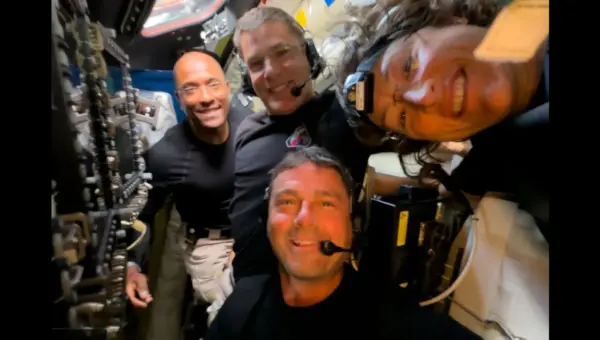
Astronauts Inspire Nation on Historic Moon Journey Home
Lawmakers connected with the Artemis II astronauts as they prepared for re-entry, praising their inspiring journey around the moon. The crew shared personal reflections and a commitment to future space exploration, highlighting the mission's unifying impact.

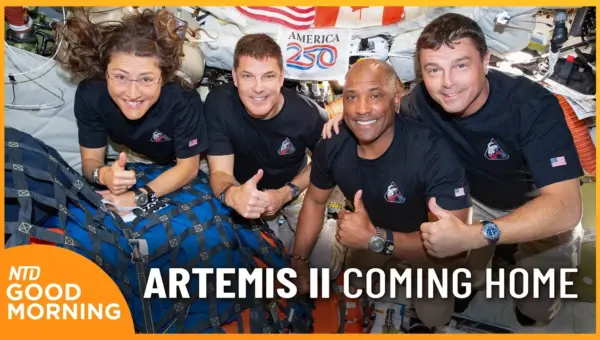
Artemis II Nears Earth; Vance to Lead US-Iran Talks
NASA's Artemis II mission is nearing its critical splashdown, with the crew preparing for a high-speed return to Earth. Simultaneously, Vice President JD Vance is set to lead U.S.-Iran talks in Pakistan aimed at securing a ceasefire. Meanwhile, a federal court will review the legality of President Trump's global tariffs.
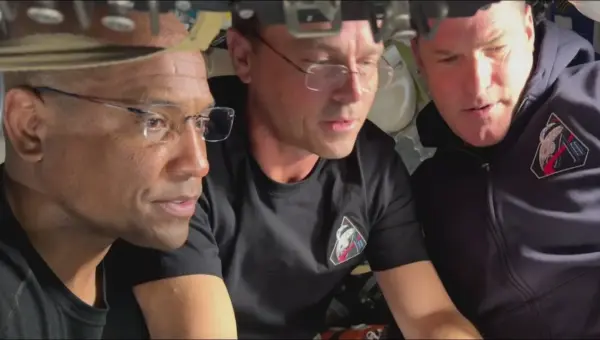
Artemis II Crew Faces Fiery Return
The Artemis II crew faces a critical reentry into Earth's atmosphere, a phase demanding precision and resilience. Astronauts will endure intense G-forces and heat as they return from lunar orbit, testing both human endurance and spacecraft technology.