Artemis II Astronauts Gear Up for Fiery Earth Re-entry
The Artemis II astronauts are preparing for a high-speed return to Earth after their lunar mission. The Orion spacecraft will endure intense heat and deploy parachutes to slow down for a splashdown off the coast of San Diego, where a naval recovery team awaits to assess the crew's health.


Artemis II Nears Earth After Lunar Journey
The Artemis II mission is drawing to a close as its four astronauts prepare for a dramatic return to Earth. After an extended journey that has taken them around the Moon and back, the crew is currently packing and making final preparations for their re-entry. NASA has released stunning high-resolution images from the mission, including breathtaking views of the Moon and a time-lapse video of a recent solar eclipse, offering the public a glimpse into the wonders of space exploration.
One astronaut described the experience, stating, “It’s really hard out here. We’re a long way from home. We’ve been learning the entire journey.” This sentiment highlights the challenges and continuous learning that define such deep space missions, emphasizing the crew’s isolation and the vastness of their undertaking.
Splashdown Preparations Underway Off San Diego Coast
In anticipation of the astronauts’ return, naval teams are already in position in the designated splashdown zone. The USS John P. Murtha and specialized recovery units have been stationed off the coast of San Diego, California. Their critical role is to safely recover the astronauts and their Orion capsule once it lands in the Pacific Ocean.
“The primary mission is to recover the astronauts from the capsule once it splashes down in San Diego,” confirmed a naval representative. This recovery operation is the culmination of years of planning and training, ensuring the safe transition of the crew from the extreme environment of space back to Earth.
Orion’s Perilous Descent Through Earth’s Atmosphere
The Orion spacecraft is set to re-enter Earth’s atmosphere at an astonishing speed of 25,000 miles per hour. During this descent, the ship’s advanced heat shield will face temperatures reaching 5,000 degrees Fahrenheit. This is about half the temperature found on the surface of the Sun, illustrating the immense thermal stress the spacecraft must endure.
To manage this intense re-entry, a series of parachutes will deploy at an altitude of 22,000 feet. These parachutes will drastically slow Orion’s speed from 25,000 mph down to a much safer 20 mph, ensuring a controlled splashdown in the Pacific. The targeted splashdown location is just off the coast of San Diego.
Medical Team Ready to Assess Astronauts Post-Landing
Once Orion safely reaches the water, Navy divers will quickly approach the capsule. Lieutenant Commander Dr. Jesse Wang and his medical team aboard the USS John P. Murtha will be ready to evaluate the astronauts immediately after their recovery. Space travel, even for relatively short durations like this 10-day mission, can have significant physiological effects on the human body.
“We do expect them to have some symptoms for being in space for 10 days,” Dr. Wang stated. “Most commonly, nausea, a little bit of vertigo, or just equilibrium issues.” These are expected side effects of the body readjusting to Earth’s gravity after experiencing the microgravity environment of space. Medical personnel will monitor the astronauts closely to ensure their well-being and manage any discomfort.
Final Moments Hinge on Mission Success
The success of the entire Artemis II mission ultimately depends on the final, critical minutes of the spacecraft’s return. From the precise deployment of parachutes to the controlled splashdown and swift recovery, every step must go according to plan. NASA officials emphasize that bringing the crew home safely is the paramount objective, concluding a vital test flight for future lunar exploration.
As the Orion capsule hurtles towards the Pacific, the world watches, awaiting the safe return of the Artemis II astronauts. This mission serves as a crucial stepping stone, paving the way for more ambitious journeys to the Moon and beyond, pushing the boundaries of human exploration. The coming hours will mark the triumphant end of a significant chapter in space history.
Source: Artemis II astronauts prepare for splashdown and return to Earth (YouTube)

Related Articles


Artemis II Astronauts Share Inspiring Insights with Lawmakers
The Artemis II astronauts, nearing their splashdown, connected with U.S. lawmakers, sharing personal reflections on their historic lunar journey. They discussed inspiration, resilience, and the importance of human connection in space exploration. The crew's messages emphasized chasing dreams and embracing excellence for the next generation.


10-Year-Old’s Plea to NASA: Make Pluto a Planet Again!
A 10-year-old girl's passionate letter urging NASA to make Pluto a planet again has gone viral, prompting a direct response from the space agency. Kayla's heartfelt reasoning, including the idea that it would make people happy, has captured public imagination. NASA Administrator Jared Isaacman has stated the agency is "looking into this," sparking hope and discussion about Pluto's status.

NASA Bets on Moon Mission Amid Heat Shield Concerns
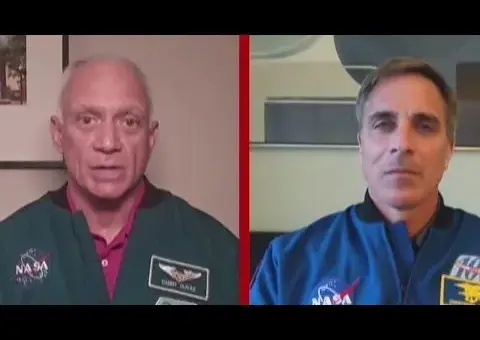
NASA's Artemis II mission faces critical re-entry challenges due to heat shield concerns, despite aiming for historic lunar orbit. The program highlights economic, cooperative, and pride-driven motivations for space exploration.