Sun’s Fiery End Could Terraform Jupiter’s Moons
Our Sun's future red giant phase could turn Jupiter's moons into water worlds. Scientists explore the potential for life on icy moons and discuss the far-reaching implications of stellar evolution and the search for habitable zones beyond our familiar solar system.

Sun’s Fiery End Could Terraform Jupiter’s Moons
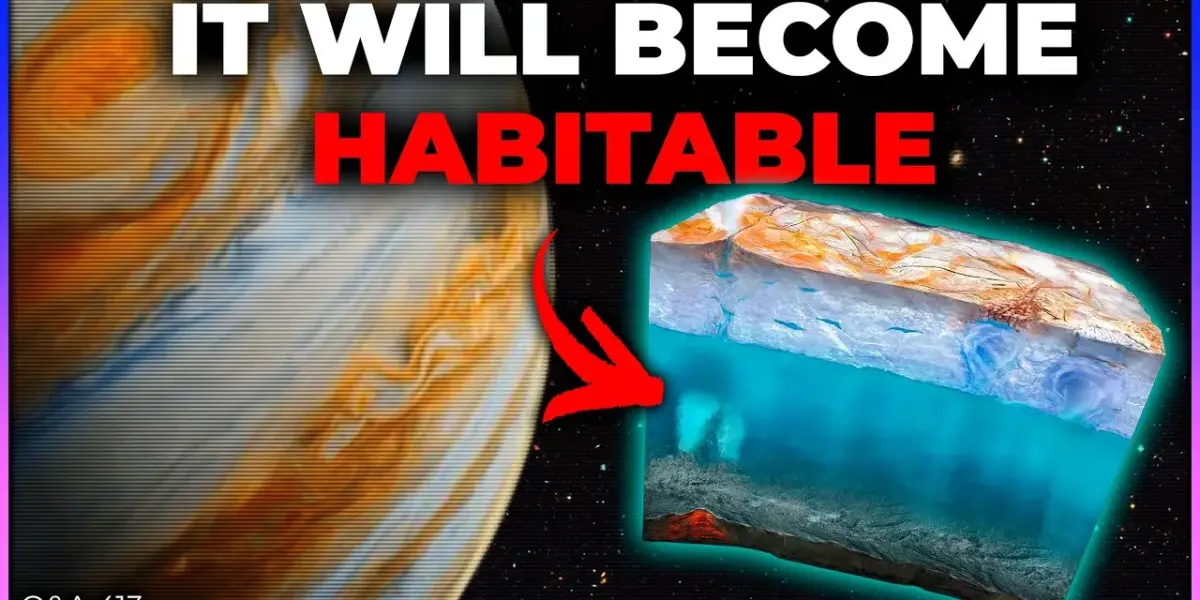
In about 5 billion years, our Sun will transform into a red giant, expanding outwards and potentially engulfing Mercury and Venus. While Earth will likely be scorched beyond recognition, this cosmic event could unexpectedly make the moons of Jupiter habitable.
Life’s Thirst for Water
The search for life beyond Earth hinges on a simple ingredient: liquid water. Wherever we find water on our own planet, from the deepest ocean trenches to the icy Antarctic, life thrives. This fundamental connection drives astrobiologists to look for similar conditions elsewhere in the solar system.
Mars offers a tantalizing possibility, with evidence suggesting liquid water might exist beneath its surface. However, the moons of the outer solar system present even more promising prospects. Europa, one of Jupiter’s large moons, is almost certainly covered by a vast ocean of liquid water beneath its icy shell. Saturn’s moon Enceladus is another prime candidate, actively spewing water ice and organic chemicals into space, hinting at the necessary ingredients for life.
Scientists are also investigating Ganymede and Callisto (Jupiter’s moons), Titan (Saturn’s moon), Triton (Neptune’s moon), and even some of Uranus’s moons and Pluto, all of which could harbor liquid water oceans beneath their surfaces. If life arose on Earth independently in these watery environments, it would suggest that life is common throughout the cosmos.
Venus: A Moonless Mystery
Venus, Earth’s closest planetary neighbor, presents a unique puzzle. Its axial tilt is almost completely upside down, and it spins backward compared to most other planets. One theory suggests this unusual rotation might be due to the planet’s lack of a large moon, unlike Earth, whose moon helps stabilize its axial tilt. Without this gravitational anchor, Venus might have tipped over, possibly due to a massive impact similar to the one that formed Earth’s moon.
The Moon’s Atmosphere Potential
Could the Moon have a substantial atmosphere? Theoretically, yes. The amount of atmosphere a celestial body can hold depends on its gravity and the amount of gas available. While the Moon’s gravity is weaker than Earth’s, if enough gas were supplied, it could develop a much thicker atmosphere than it currently has. The ultimate limit would be when gas escapes the Moon’s gravitational pull into Earth’s larger influence, but this is a considerable distance away.
Careers in Space Exploration
For students interested in careers building advanced telescopes like the James Webb Space Telescope or the Extremely Large Telescope, a strong foundation in robotics and STEM fields is crucial. Roles in aerospace engineering, avionics, software development, and optical systems are all vital components of modern space missions. Hands-on experience with robotics, even through personal projects using readily available components like Arduino or Raspberry Pi, is highly valued.
The Sun’s Red Giant Phase
When our Sun enters its red giant phase in about 5 billion years, its outer layers will expand significantly. This expansion will push the habitable zone—the region where liquid water can exist on a planet’s surface—outward. The habitable zone is expected to extend to between 7 and 16 astronomical units (AU) from the Sun. For context, Jupiter is currently about 5.2 AU away, and Saturn is about 9.5 AU away.
This outward shift means Jupiter and its moons could find themselves within this newly expanded habitable zone. The icy shells of moons like Europa could melt, creating vast liquid oceans. While these moons might become theoretically habitable in terms of temperature, they would still be subjected to Jupiter’s intense radiation, posing a significant challenge for any potential life.
Habitable Zones Around Quasars
The concept of a habitable zone isn’t limited to stars. Any object emitting significant radiation, like a quasar, also possesses a habitable zone. Quasars are incredibly luminous active galactic nuclei powered by supermassive black holes at their centers. As material falls into the black hole, it forms an accretion disk that heats up to extreme temperatures, emitting vast amounts of radiation.
At a specific distance from this accretion disk, the radiation levels could be just right for liquid water to exist on the surface of a planet. This distance depends on the black hole’s mass, the amount of material in the accretion disk, and its temperature. Therefore, even around these energetic cosmic phenomena, a region conducive to life could theoretically exist, provided a planet has a protective geomagnetic field.
The Challenge of Content Overload
In the realm of science communication, creators often grapple with the challenge of producing too much content. While high-quality content is always the goal, some viewers may find it difficult to keep up with the volume of information. The key is to balance prolific output with viewer capacity, ensuring that valuable scientific discoveries and discussions remain accessible without overwhelming the audience. Finding ways to distill complex topics, like the potential habitability of distant moons or the life cycle of stars, into digestible formats remains an ongoing effort.
Source: Moon Atmosphere, Habitable Quasars, Sun's Red Giant Phase | Q&A 413 (YouTube)

Related Articles
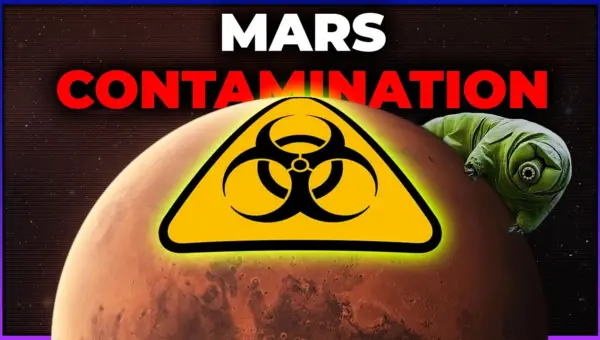
Mars’ Soil May Naturally Block Earth Life, Study Finds
New research suggests that the soil on Mars may naturally inhibit Earth life. Experiments with hardy tardigrades show that Martian regolith simulants contain compounds that slow down or stop microbial activity. This finding could be crucial for planetary protection during future human missions to Mars.


Ocean Mysteries Hint at Extraterrestrial Life
Harvard astrophysicist Avi Loeb proposes that alien life, or 'cryptoterrestrials,' might already exist on Earth, potentially hidden in our oceans. He suggests analyzing the isotopic composition of discovered materials is key to determining their origin outside our solar system. This idea challenges traditional approaches to searching for extraterrestrial life.


AI is Life? Physicist Challenges Definition of Existence
Theoretical physicist Dr. Sara Imari Walker argues that artificial intelligence could be considered a form of life, challenging traditional definitions. Her work with Assembly Theory seeks a new metric to identify life based on complexity and construction history, applicable from exoplanets to AI.