Trump’s Iran Rhetoric Risks War Crimes Allegations
Retired Lt. Col. Rachel Van Lindingham warned that threats to bomb Iranian infrastructure could be war crimes. Facilities like the Pars energy plant and Sharif University are identified as key IRGC hubs, raising questions about legitimate targets and international law.


Trump’s Iran Rhetoric Risks War Crimes Allegations
Retired Lieutenant Colonel Rachel Van Lindingham has stated that former President Donald Trump’s threats to bomb bridges and power plants in Iran could be considered a war crime. This strong assertion comes from her analysis on PBS, where she explained that such rhetoric can terrorize a civilian population. This violates the laws of war, which are also part of U.S. law. Van Lindingham emphasized that this is not just reckless talk but a potential legal violation.
The laws of war are designed to protect civilians during conflicts. When leaders use language that intentionally frightens ordinary people, it crosses a line defined by international legal standards. These standards aim to ensure that even in wartime, a basic level of humanity is maintained. Van Lindingham’s comments highlight the serious real-world consequences that such strong language can carry for a political figure like Trump.
Strategic Context of Military Targets
Some analysts suggest that Trump’s statements are often part of a negotiation strategy, used to gain leverage. When it comes to actual military action, such as targeting specific facilities, there are strict rules of engagement. For example, during combat operations in Afghanistan, every action required a thorough review. The goal was always to minimize harm to civilians in the vicinity of any strike.
However, certain facilities in Iran are considered legitimate military targets. The Pars energy plant, for instance, is crucial for powering the ballistic missile program of the Islamic Revolutionary Guard Corps (IRGC). The IRGC is a military organization within Iran. Because the plant directly supports Iran’s missile capabilities, it can be seen as a valid target under the laws of war. It is directly linked to the development of weapons that could threaten others.
Sharif University: A Key IRGC Hub
Sharif University is also identified as a significant site. It is described as a nerve center and data hub for the IRGC. This is where the IRGC allegedly designs and develops its missiles and drones. Targeting such a facility could be seen as an attempt to disrupt Iran’s advanced weapons programs. Information and research conducted at universities can sometimes be dual-use, meaning it has both civilian and military applications.
The discussion around these targets brings up the complex nature of modern warfare. It often involves distinguishing between military objectives and civilian infrastructure. The intent behind striking a facility and its direct contribution to a military threat are key factors in determining legality. The IRGC’s role in Iran’s military strategy makes its associated facilities subjects of intense scrutiny.
Broader Geopolitical Implications
The panel discussion also touched on the emotional reactions to Trump’s approach. Some believe that his assertive stance is what triggers strong responses. This perspective suggests that when someone appears to have a strong will and stands firm against perceived threats, it can provoke reactions. The idea of standing up to ‘evil’ is a powerful motivator in political and military rhetoric.
This kind of rhetoric can escalate tensions between nations. It can also influence public opinion and shape foreign policy decisions. The international community closely watches statements made by political leaders regarding potential military actions. This is especially true when those statements involve threats against another country’s infrastructure.
Strategic Implications
The potential classification of Trump’s rhetoric as a war crime carries significant weight. It means that even words can have legal consequences under international law. This could impact future political campaigns and foreign policy discussions. It also raises questions about accountability for leaders who make such threats.
Furthermore, identifying specific Iranian facilities like the Pars energy plant and Sharif University as legitimate targets highlights the ongoing strategic focus on Iran’s military capabilities. Disrupting missile and drone programs is a key objective for many nations concerned about regional stability. The debate over what constitutes a legitimate target is central to preventing escalation and upholding international law during times of tension.
Source: Explosive Exchange Piers Morgan Challenges Max Afterburner on Trump Iran Stance (YouTube)

Related Articles


Congress Must Curb Trump’s War Powers Now
Concerns are mounting over President Trump's actions regarding Iran, prompting calls for Congress to reclaim its constitutional war powers. Senator Schumer is forcing a vote to highlight this issue, putting Republicans in a tough spot during an election year. This debate is crucial for maintaining the balance of power in U.S. foreign policy.

Iran Demands Full Control Over Strait of Hormuz
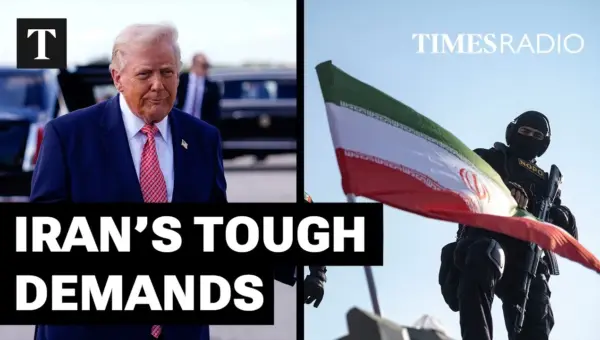
Iran is pushing for maximum control over the Strait of Hormuz, presenting a maximalist demand in ongoing negotiations. Deep disagreements persist between key global players, particularly concerning Iran's nuclear ambitions and the stability of a potential ceasefire. The clarity and unity of negotiating teams remain uncertain, adding further complexity to the delicate geopolitical situation.

Iran Tests Global Order Amid Strait of Hormuz Standoff
Peace talks loom as Iran's control over the vital Strait of Hormuz fuels global concern. Analysts question Iran's commitment to agreements, while regional demands and proxy conflicts complicate diplomatic efforts. The situation tests the international order and global energy security.