Universe’s Expansion Accelerates, Then ‘Jerks,’ New Data Reveals
New data from the DESI project suggests the universe's expansion is not only accelerating but that the rate of acceleration is also changing. This phenomenon, known as a 'jerk' in physics, challenges current models and points to new mysteries about dark energy and cosmic evolution.


Universe’s Expansion Accelerates, Then ‘Jerks,’ New Data Reveals
Our understanding of the universe is constantly evolving, and new findings often challenge long-held scientific beliefs. For decades, scientists have observed that the universe is not only expanding but that this expansion is speeding up. Now, recent data suggests something even more surprising: the rate of this acceleration might not be constant. This phenomenon, described by physicists as a ‘jerk,’ could mean our current models of cosmic expansion need a significant update.
A Universe on the Move
The story of cosmic expansion began in the 1920s with Edwin Hubble. He noticed that galaxies farther away from us seemed to be moving away faster than closer ones. This observation led to the groundbreaking idea that space itself is stretching, carrying galaxies along with it. For many years, scientists assumed this expansion happened at a steady, constant rate, like a car maintaining a consistent speed.
The Surprise of Acceleration
This assumption held true until the 1990s. A new generation of astronomers, using more powerful telescopes, looked at galaxies much farther away. They discovered that these distant galaxies were moving away from us even faster than expected. This meant the universe’s expansion wasn’t constant; it was actually accelerating. Imagine a car that isn’t just speeding up but is pressing harder on the gas pedal over time. This acceleration is attributed to a mysterious force called dark energy, which we still don’t fully understand.
Introducing the ‘Jerk’
Even with the discovery of accelerating expansion, scientists largely assumed this acceleration was happening at a steady pace. It was like the car was accelerating at a consistent, predictable rate. However, the latest results from the Dark Energy Spectroscopic Instrument (DESI) are painting a different picture. DESI is a massive project that maps the positions and speeds of millions of galaxies across a vast portion of the universe.
The data from DESI suggests that the rate of acceleration itself is changing. This means the universe isn’t just speeding up; the *rate* at which it’s speeding up is also changing. In physics, this change in acceleration is called a ‘jerk.’ It’s like the driver of our cosmic car is now not only pressing the gas harder but is varying how hard they’re pressing it.
Challenging Current Theories
This finding raises fundamental questions about our current understanding of physics. We initially thought the expansion rate was constant, then we learned it was accelerating, and now we’re seeing evidence that this acceleration isn’t constant either. If the universe is ‘jerking,’ is this jerk happening at a constant rate, or is the amount of jerk also changing over time? This cycle of discovery and re-evaluation is a hallmark of scientific progress.
Scientists are now grappling with how to incorporate this ‘jerk’ into their models. Does it point to new properties of dark energy? Or does it hint at entirely new physics beyond our current theories? It’s a complex puzzle, much like trying to understand why an atom, once thought indivisible, could be split.
What Comes Next?
The DESI collaboration will continue to gather data, refining our measurements and providing a clearer picture of the universe’s behavior. Future observations from telescopes like the James Webb Space Telescope will also play a crucial role in testing these new ideas. Scientists will be working to develop new theoretical frameworks that can explain this changing acceleration.
Understanding the universe’s ‘jerk’ is vital. It helps us to better comprehend the fundamental forces shaping our cosmos and its ultimate fate. It pushes the boundaries of our knowledge, reminding us that the universe is full of wonders yet to be discovered, and that our journey to understand it is far from over.
Source: Is the Universe JERKING? #shorts (YouTube)

Related Articles


10-Year-Old’s Plea to NASA: Make Pluto a Planet Again!
A 10-year-old girl's passionate letter urging NASA to make Pluto a planet again has gone viral, prompting a direct response from the space agency. Kayla's heartfelt reasoning, including the idea that it would make people happy, has captured public imagination. NASA Administrator Jared Isaacman has stated the agency is "looking into this," sparking hope and discussion about Pluto's status.
Universe Expands Faster Than Light, Defying Physics Laws
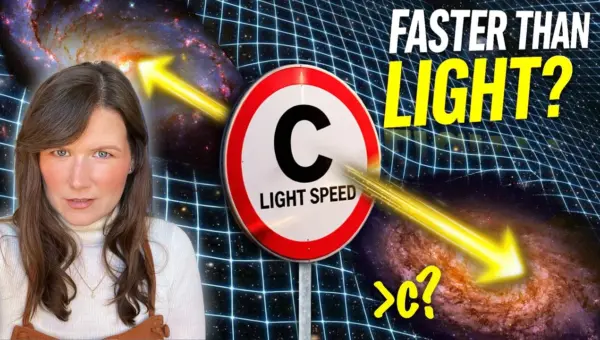
The universe appears to be expanding faster than the speed of light, a phenomenon that seems to contradict Einstein's laws. However, this cosmic speedster doesn't break physics rules because it's space itself expanding, not galaxies moving through space. This mind-bending concept reveals the universe's true scale and dynamics.


Stars Could Power Galaxy-Sized Starships
Scientists explore the feasibility of Jupiter becoming a star to power galaxy-sized starships and revisit Project Orion's nuclear propulsion concept. The article also delves into the science behind meteor storms, lunar water ice, ring galaxies, and the exciting return of human missions to the Moon with Artemis.