Pentagon Declares Major Victory Over Iran Amid Ceasefire
Pentagon officials announced a decisive military victory over Iran following 'Operation Epic Fury,' detailing the destruction of Iran's military capabilities. A tentative ceasefire is in place, with U.S. forces remaining vigilant to ensure compliance and facilitate negotiations for lasting peace.

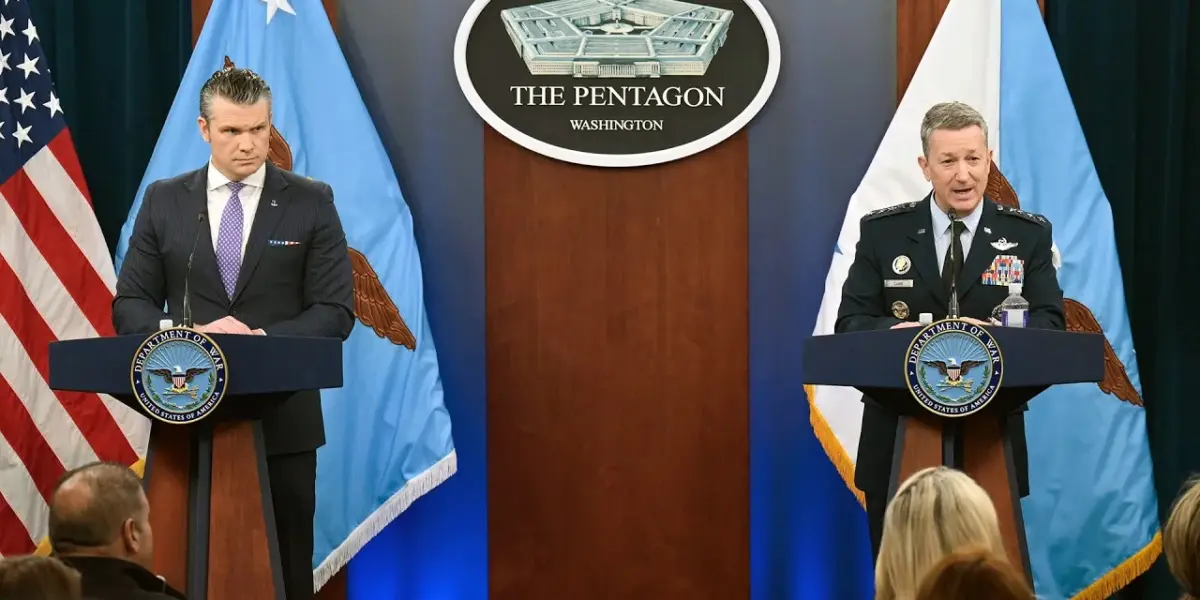
Pentagon Briefs on Iran Conflict Amid Tentative Ceasefire
In a significant press briefing, Pentagon officials have declared a decisive military victory over Iran, coinciding with a tentative ceasefire agreement. The briefing, featuring Defense Secretary Pete Hegseth and Chairman of the Joint Chiefs of Staff General John Keane, detailed the extensive military operations conducted under ‘Operation Epic Fury’ and addressed the terms of the emerging peace.
Operation Epic Fury: A Devastating Blow to Iran
Defense Secretary Pete Hegseth presented a stark picture of Iran’s military capabilities following Operation Epic Fury. He stated that Iran has been a threat for 47 years, engaging in actions ranging from targeting American lives to pursuing nuclear weapons. Hegseth credited President Trump’s administration with taking decisive action, unlike previous administrations that he claimed ‘kicked the can down the road.’
According to Hegseth, Operation Epic Fury, lasting less than 40 days, was an ‘overwhelming victory’ that ‘decimated Iran’s military and rendered it combat ineffective for years to come.’ He detailed the destruction of Iran’s navy, air force, and missile programs. ‘Iran’s navy is at the bottom of the sea,’ Hegseth asserted, listing sunk frigates, aircraft carriers, submarines, and mine-laying vessels. He also claimed that Iran’s air defense systems are gone, its missile launchers and production facilities are destroyed, and its ability to build new weapons is ‘functionally destroyed.’
The Secretary further elaborated on the precision of the strikes, noting that Iran’s attempts to attack American aircraft carriers with hundreds of missiles and drones were all shot down miles away. He highlighted the destruction of Iran’s defense industrial base as a core mission objective, stating that factories producing drones and missiles have been ‘razed to the ground.’ Hegseth emphasized that had Iran refused the ceasefire terms, the next targets would have been Iran’s power plants, bridges, and oil infrastructure, which he claimed would have taken decades to rebuild.
Terms of the Ceasefire and Future Outlook
The briefing acknowledged a tentative ceasefire deal, but also pointed out apparent conflicts in its interpretation. Colonel Steve Warren, a military analyst, noted that while officials declared victory, the situation is complex. He stated that Iran’s capabilities have been ‘significantly reduced’ but not entirely ‘wiped out.’
A key point of discussion was the Strait of Hormuz, which Iran has historically controlled. The agreement reportedly includes Iran allowing ships to pass through. Secretary Hegseth stressed that the U.S. military will remain in the region to ensure Iran complies with the ceasefire and negotiates a deal. ‘We’re going to make sure Iran complies with the ceasefire and then ultimately comes to the table and makes a deal,’ he said.
Regarding Iran’s nuclear program, officials reiterated that Iran will ‘never, ever possess a nuclear weapon.’ The agreement reportedly includes the removal of any nuclear material Iran possesses. Secretary Hegseth stated that this material is currently ‘deeply buried and watched 24/7,’ and that Iran will either voluntarily hand it over or the U.S. will take other actions. The concept of a ‘new regime’ in Iran was also discussed, with officials suggesting this new leadership has a different calculus after witnessing the U.S. military’s capabilities.
Military Achievements and Sacrifice
General John Keane provided more detailed military statistics, confirming that Operation Epic Fury lasted 38 days of major combat operations. He stated that the Joint Force achieved three distinct military objectives: destroying Iran’s ballistic missile and drone capabilities, destroying the Iranian navy, and destroying its defense industrial base. He noted that over 13,000 targets were struck, including more than 4,000 dynamic targets.
General Keane highlighted the destruction of approximately 80% of Iran’s air defense systems, over 450 ballistic missile storage facilities, and 801 one-way attack drones. He also mentioned the sinking of over 90% of Iran’s regular navy fleet, including all major surface combatants, and the destruction of over 95% of their naval mines. The industrial base, including factories for drones and missile components, was heavily targeted. He also noted that nearly 80% of Iran’s nuclear industrial base was hit.
The General honored the 13 members of the American Joint Force killed in action during the operation, emphasizing their sacrifice. He also thanked coalition partners, including Saudi Arabia, the UAE, Bahrain, Qatar, and Jordan, for their support. The operation involved over 50,000 American warfighters and tens of thousands of sorties, including long-range bomber missions from the United States.
Looking Ahead: Vigilance and Peace
While celebrating the military success and the hope for peace, officials stressed the need for continued vigilance. Secretary Hegseth stated, ‘We’ll stay put, stay ready, stay vigilant.’ The military remains prepared to resume combat operations if necessary. The focus now shifts to ensuring Iran upholds the terms of the ceasefire and engages in meaningful negotiations for a lasting peace. The world watches to see if this fragile ceasefire will hold and lead to a stable resolution in the region.
Source: LIVE: Pentagon holds press briefing on the Iran conflict amid ceasefire | NBC News (YouTube)

Related Articles


Analyst Slams Secy. Hegseth for False Claims on Iran Conflict
Analyst David Rohde has challenged Secretary Hegseth's claims about the Iran conflict, calling them "false statements." Rohde disputes assertions of a decisive U.S. military victory and a "new regime" in Iran. He also criticizes the politicization of the military and the framing of the conflict.

Iran Ceasefire Shatters Amidst Oil Target Bombings
A recent ceasefire in the Middle East has collapsed just hours after its announcement, with Iran's oil targets being bombed and widespread attacks resuming. The IRGC's control within Iran appears to be undermining diplomatic efforts, leading to a dangerous escalation. The future of regional stability hangs precariously in the balance.


US Declares ‘Historic Victory’ Over Iran in Operation Epic Fury
U.S. officials have declared a "historic and overwhelming victory" over Iran following the conclusion of Operation Epic Fury and a subsequent ceasefire. The operation reportedly decimated Iran's military capabilities, including its navy, air force, and missile program. The U.S. also stated that Iran's defense industrial base and nuclear program have been severely degraded, ensuring Iran will not possess nuclear weapons.