Gulf States Face Missile Barrage Amid Israel Ceasefire Silence
Missile alerts are sounding across Israel and several Gulf Arab nations, including the UAE, Bahrain, and Kuwait, despite reports of a ceasefire agreement from Iran. Israel has not publicly acknowledged the ceasefire, leaving its official stance unclear amidst the active aerial threats.


Gulf States Face Missile Barrage Amid Israel Ceasefire Silence
The Middle East is experiencing a tense night as missile alerts sound across Israel and several Gulf Arab nations. This comes despite reports of a ceasefire agreement emerging from Iran. The situation remains highly active, with ongoing alerts and missile interceptions in real-time.
Missile Alerts Sound Across Region
As night fell, the skies over Israel lit up with missile alerts. Sirens wailed in Tel Aviv, and reports confirmed missile activity north of the city. One observer described seeing a cluster warhead break apart in the sky. Israel experienced at least three separate rounds of missile alerts, affecting areas including Jerusalem and the south.
The threat is not confined to Israel. The United Arab Emirates (UAE) defense ministry announced it has been actively responding to missiles and drones. Alerts have also been issued in Bahrain and Kuwait. Early warnings were sent out in Saudi Arabia, indicating a widespread aerial threat across the Gulf.
Israel Remains Silent on Ceasefire
Despite the reports of a ceasefire agreement from Tehran, there has been no public acknowledgment from Israel. Neither the Israel Defense Forces (IDF) nor the Israeli government has confirmed the ceasefire. Historically, major announcements regarding such matters are usually made by the Prime Minister, and no statement has been released yet.
Geopolitical Implications and Actor Interests
The ongoing missile alerts and the silence from Israel highlight a complex geopolitical situation. Iran, a key player in the region, has reportedly acknowledged a ceasefire. However, the continued missile activity suggests potential internal factions or a deliberate tactic to maintain pressure. The actions could be aimed at demonstrating capabilities, projecting power, or influencing ongoing negotiations.
Israel, facing direct threats, is likely assessing the situation and its response options. Its primary interest is national security and de-escalation of conflict. The decision to remain silent on the ceasefire could be strategic, possibly to verify the agreement’s terms or to avoid appearing to concede under pressure. The UAE, Bahrain, and Kuwait, now directly affected by the missile alerts, are increasingly drawn into the regional security dynamics. Their involvement signals a growing concern for stability and a potential alignment of interests with Israel against common threats.
Historical Context and Shifting Alliances
The current events echo past periods of heightened tension in the region. The long-standing Israeli-Palestinian conflict has often spilled over into wider regional instability. The involvement of Gulf states in responding to aerial threats is a newer development. It reflects the evolving security landscape, particularly the Abraham Accords, which normalized relations between Israel and several Arab nations. This normalization has led to increased security cooperation, including joint efforts against shared threats.
Economic Factors at Play
While specific economic figures are not detailed in the initial reports, regional stability is crucial for the economies of all involved nations. The Gulf states, heavily reliant on oil exports and international trade, depend on secure shipping lanes and a stable investment climate. Disruptions caused by conflict or the threat of conflict can impact global energy prices and investor confidence. Sanctions, a common tool in international diplomacy, are often used against actors like Iran. The effectiveness and impact of any sanctions are directly tied to regional stability and the ability of nations to enforce them.
Potential Future Scenarios
Several outcomes are possible. The reported ceasefire could hold, leading to a de-escalation of immediate hostilities. However, the continued missile activity suggests that underlying tensions may persist, leading to sporadic flare-ups. Another scenario involves the collapse of the ceasefire, potentially triggering a wider conflict with significant regional and international repercussions. The involvement of multiple Gulf states in responding to attacks indicates a potential for broader regional alliances forming to counter perceived threats.
Global Impact
The events unfolding in the Middle East have far-reaching consequences. Any escalation of conflict can disrupt global energy markets, impacting economies worldwide. The involvement of multiple states in the current situation underscores the interconnectedness of regional security. The actions taken tonight, and the responses from various capitals, will shape future diplomatic efforts and the balance of power in one of the world’s most critical regions.
Source: Missiles come down on Israel amid ceasefire agreement | CUOMO (YouTube)

Related Articles


Ceasefire Sparks Hope for Crypto Market Rebound
A recent ceasefire has sparked renewed optimism in the crypto markets, prompting analysts to examine technical indicators for signs of a sustained rebound. While geopolitical calm can boost investor confidence, the long-term outlook also depends on regulatory clarity and broader adoption trends. The upcoming launch of the Commonwealth Union Blockchain Network adds another layer of interest to the evolving digital asset space.


Trump’s Iran Deal: Bold Tactics Yield Fragile Peace
A panel discusses President Trump's Iran ceasefire deal, a special election in Georgia, the DOJ's renewed fight against fraud, and Trump's relationship with Hungarian Prime Minister Viktor Orbán. Analysts debate Trump's negotiation tactics, the implications of the Georgia race, and the U.S.'s foreign policy stance.

Trump Halts Iran Attacks, Seeks Peace Deal
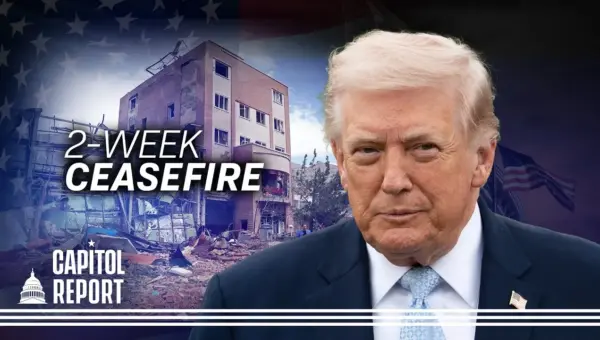
President Trump has agreed to a two-week suspension of attacks on Iran, contingent on Iran reopening the Strait of Hormuz. This move comes as the U.S. reports progress on a peace proposal and highlights the Iranian people's desire for freedom.