Democrats Eye 25th Amendment Amid Trump’s Iran Ultimatum
Democrats are considering invoking the 25th Amendment against President Trump following his aggressive ultimatum to Iran. Constitutional expert Robert McDerer explains the amendment's complex provisions for presidential disability. Trump, however, has pushed back, suggesting such an attempt would fail.

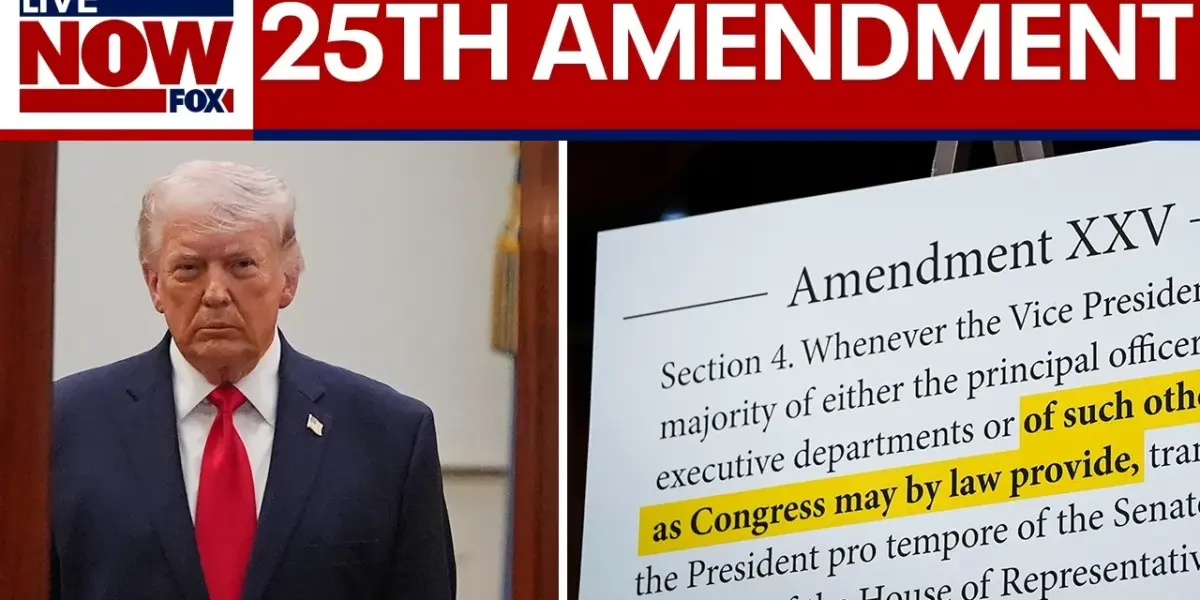
Calls Mount for 25th Amendment Over Trump’s Iran Stance
Amid escalating tensions with Iran, President Trump issued a stern ultimatum demanding the reopening of the Strait of Hormuz by 8:00 p.m. Eastern time. The demand, posted on Truth Social, warned that “a whole civilization will die tonight” if Iran failed to comply. As Iran showed no signs of yielding, the President’s strong language has prompted some Democrats in Congress to consider invoking the 25th Amendment, raising questions about presidential fitness and authority.
Understanding the 25th Amendment
Constitutional law expert Robert McDerer explained that the 25th Amendment, ratified after President John F. Kennedy’s assassination, addresses presidential disability, resignation, or removal. “It was designed to clarify when somebody becomes president when the vice president assumes the job of being president,” McDerer stated. In simpler terms, it allows for the smooth transfer of power if a president is unable to fulfill their duties, such as in cases of death or incapacitation. The amendment has been used sparingly in U.S. history. For example, when President George W. Bush underwent a colonoscopy, he temporarily transferred his powers to Vice President Dick Cheney under the 25th Amendment until he recovered.
Mental Acuity and the Amendment’s Complexities
The current debate focuses on the amendment’s provisions for mental or physical inability. McDerer noted that this aspect becomes significantly more complicated. According to the amendment, a majority of the Cabinet, along with the Vice President, can declare the President unable to discharge his duties. This would temporarily transfer power to the Vice President. However, if the President disputes this, the issue escalates to Congress. Both the House and Senate would need to vote by a two-thirds majority to confirm the President’s removal, a high bar that is difficult to meet.
“What the 25th Amendment says is that a majority of the cabinet and the vice president can then decide… if the president objects, it goes back into the house of representatives that then has to hold a vote by three force members of all of both houses to determine whether he can take his job back.”
Robert McDerer, Constitutional Law Expert
Trump Responds to 25th Amendment Talk
President Trump himself has addressed the 25th Amendment, referencing it during a cabinet meeting. When asked about future actions regarding Iran, he mentioned the amendment, suggesting that those who question his motives might try to invoke it. However, he dismissed the possibility, stating, “They didn’t do with Biden.” McDerer interpreted this as Trump signaling to his cabinet not to pursue the 25th Amendment, warning of a potential political crisis if they did. “I think that’s what he’s signaling to as he looks over at Pete Hegseth, you know, who’s also a member of the cabinet. He’s kind of giving him a signal. Don’t even go down this path, buddy,” McDerer said.
Congressional Reactions and Alternative Approaches
While some Democrats are discussing the 25th Amendment, others are exploring different avenues. House Democratic leadership has called for the House to reconvene immediately to vote on ending the conflict, aiming to prevent what they describe as Trump plunging the country into World War III. Meanwhile, some Senate Republicans have stated that Iran would be wise to heed President Trump’s warning, suggesting continued support for his actions.
Broader Constitutional Powers and Political Strategy
McDerer highlighted the constitutional tension between the President’s role as Commander-in-Chief under Article II and Congress’s power to declare war under Article I. He pointed out that Congress has not formally declared war or passed resolutions like the Gulf of Tonkin Resolution, which provided a basis for U.S. military involvement in Vietnam. “Congress has got to start doing its job,” McDerer urged. Democrats, he added, may focus on connecting the Iran conflict to rising gas prices and public opposition to war as a strategy leading up to the midterm elections. Trump’s rhetoric, comparing it to that of the Iranian Republican Guard, is also likely to be emphasized by opponents.
Looking Ahead
As the situation with Iran remains critical and political divisions deepen, the focus remains on President Trump’s actions and the constitutional checks and balances in place. The coming days will reveal whether the 25th Amendment discussion gains further traction or if Congress will assert its powers regarding foreign conflicts. Public opinion and the upcoming midterm elections will likely play significant roles in shaping the political response to these events.
Source: Calls for 25th Amendment to be invoked against Pres Trump (YouTube)

Related Articles


US Tightens Iran Stranglehold with Deadline
The Trump administration has issued a firm deadline to Iran, threatening further military action if the regime does not alter its behavior. This escalation follows strikes on key oil infrastructure and highlights deep-seated U.S. grievances against Iran.


Iran Ceasefire Talks Extend Amid Oil Price Surge
Pakistan has proposed a two-week ceasefire in the Middle East, leading to reviews by the White House and Iran. The talks aim to stabilize the region and prevent further disruption to oil supplies, with Brent crude prices briefly hitting $144 per barrel. Potential progress in negotiations has also influenced Bitcoin's climb towards $70,000.


Trump’s Iran Threat Sparks Global Alarm, Allies Urge Restraint
President Donald Trump's stark warning that "a whole civilization will die tonight" has escalated global tensions, creating fears of an imminent military assault on Iran. Critics describe the situation as a "worldwide tinderbox," with diplomatic channels reportedly severed and Iran reportedly preparing defensive measures. Allies and commentators are urging restraint, warning of catastrophic consequences if the threats are acted upon.