US Trust Erodes, Shaking Global Security Alliances
Once seen as a high-trust society, the United States is now deeply divided, impacting its international standing. This erosion of trust within the US creates global uncertainty, weakening alliances like NATO and making international cooperation more difficult. The decline affects everything from political stability to economic relationships.


US Trust Erodes, Shaking Global Security Alliances
Trust is the bedrock of cooperation, both at home and abroad. It acts like a lubricant for economies, helping businesses and markets run smoothly. In politics, trust builds what’s called social capital. This is how people come together in groups, work towards common goals, and participate in democracy. Societies have different levels of trust. For example, Northern Italy is known for high trust, with many community groups and active public life. This contrasts with the South, where people often only trust close family and are suspicious of outsiders. In such a place, distrust can lead to problems like organized crime, as people can’t rely on the government to protect their rights.
For a long time, the United States was seen as a high-trust society. Back in the 1830s, a French observer named Alexis de Tocqueville noticed Americans easily worked together in associations, from Bible studies to clubs. He found this was very different from France, where people struggled to cooperate. Later, in the mid-20th century, surveys showed Americans trusted each other more than people in many other countries.
Polarization Tears At American Social Fabric
However, this view of America is no longer accurate. Around the mid-1990s, when the book “Trust, the Social Virtues and the Creation of Prosperity” was published, political division began to grow. Americans started to group themselves based on their political views. This division has only gotten worse. It has become so intense that people don’t just disagree on issues; they believe their opponents are bad and dishonest. Trust still exists within these political groups, but across the whole country, distrust is widespread.
This distrust means people can’t agree on basic facts, like vaccine safety or election results. Instead, many believe in conspiracy theories, thinking hidden elites are secretly controlling things. Trust is built on honesty, reliability, and keeping promises. It grows over time through repeated positive interactions, creating a cycle of trust. But trust can be broken instantly if someone betrays another. Similarly, distrust can grow quickly if people seek revenge for perceived betrayals.
International Relations Suffer From Declining Trust
This breakdown of trust is critical in international relations too. Countries build trust with each other based on how they act over time. There’s no world government to force nations to follow rules. The use of force is limited only by the expectation of retaliation. This makes the current global situation worrying, as trust is essential for world order.
NATO Faces a Crisis of Confidence
The current conflict involving Iran and the crisis in the Strait of Hormuz represent a major break in the security structure of North America and Europe. NATO, the North Atlantic Treaty Organization, is an alliance built on trust. Its strength comes from the belief that members will defend each other if attacked. This was seen after September 11th, when NATO members supported the US in Afghanistan and Iraq.
However, NATO was never meant to support a member engaged in an offensive war against another country. Some leaders, like former President Trump, have accused NATO members of betraying the US by not helping to reopen the Strait of Hormuz. But no country agreed to join NATO for collective offensive wars. The reality is that the United States is more isolated now than ever before.
While NATO’s Secretary General has made supportive statements, this is likely a strategic move to avoid angering former President Trump. No European leader truly believes that supporting the US now would be returned by a future US administration. Even rivals like Russia and China, who may have benefited from recent US actions, know they cannot rely on the US to consistently serve their interests.
Reciprocity and Reliability Key to Global Standing
Former President Trump has claimed the US is more respected now than ever under his leadership. This statement is far from the truth. The US is currently less trusted by both friends and adversaries. A skilled negotiator needs to establish a basic level of trust, showing they will uphold their end of any deal. However, the concept of reciprocity, or give-and-take, is something that has not been well understood or practiced by him.
Global Impact
The decline in trust within the United States and its impact on international relationships is reshaping the global order. When a major power like the US becomes less predictable and trustworthy, it creates uncertainty. Allies question their commitments, and rivals may see opportunities to advance their own interests. This can weaken international cooperation on critical issues like trade, security, and climate change. The erosion of trust can lead to a more fragmented and unstable world, where countries rely more on their own strength rather than collective action.
Historical Context
The idea that trust is fundamental to a functioning society and international relations is not new. Alexis de Tocqueville observed the high levels of civic association and cooperation in the US in the 1830s, contrasting it with France. This social capital, as described by Robert Putnam, was seen as a key strength of American democracy and its economy. The current situation represents a significant departure from this historical understanding, suggesting a potential unraveling of the social and political bonds that once defined the nation and its role in the world.
Economic Leverage and Future Scenarios
While the transcript doesn’t detail specific economic leverage like sanctions or trade figures, it implies that a lack of trust can hinder economic cooperation. When countries distrust each other, trade deals become more difficult, and investment may decrease. In the future, this could lead to a world where countries are less interconnected economically, potentially increasing regional trade blocs or a return to more protectionist policies. Alternatively, a global crisis could force nations to rebuild trust to address common challenges. However, given the current trajectory, a more fragmented and less cooperative international system seems a likely scenario if trust continues to erode.
Source: Low Trust America (YouTube)

Related Articles
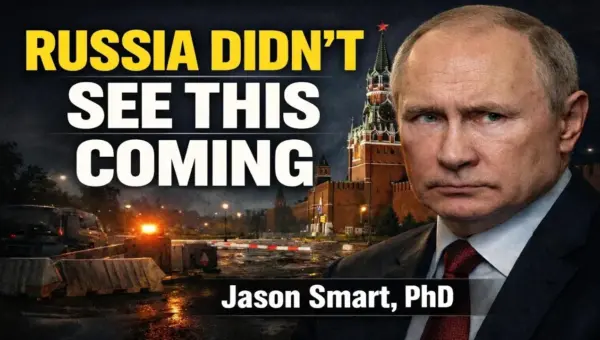
Ukraine Strikes Deep: Russia’s War Machine Weakens
Ukraine is increasingly launching drone attacks deep inside Russia, hitting critical oil infrastructure and weakening Moscow's war machine. Russia faces a severe manpower crisis and economic strain, with territorial gains plummeting and recruitment targets missed. This strategic pressure is making the war unsustainable for the Kremlin.
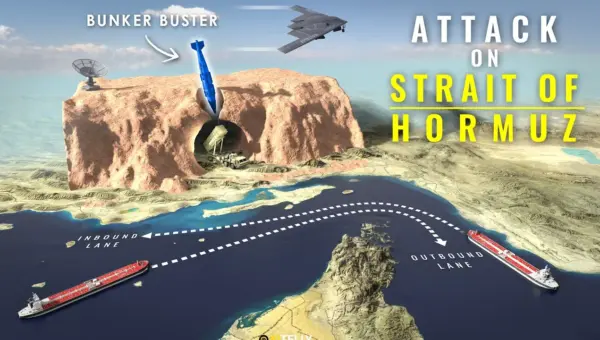
Iran’s Strait of Hormuz Trap: How the US Fights Back
Iran's strategy to control the Strait of Hormuz involves using islands as bases for anti-ship missiles and launching swarm attacks with small boats. The US counters with advanced defense systems, surveillance drones, and powerful bunker-buster bombs, highlighting the ongoing tension in this vital global shipping lane.
US Aims to Cripple Iran’s Power Grid to Secure Strait of Hormuz
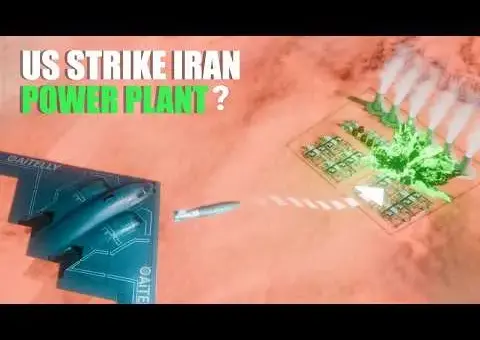
A new US strategy reportedly targets Iran's power grid, including major plants like Damavand, to force open the Strait of Hormuz. The plan involves multi-stage air attacks using advanced bombers and precision munitions to cripple energy infrastructure and cause cascading failures.