Trump Threatens Iran’s Infrastructure in Hormuz Standoff
President Trump has threatened to cripple Iran's infrastructure, including bridges and its power grid, if it continues to harass shipping in the Strait of Hormuz. Former Congressman Bob McEwen explained this strategy aims to force Iran to negotiate by severely damaging its operational capacity. The discussion also addressed the potential for such actions to be considered war crimes, with McEwen distinguishing between infrastructure attacks and the targeting of civilians.


Trump Issues Stark Warning to Iran Over Strait of Hormuz
President Donald Trump has issued a direct threat to Iran, stating he could cripple the nation’s infrastructure if Tehran continues to harass shipping in the Strait of Hormuz. Former Congressman Bob McEwen, speaking on a recent broadcast, interpreted Trump’s comments as a strategy to force Iran to negotiate by targeting its ability to function.
Targeting Bridges and Power Grids
McEwen explained that Trump’s threat is not about nuclear weapons. Instead, it involves striking key infrastructure like bridges and the electrical grid. “The electrical grid, of course, just does permanent severe damage,” McEwen stated. He elaborated that this would disable refrigerators, air conditioners, and communications systems.
The goal, according to McEwen, is to compel Iran to agree not to interfere with ships passing through the vital Strait of Hormuz. “If you will make an agreement not to harass people going through the straits of Hormuz, we’ll we’ll call it quits,” McEwen described Trump’s message. However, he warned that without such an agreement, Iran’s capacity to operate would be “decapitated.”
Iran’s Radical Stance and Nuclear Ambitions
McEwen characterized Iran’s leadership as having engaged in “very radical things” for nearly 50 years. He pointed to Iran’s consistent support for groups like Hamas, Hezbollah, and the Houthis, which he sees as proxy attacks on the international community. “No one has ever confronted the source of it,” McEwen said, suggesting Trump’s approach is different by directly addressing Iran.
The former congressman also touched on Iran’s nuclear program, stating that Iran has bragged about its ability to create nuclear bombs. He recalled an offer from the U.S. to provide enriched uranium for peaceful purposes, which Iran reportedly rejected, claiming they already possessed the means for multiple bombs and intended to use them. “There is no question in anyone’s mind that they would use it,” McEwen asserted, highlighting the perceived danger of Iran obtaining nuclear weapons.
Debate Over War Crimes
The discussion also touched upon the potential for Trump’s actions to be considered war crimes. McEwen distinguished between attacking infrastructure and targeting civilians. He argued that destroying a dam or a bridge is not a war crime unless done with the intent to intimidate. He contrasted this with actions like torture or attacking civilians, which he defined as war crimes.
McEwen found it “pathetic” to equate the destruction of Iranian infrastructure with the severe human rights abuses allegedly carried out by the regime, such as beating women to death for minor offenses. He believes that while war itself is inherently destructive, targeting the means of aggression is different from committing atrocities.
Superpower Restraint vs. Confrontation
The conversation explored the idea of superpower responsibility, questioning whether restraint is always the proper response. McEwen acknowledged that a superpower should ideally show restraint in rational confrontations. However, he argued that Iran’s actions and rhetoric, including chants of “Death to America” and consistent attacks, demonstrate a dedication to destroying the U.S. and civilization.
He cited Winston Churchill’s saying, “The history of war can be summed up in two words: too late.” McEwen believes that waiting too long to confront threats, especially concerning nuclear proliferation, leads to dire consequences. He concluded that the U.S. must act decisively now, even if it means taking forceful measures, to prevent a nuclear confrontation and stop Iran’s aggressive behavior.
Looking Ahead
The situation remains tense as Iran’s actions in the Strait of Hormuz and its nuclear program continue to be a focal point of international concern. President Trump’s willingness to employ aggressive tactics against Iran’s infrastructure signals a potential escalation, while the international community grapples with defining the lines of acceptable military action. Observers will be watching closely to see if Iran alters its behavior in the strait or if further actions are taken by the United States.
Source: Trump ‘Will Call It Quits’ If Iran Re-Opens Strait Of Hormuz | Bob McEwen (YouTube)

Related Articles
US Strikes Iran’s ‘Mosquito Fleet’ to Secure Oil Lanes
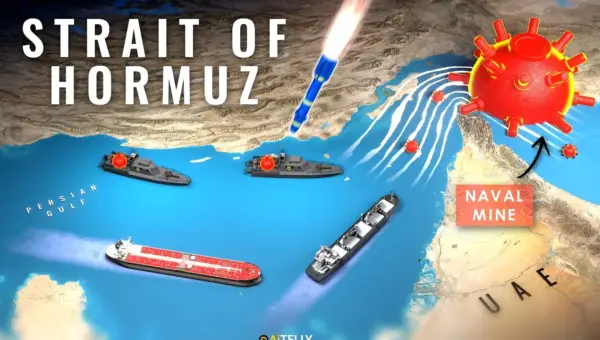
Iran's use of naval mines and fast attack boats in the Strait of Hormuz prompted a decisive US response. The US employed a preemptive strategy, striking mine-laying ships and storage facilities with precision-guided missiles and bombs.
Iran’s Strait of Hormuz Trap: How the US Fights Back
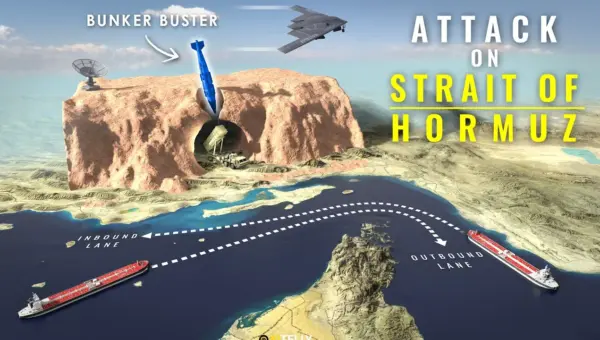
Iran's strategy to control the Strait of Hormuz involves using islands as bases for anti-ship missiles and launching swarm attacks with small boats. The US counters with advanced defense systems, surveillance drones, and powerful bunker-buster bombs, highlighting the ongoing tension in this vital global shipping lane.
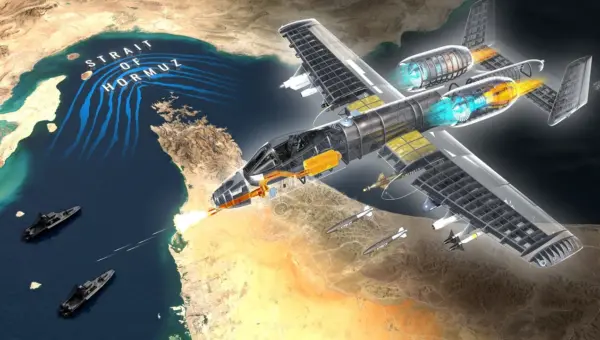
A-10 Warthog Defies Retirement in Hormuz Strait
The U.S. Air Force's plan to retire the A-10 Thunderbolt faces a challenge in the Strait of Hormuz. Its unique design, built for low-and-slow flight and extreme durability, makes it essential for countering small boats and drones in the narrow waterway. The Warthog's ruggedness and specialized firepower prove its continued value.