Artemis II Astronauts Face Lunar Silence, Ex-Astronaut Hadfield Explains
Former astronaut Chris Hadfield discusses the Artemis II mission's historic lunar flyby, where astronauts will experience 40 minutes of radio silence behind the Moon. He explains the training involved and the unique opportunities this period offers for reflection and observation. The mission also utilizes new digital cameras to capture unprecedented details of the lunar surface, aiding future exploration and potential settlements.


Artemis II Crew Navigates Deep Space Silence
The Artemis II mission has reached a pivotal moment as the Orion capsule passed behind the Moon, entering a period of complete radio silence. This historic flyby marks the furthest humans have traveled from Earth in this capacity, with the crescent Earth visible over 252,000 miles away. For approximately 40 minutes, the four astronauts aboard will be cut off from communication with Earth. This planned event serves as a stark reminder of the risks involved in deep space exploration, but also as a unique opportunity for the crew.
Hadfield: Silence Offers Unique Opportunity for Astronauts
Retired Canadian astronaut Chris Hadfield described the 40 minutes of silence not as a void, but as a valuable time for the crew. “On board, it’ll go by like that. It’ll be the best 40 minutes of the whole flight,” Hadfield stated. He explained that this period allows astronauts to focus without constant communication from mission control. It’s a chance to reflect on the significance of their journey, soak in the extraordinary views, and have uninterrupted conversations. For mission control in Houston, Hadfield humorously noted, it’s a brief respite to grab a meal before resuming work.
Training Prepares Astronauts for Communication Blackouts
The ability to handle communication blackouts is a fundamental part of astronaut training. Hadfield emphasized that losing contact with Earth is a known possibility, especially if critical systems fail. “So the crew, that’s why the training takes so long is because no matter what happens at any given moment of the flight, they amongst the four of them have to be able to solve any problem that can crop up,” he explained. This self-reliance can even simplify operations, as the crew knows the responsibility rests solely with them. The 40-minute blackout is a small part of the 10-day mission, occurring while the spacecraft is coasting and using lunar gravity.
New Digital Cameras Capture Unseen Lunar Details
Artemis II is utilizing advanced digital cameras, a first for a lunar flyby of this nature since 1972. Hadfield highlighted the advantage of these cameras, explaining that they can capture finer details than human eyes alone. “When you look at something with a camera, you know, like if you photograph a sunset, it was better than that,” he said. The astronauts’ rapid orbit around the Moon allows them to observe changing textures and colors that a static snapshot would miss. In addition to tens of thousands of photographs, the crew is providing a continuous verbal log of their observations, which scientists will use to gain a deeper understanding of the lunar surface.
Seeking Resources for Future Lunar Bases
The Artemis program aims not only for exploration but also for establishing a long-term human presence on the Moon. Hadfield pointed out that previous lunar missions, like Apollo, were focused on proving feasibility. Now, the focus shifts to essential human needs: power and water. He noted the discovery of vast amounts of frozen water in permanently shadowed craters at the Moon’s poles, estimated at around 100 billion gallons. Additionally, the poles offer consistent solar power. These resources make the polar regions prime locations for future settlements. The Artemis II crew’s observations will help inform where and how humans can eventually live on the Moon.
Mineral Wealth and Lunar Geology
Beyond water, the Moon holds significant mineral wealth. Hadfield compared the Moon’s accessible surface area to a continent larger than Africa. “It’s as if we have just gotten access to a whole new continent that’s bigger than Africa and we have no idea of the mineral wealth,” he remarked. Understanding the Moon’s geology, including features that resemble ancient lava flows, can provide insights into its formation and the potential presence of valuable resources like rare earth elements and Helium-3. The mission’s detailed observations are crucial for assessing this potential.
Psychological Impact of Deep Space Travel
Spending extended periods far from Earth presents significant psychological challenges. Hadfield, who has spent over 165 days in space, anticipates that future long-duration lunar missions will be psychologically demanding due to the profound sense of isolation. Unlike the International Space Station, where a return to Earth is relatively quick, the Moon is at least a three-day journey away. This distance can foster a sense of separateness and potentially lead to the development of a distinct lunar identity. Supporting astronauts’ mental health through connections with family, as seen on Artemis II with video calls and family viewing areas, is critical for sustained deep space missions.
A Legacy of Exploration and Future Ambitions
The Artemis II crew embodies the spirit of exploration and builds upon the legacy of past astronauts. Hadfield praised the crew’s capability, humility, and dedication to the mission over personal glory. He noted the historical connection, with astronauts being woken by recordings from lunar walkers like Charlie Duke. The mission is not just about current achievements but also about paving the way for future generations. Astronaut Jeremy Hansen hopes that the records set by Artemis II will be short-lived, encouraging future crews to push boundaries even further. This collaborative approach, where each mission provides confidence for the next, is fundamental to space exploration.
The Transformative Experience of Launch
Describing the experience of going to space, Hadfield likened it to a rite of passage. He acknowledged the immense danger involved, requiring a careful assessment of risks. “It’s enormously dangerous, so you have to decide what risks are worth taking in your life,” he said. Yet, the transition from lying on a beach to orbiting Earth at five miles per second in just minutes is profoundly exciting. The launch itself is a violent, powerful, and overwhelming experience, but the moment the engines cut off, the sudden shift to weightlessness brings relief, joy, and anticipation for the journey ahead. This transformation marks the beginning of an entirely new existence.
Looking Ahead: Re-establishing Communication
As the Artemis II astronauts complete their passage behind the Moon, the next critical phase will be re-establishing communication with Earth. This moment signifies the successful completion of a challenging segment of their mission and a return to contact with mission control. The data and experiences gathered during this deep space excursion will be invaluable as NASA and its partners continue to plan for future lunar landings and sustained human presence on the Moon.
Source: Former astronaut Chris Hadfield talks historic Artemis II lunar flyby (YouTube)

Related Articles


NASA’s Moon Return: Rockets Blaze, Shields Glow, Risks Loom
NASA's Artemis 2 mission prepares to launch the most powerful rocket ever built, the Space Launch System (SLS), sending astronauts back to the Moon after 50 years. This complex journey involves a powerful liftoff, a critical lunar injection burn, a gravitational slingshot maneuver around the Moon, and a dangerous re-entry through Earth's atmosphere. The mission highlights both incredible engineering achievements and the inherent risks of space travel.


Moon Mission Sparks New Space Race Era
The Artemis II mission's return from the Moon marks a new era in space exploration, potentially sparking a modern space race. The mission provided new scientific data and breathtaking views, while also highlighting the inherent risks of deep space travel. This renewed focus on lunar exploration has significant geopolitical and economic implications for global powers.

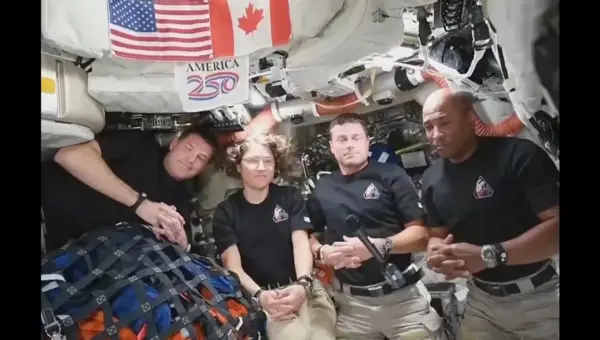
Astronauts’ Silent Treatment Exposes Trump’s Space Rift
An awkward call between Donald Trump and the Artemis 2 astronauts, marked by prolonged silence from the crew, highlights a perceived disconnect in values and leadership. The incident contrasts with past presidential interactions and raises questions about Trump's stance on space exploration versus his proposed budget cuts.