Israel’s Laws Spark Outrage, Risk Global Standing
A new Israeli law allowing the death penalty for Palestinians has ignited global outrage, fueling accusations of discrimination and apartheid. Reports of widespread abuse in Israeli prisons and settler violence further intensify international concern. This growing criticism signals a potential shift in global alliances and domestic political debates.

Israel’s New Death Penalty Law Fuels Global Condemnation
A new law passed in Israel allowing the death penalty for Palestinians convicted of deadly attacks has sparked widespread anger and accusations of discrimination. The law, which passed on March 30, makes the death penalty the standard sentence in military courts for certain crimes. Judges can only avoid it if they find special reasons to give a life sentence. This law, pushed by far-right members of the government, was approved by 62 out of 120 lawmakers, showing support beyond the ruling coalition. Critics call it a discriminatory law that supports an apartheid system.
This law is not the first of its kind targeting Palestinians. Those from the West Bank are tried in military courts under Israeli military order 1651. These trials are often not open and defendants may not even see the charges against them. In contrast, Israeli settlers living in illegal settlements get trials in civilian courts. This double standard highlights deep inequalities in the justice system.
Detention and Abuse in Israeli Prisons
Reports from within Israeli prisons paint a grim picture. Over 9,000 Palestinian political prisoners are held, including 350 children. Around 3,000 are kept without charge or trial as administrative detainees. Organizations that support prisoners report widespread cases of mass rape, torture, and killing within these facilities. These issues have been documented for years.
In one disturbing instance in 2024, leaked video showed Israeli soldiers severely beating and sexually assaulting a Palestinian man at the Setan detention center. Although five soldiers were indicted, the charges were later dropped in March 2026 due to a lack of evidence. The victim had also been returned to Gaza and could not testify. Another case involved Ahmed Manos, who was detained at age 13. He spent years in solitary confinement and was diagnosed with schizophrenia by the time he was released a decade later.
Dr. Husam Abu Safia, a physician, was taken from Gaza in late 2024 and held without charge or trial. His lawyer reported that he was tortured in custody. UN experts have called for his release, stating that Israel may be violating the UN’s Mandela Rules, which ensure fair and humane treatment for prisoners. The system that allows such treatment of thousands of Palestinians yearly now has the power to sentence them to death.
Settler Violence and Impunity
Violence from Israeli settlers in the West Bank is another serious concern. Palestinians report facing sexual assault and theft. In one account, settlers allegedly stormed a tent, tied up a Palestinian man, bound his genitals with a zip tie, and paraded him in front of his family. They also reportedly stole hundreds of his sheep. While Israeli authorities say they investigate these incidents, critics note that arrests are rare, leading to ongoing impunity for settlers.
This lack of justice for Palestinians under Israeli law is seen by some as a parallel to the experiences of Black and brown people in America, particularly during certain political periods. The situation is further complicated by actions in Lebanon, where reports suggest Israeli troops are warning Christian and Druze communities not to hide Shiite Muslims. This is viewed by some as ethnic cleansing, with the abused appearing to become the abusers, echoing historical traumas.
International Reactions and Shifting Alliances
The international community is increasingly critical of Israel’s actions. Eighteen countries have joined South Africa’s case against Israel at the International Court of Justice. Spain recently announced it would officially recognize Palestine as a state, joining over 140 countries. Spain has also blocked the United States from using its air bases to launch attacks against Iran, showing a growing divergence from US policy.
Domestically, some US politicians are also taking a stand. Representative Alexandria Ocasio-Cortez announced she will no longer support taxpayer-funded arms for Israel, stating the country can afford its own defense systems. She cited Israel’s alleged violations of international law and human rights as reasons for her decision. This comes as Israel’s allies are reportedly diminishing, a trend some believe is linked to its actions and continued US support.
Why This Matters
The allegations of human rights violations and war crimes by Israel, including discriminatory laws and abuses in detention, raise serious questions about its adherence to international law and democratic values. The death penalty law, in particular, is seen by many as a dangerous escalation that further marginalizes Palestinians. The reported impunity for settler violence and the treatment of prisoners suggest a systemic issue that needs urgent attention.
The increasing international criticism and the growing number of countries recognizing Palestine signal a potential shift in global politics. The US, by continuing its strong support for Israel, risks alienating allies and facing international isolation. At home, these issues are becoming a point of contention, potentially impacting political outcomes as voters become more aware of how their tax dollars are being used.
Future Outlook
The current trajectory suggests a continued struggle for justice and human rights for Palestinians. The expansion of the death penalty law and ongoing reports of abuse could further destabilize the region and damage Israel’s international reputation. The growing movement for accountability, both internationally and within countries like the US, may lead to greater pressure on governments to re-evaluate their policies and alliances. The call for supporting progressive candidates who prioritize human rights and ethical foreign policy highlights a desire for change among a segment of the electorate. The path forward will likely involve continued diplomatic efforts, legal challenges, and public advocacy to ensure adherence to international human rights standards.
Source: Trump War EXPOSES MAJOR WEAKNESS That Risks EVERYTHING (YouTube)

Related Articles


Trump’s Words Harm US Standing, Damage Democracy: Law Prof
Legal experts warn that President Trump's rhetoric has already harmed America's global standing and strained its democracy. Discussions highlight concerns over potentially unlawful military orders targeting civilian infrastructure and the legal obligations of service members. The debate also revisits the effectiveness of the Iran nuclear deal, with former negotiator Robert Malley asserting diplomacy's superiority over military action.

Trump’s Iran Threat: War Crimes or Diplomacy?
President Trump's threats to 'decimate' Iranian infrastructure have raised alarms about war crimes and a major escalation in the Middle East. With civilians reportedly forming human shields, international law experts and analysts debate the president's motives and the potential consequences.

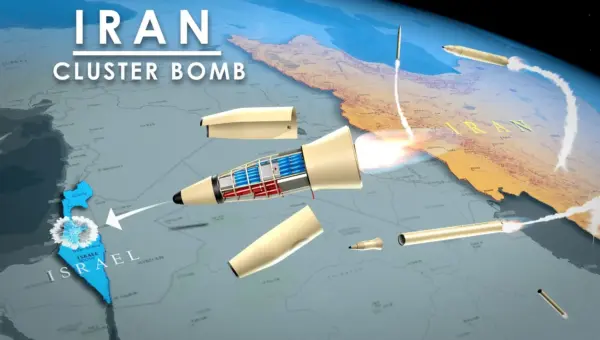
Iran’s Cluster Bombs: A Calculated Gamble to Overwhelm Defenses
Iran's use of cluster bombs against Israel was a deliberate tactic to overwhelm advanced missile defenses. These weapons scatter numerous smaller explosives, making interception difficult. While tactically advantageous, they raise serious humanitarian concerns due to their indiscriminate nature and unexploded ordnance.