Trump Threatens Iran: “Open Strait or Live in Hell”
President Trump issued a severe warning to Iran, threatening "hell" if the Strait of Hormuz is not reopened, while U.S. forces successfully rescued a downed airman. Experts suggest potential escalation and regional realignments are unfolding.


Trump Issues Stark Warning to Iran Over Strait of Hormuz
President Donald Trump escalated his rhetoric dramatically on Easter Sunday, issuing a stark ultimatum to Iran via social media. In a series of posts, Trump warned Iran to “Open the f****n’ strait… or you’ll be living in hell.” The president also declared that Tuesday would be “power plant day and bridge day” in Iran, signaling a potential increase in U.S. military action.
Complex Rescue Operation Boosts U.S. Morale
The heightened tensions come as U.S. special forces successfully rescued a downed American airman deep within Iran. The airman, a weapons officer from an F-15 jet, was shot down on Friday and was wounded but is expected to recover. The pilot of the aircraft had been rescued earlier.
President Trump described the operation as “one of the most daring search and rescue operations in U.S. history.” The rescue mission involved dozens of military aircraft and faced significant resistance from Iranian forces. A U.S. official confirmed that U.S. forces had to destroy at least one of the aircraft used in the mission due to malfunction after the rescue.
The operation reportedly utilized two specialized MC130J aircraft for covert infiltration and troop extraction. These aircraft were later destroyed by U.S. forces after malfunctioning. A senior Washington official suggested the rescue involved a CIA deception campaign to mislead Iranian forces about the airman’s location.
Israel Confirms Assistance in Rescue Mission
Israeli Prime Minister Benjamin Netanyahu congratulated President Trump on the successful rescue, calling it an “incredible rescue of a brave American pilot by America’s dauntless warriors.” Netanyahu emphasized that the operation reinforced the principle of leaving no one behind, a shared value between the U.S. and Israel.
“This proves that when free societies muster their courage and their resolve, they can confront seemingly insurmountable odds and overcome the forces of darkness and terror,” Netanyahu stated. He also highlighted Israel’s own history of daring rescue operations and his personal experience with such missions.
Iran Continues Regional Attacks Amidst Tensions
Despite U.S. and Israeli military actions, Iran has shown no signs of complying with Trump’s demands regarding the Strait of Hormuz. The vital waterway is crucial for about one-fifth of the world’s oil and natural gas supply and has been largely shut down.
Iran has continued to launch missile and drone attacks against Israel and its allies. Recently, Iran launched drone attacks on petrochemical plants in Bahrain and Abu Dhabi, underscoring its ability to strike U.S. allies in the Gulf. Iran’s Revolutionary Guards have warned of further attacks if civilian targets within Iran are hit.
Expert Analysis: Escalation and Regional Realignment
Alex Trayman, CEO of the Jewish News Syndicate, discussed the ongoing conflict, noting that the war is entering its sixth week. He suggested that the U.S. and Israel are likely past the halfway point in their military objectives.
“You see that there is an escalation strategy here,” Trayman explained, referring to Trump’s threats against Iran’s infrastructure. He also pointed to a significant reduction in ballistic missile firings from Iran, with over half of its missile launchers believed to be destroyed.
Trayman believes that continued military pressure could further hinder Iran’s missile capabilities. The ultimate goal, he stated, is to create greater stabilization within Iran, with President Trump encouraging civilians to overthrow the current regime.
Strait of Hormuz: A Critical Chokepoint
The Strait of Hormuz remains a central point of contention. President Trump has repeatedly issued deadlines for Iran to reopen the shipping lanes. “If they meaning Iran if they don’t make a deal and fast I’m considering blowing everything up and taking over the oil,” Trump was quoted as saying in a conversation with Fox News correspondent Trey Yingst.
Trayman noted that Trump has expressed optimism about reaching a deal but has yet to achieve accommodation with Iran. He recalled previous deadlines and negotiations that did not yield results, leading to bolder military operations.
The expert suggested that the most likely outcome is further escalation, with Trump potentially taking over Iranian oil and opening the Strait of Hormuz to direct supply to America and its allies, rather than allowing it to go to China and its allies at discounted prices.
Regional Neighbors Draw Closer Amidst Attacks
Iran’s continued attacks on regional neighbors, including desalination and petrochemical plants, are paradoxically drawing these countries closer to Israel. Trayman observed that these nations are supportive of the U.S. military campaign and Israel’s efforts against a common enemy.
The war, which began with Iran and its proxies attacking Israel on October 7th, was partly motivated by Israel’s progress toward normalization with Saudi Arabia. However, Iran’s actions have instead accelerated normalization agreements between Israel and other Gulf countries.
Uncertainty Looms Over Iran’s Future
Looking ahead, the biggest unknown is who will lead Iran after the current conflict. Trayman emphasized the need for a clear “day after” plan.
“There needs to be a day after at some point,” he said. “You’re definitely in the window phase of this military operation.” The U.S. and Israel aim to avoid prolonged ground troop involvement.
Key questions remain about who the U.S. will work with in Iran’s post-conflict phase. Possibilities include engaging with the speaker of the Iranian parliament, considering the return of Crown Prince Reza Pahlavi, or establishing a government that can normalize relations with the West. The nature of the future Iranian regime—whether a remnant of the Islamic Republic or a completely new government—is uncertain.
What to Watch Next
All eyes are now on President Trump’s response if the Strait of Hormuz is not opened within the remaining 48-hour deadline. While 40 nations have discussed potential actions, it appears President Trump intends to act unilaterally.
The question remains how this will unfold: whether through special forces, ground troops, or taking control of Iranian oil facilities. The distribution of oil from the Persian Gulf post-operation is also a significant factor to monitor. President Trump is scheduled to address the nation on Monday at 1 p.m. Eastern Time to discuss the latest developments in Iran.
This article is based on reporting from Live Now from Fox and incorporates insights from an interview with Alex Trayman, CEO of the Jewish News Syndicate.
Source: Trump to Iran: "Open the f****n' strait…" (YouTube)

Related Articles


Trump Threatens Iran, Shaking Global Stability
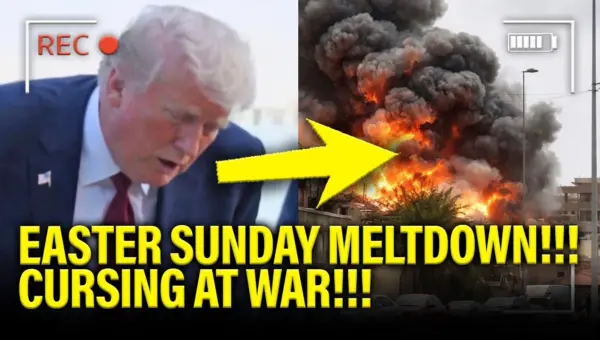
Former President Trump's aggressive Easter Sunday warning to Iran has ignited global concerns, highlighting a volatile intersection of politics, religion, and foreign policy. The analysis explores the motivations behind such rhetoric, the deep divisions within American society, and the potential for severe economic and geopolitical repercussions worldwide.
Trump’s Rhetoric Fuels Iran Tensions, Raises War Crime Alarms
Former President Donald Trump's aggressive Easter weekend social media posts directed at Iran have sparked international concern. His threats of military action and ultimatums, coupled with conflicting narratives about military engagements, have raised alarms about potential war crimes and a dangerous escalation of conflict. Critics accuse both Trump and segments of the media of downplaying the severity of his rhetoric.
Trump’s Vulgar Iran Threat Sparks Global Outrage
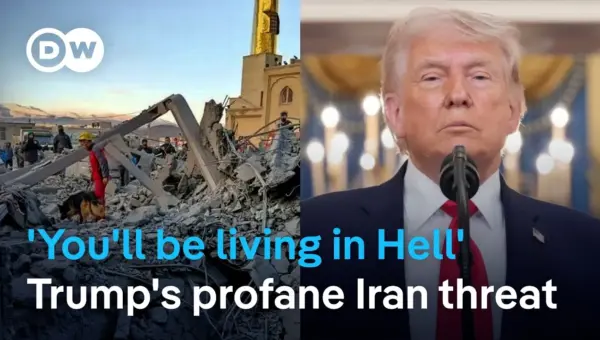
President Donald Trump issued a highly profane threat against Iran via social media, warning of attacks on civilian infrastructure if the Strait of Hormuz was not opened. Experts suggest the outburst stems from frustration and desperation, while legal scholars warn of potential war crimes. The situation continues to escalate, with significant economic and political implications for the region.