Artemis II Crew Heads to Moon After Flawless Burn
NASA's Artemis II mission has successfully propelled its four-person crew toward the Moon following a flawless translunar injection burn. The Orion spacecraft is now on its planned trajectory, marking a significant step in humanity's return to lunar exploration. This test flight continues to gather crucial data on the spacecraft's performance in deep space.


Artemis II Reaches Moon Trajectory After Key Burn
The four astronauts aboard NASA’s Artemis II mission are now on their way to the Moon. This historic journey marks the first time humans have left Earth’s orbit since 1972. The Artemis II crew successfully completed a critical engine burn called the translunar injection (TLI) on the evening of [Date of Launch, inferred from transcript], propelling the Orion spacecraft out of Earth’s orbit and onto its path toward the Moon. The mission’s flight directors and program managers announced the success in a press briefing held at NASA’s Johnson Space Center in Houston.
A “Flawless” Burn Puts Astronauts on Lunar Path
The TLI burn, which lasted five minutes and 52 seconds, was described as “flawless” by NASA officials. “From this point forward, the laws of orbital mechanics are going to carry our crew to the moon, around the far side, and back to Earth,” stated Dr. Lorie Glaze, who leads NASA’s Artemis program. The crew, consisting of NASA astronauts Reid Wiseman, Victor Glover, Christina Koch, and Canadian astronaut Jeremy Hansen, are healthy and the Orion spacecraft is performing exceptionally well. This burn was the last major engine firing planned for the mission, with the rest of the journey relying on the natural forces of space.
Artemis II: A Crucial Test Flight
Despite the successful trajectory, NASA officials emphasized that Artemis II remains a test flight. “We are we are getting and we’re going to continue to get lots of new data every day, important information as we continue learning how we’re going to operate this uh Orion spacecraft um in the actual space environment,” explained Dr. Glaze. The team has encountered several minor issues since launch, but none have raised concerns. These were discussed with the mission management team, and all issues were resolved with a clear path forward. The crew has eight days dedicated to gathering as much data as possible about the Orion spacecraft’s performance in space.
Key Milestones Achieved: Proxops and System Checks
Before the TLI burn, the Artemis II crew completed several vital tests. Jud Freeling, Ascent Flight Director, detailed the successful checkouts of the spacecraft’s systems, including the water dispenser and toilet. A brief communication outage was resolved, and the Orion spacecraft was placed into a stable high Earth orbit. A significant achievement was the proximity operations demonstration (Proxops), where astronaut Victor Glover used manual controls to maneuver the spacecraft. This test, described as “absolutely spectacular” by Dr. Glaze, provided valuable data for future rendezvous and docking operations. Howard Hugh, Orion Program Manager, explained that this demonstration involved backing away from a target, performing “coarse manual piloting” at a distance, and then executing “fine manual piloting” at closer ranges, simulating how astronauts will need to control the spacecraft for future missions, including those involving lunar landers.
Orion Spacecraft Performance Exceeds Expectations
The Orion spacecraft’s systems have shown strong performance. All three carbon dioxide scrubbers were checked and are functioning well. The life support system, including CO2 scrubbing, water distribution, and cabin temperature control, is performing as predicted, and in some cases, even better. Power generation also exceeded expectations, producing over 13 kilowatts. The guidance, navigation, and control system demonstrated its precision during the TLI burn, proving its capability for the journey to the Moon and the return to Earth. “The performance was outstanding, and of course the crew was outstanding. They did a terrific job,” commented Mr. Hugh regarding the Proxops demonstration.
Crew Well-being and Future Views
The astronauts are reportedly adjusting well to space. There have been no indications of space adaptation syndrome, commonly known as space sickness. During the translunar coast, the spacecraft will primarily maintain a “tail-to-sun” attitude, meaning the back of the vehicle will face the Sun. This orientation helps manage power and thermal conditions. While this attitude may limit direct views of Earth or the Moon for extended periods, NASA has the flexibility to reposition the solar arrays, which have cameras, to capture images. For the lunar flyby on mission day six, the spacecraft’s attitude will be adjusted to provide the crew with optimal views of the lunar surface.
Looking Ahead: Lunar Flyby and Return
With the TLI burn successfully completed, the Artemis II mission is now focused on its lunar flyby. The crew will orbit the Moon and conduct further system checks and data collection. The mission is designed to test the capabilities of the Orion spacecraft and its systems with humans aboard before NASA’s subsequent Artemis missions, which aim to land astronauts on the Moon. The Artemis II crew is expected to return to Earth and splashdown in the Pacific Ocean on [Date of Splashdown, inferred from transcript].
Source: NASA Artemis II update: Orion completes translunar injection burn, next stop lunar flyby (YouTube)

Related Articles


Trump Fires AG Bondi, Iran Tensions Rise, Artemis II Heads to Moon
Attorney General Pam Bondi has been fired by President Trump, with Deputy AG Todd Blanche stepping in as acting AG. Amidst rising oil prices and escalating tensions, the U.S. warns Iran as the Artemis II mission successfully heads towards the Moon. Golfer Tiger Woods was arrested for DUI and is stepping away for treatment.
Astronauts Head to Moon Amidst Divided Nation
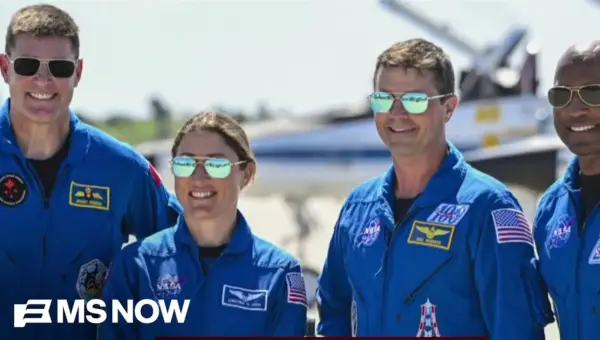
The Artemis II mission has launched, sending four astronauts towards the Moon in a journey that highlights both humanity's drive for exploration and the current divisions within society. While the launch captured global attention, it also sparked conversations about how fragmented media impacts shared national experiences.


Moon Missions Spark New Space Race: Fuel & Power
Renewed moon missions are fueling a new space race, driven by the potential for rocket fuel production and strategic control. However, concerns about space weaponization and the lack of clear property rights in this lawless frontier add a complex geopolitical layer to lunar ambitions.